
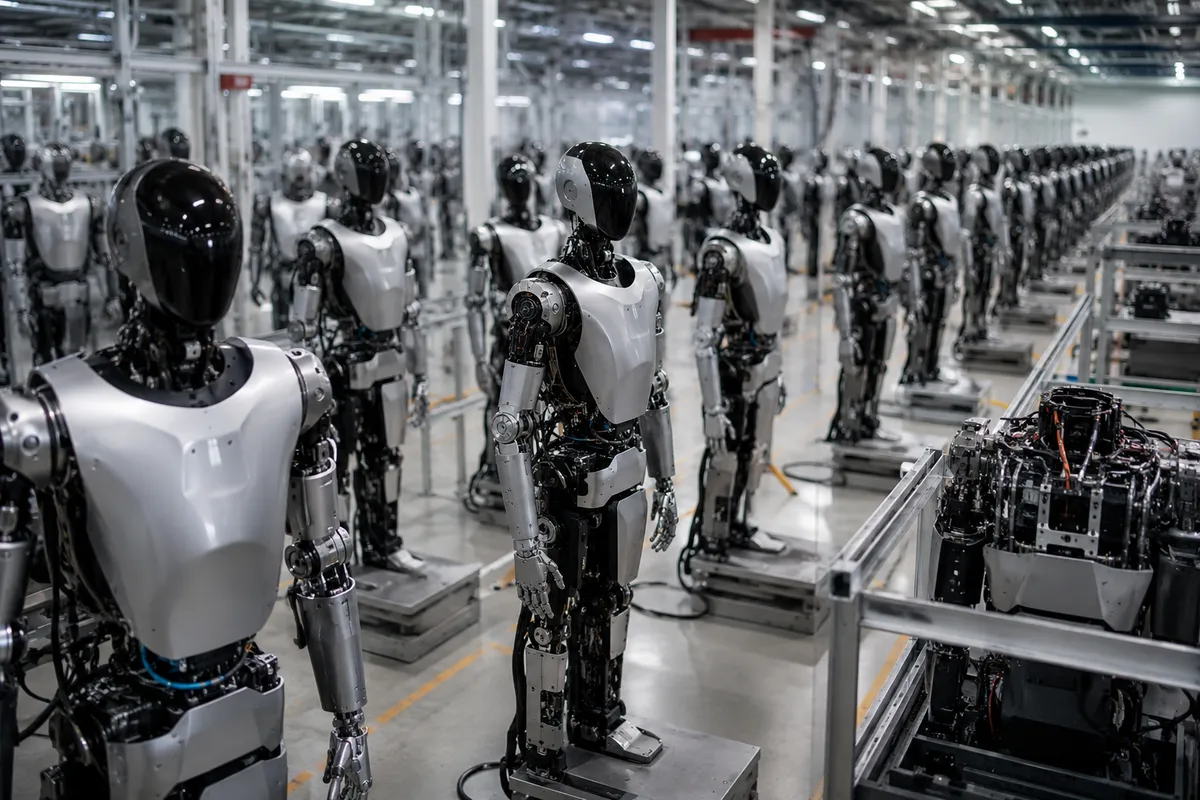
Morgan Stanley has sharply raised its 2026 forecast for China’s humanoid robot shipments, giving the market a stronger near-term signal that Chinese manufacturers are moving faster than earlier expected. The development matters because it suggests accelerating production, policy support, and supply-chain activity in China’s humanoid robotics sector. It does not, however, prove that humanoid robots are already delivering reliable, paid, repeatable work in customer environments.
CNBC reported that Morgan Stanley now expects 50,000 humanoid robots to ship in China this year, up from a previous forecast of 28,000 units and an initial January estimate of 14,000 units. South China Morning Post separately reported the same revised 2026 forecast and said Morgan Stanley also lifted its 2030 China annual shipment forecast to 446,000 units from 262,000.
That is a meaningful change in expectations. But the evidence still needs careful handling. A shipment forecast is not the same as deployment proof. A shipped robot may be used for research, education, demonstrations, reception, tour guidance, data collection, pilot testing, or actual factory work. Only the last few categories begin to answer the commercial-readiness question.
| Metric | Earlier Estimate | Revised Estimate | Why It Matters |
|---|---|---|---|
| Morgan Stanley 2026 China humanoid shipment forecast | 28,000 units | 50,000 units | Shows faster expected near-term scaling |
| Morgan Stanley initial January 2026 estimate | 14,000 units | 50,000 units | Shows how sharply expectations changed this year |
| Morgan Stanley 2030 China shipment forecast | 262,000 units | 446,000 units | Suggests stronger medium-term confidence in China’s market |
| Public evidence quality | Shipment forecast | Not deployment proof | Shipments do not confirm paid, repeatable operational use |
What The Forecast Confirms
The confirmed signal is that Morgan Stanley has become more optimistic about China’s humanoid robot shipment trajectory. According to CNBC’s report, the bank said the shift from demonstration to commercial deployment has happened faster than expected. SCMP reported that Morgan Stanley attributed China’s progress to commercial validation, policy support, supply-chain momentum, intensifying domestic competition, and production plans from companies including Xpeng.
That framing is important because Morgan Stanley is not only making a distant 2050 forecast. It is revising a near-term estimate inside the current commercialization window. Near-term shipment expectations matter for component suppliers, investors, customers, and competitors because they influence demand planning, capital allocation, and assumptions about which countries may gather the most real-world robot operating data.
Morgan Stanley’s broader humanoid research has already argued that the long-term market could be very large. In May 2025, the bank estimated that the humanoid robot market could exceed $5 trillion by 2050, including related supply chains, repair, maintenance, and support. It also estimated that more than 1 billion humanoids could be in use by 2050, with about 90% used for industrial and commercial purposes.
That long-term model remains speculative. Morgan Stanley itself has said adoption is likely to remain relatively slow until the mid-2030s, before accelerating later as technology, cost, regulation, and social acceptance improve. The new China forecast matters because it suggests that early production and external sales may be moving faster than some earlier assumptions, even if broad adoption remains years away.
Why China’s Position Matters
China has several advantages in the early humanoid robotics race. It has a deep manufacturing base, dense electronics and robotics supply chains, strong local government support, industrial customers familiar with automation, and a growing set of companies competing aggressively on hardware, pricing, and deployment claims.
Policy support is especially important. SCMP reported in June that China had launched a nationwide program to accelerate humanoid robots and embodied AI into real production and service environments, with local governments and state-owned enterprises expected to submit implementation plans and progress reports this year. The same report said Beijing is pushing to support deployment of 10,000 units by year-end across more than 100 high-value applications.
The International Federation of Robotics has also noted that China’s 15th Five-Year Plan places robotics at the center of the country’s modern industrial system. IFR said China’s manufacturing industry already has an operational stock of around 2 million industrial robots, roughly 4.5 times more than Japan, the global number two. That matters because China is not trying to build humanoid robotics in isolation. It is layering humanoids and embodied AI onto an already large automation base.
This does not mean China has solved humanoid robotics. It means China may have one of the strongest environments for producing hardware at scale, lowering costs, testing robots in many settings, and collecting real-world data. In humanoid robotics, that data advantage could become strategically important if it improves autonomy, reliability, manipulation, and task generalization.
The Commercial Evidence Is Still Mixed
The strongest caution is that shipment volume does not reveal what the robots are actually doing after delivery. Reuters reported in June 2026 that China sold about 12,000 humanoids last year, according to Morgan Stanley analysts, but most went to scientific and educational research and testing rather than commercial or industrial applications. That distinction is central.
Unitree shows the same pattern. Reuters reported that Unitree filed for a Shanghai IPO seeking to raise 4.2 billion yuan, or about $610 million. The company’s prospectus said operating income grew 335% year over year in 2025, humanoids became the key growth driver, and Unitree shipped more than 5,500 humanoid units last year. But Reuters also reported that real-world factory deployment remains limited, with industry-application revenue mainly coming from enterprise reception, tour-guide use, intelligent manufacturing, and inspection. Enterprise tour-guide use accounted for roughly 50% to 70% of that industry-application revenue.
That is not meaningless commercial activity. It shows customers are buying and using robots in some settings. But it is not yet evidence of widespread labor substitution or durable factory productivity. Reception, tour guidance, demonstrations, and research use are commercially different from multi-shift production work where customers can measure uptime, defect reduction, labor savings, safety performance, and return on investment.
AgiBot also illustrates both progress and evidence risk. The company announced in June 2026 that its 15,000th robot had rolled off the production line. It also said its G2 robots completed a six-day factory livestream at Longcheer Technology’s Nanchang factory, including more than 64 hours of operation and more than 64,000 production-line tasks in a tablet quality-inspection section. Those are specific claims and more useful than a simple demo video, but they still come from company material. Independent customer confirmation, failure logs, intervention rates, payment terms, and repeat deployment data would make the evidence stronger.
The Gap Between Motion And Work
China’s public demonstrations have improved quickly. Reuters reported that more than 300 humanoid robots were expected to participate in Beijing’s second robot half-marathon in April 2026, with nearly 40% expected to navigate autonomously, compared with all entrants being remotely controlled the previous year. That suggests real progress in mobility, perception, durability, and battery performance.
But the same Reuters report warned that half-marathon performance does not translate directly into industrial commercialization. Experts cited by Reuters said humanoids remain years away from widespread domestic or industrial deployment, with manual dexterity, perception, and useful task performance still major constraints. Yuanli Lingji founder Tang Wenbin said the industry remains at an elementary stage and that much of what is visible today is closer to “dancing disguised as working.”
That criticism is commercially important. A humanoid robot that can run, dance, or perform a rehearsed routine may still fail at picking irregular objects, handling cables, recovering from mistakes, working around people, or sustaining performance across long shifts. Factories and logistics sites care less about spectacle than uptime, safety, integration cost, repair burden, and throughput.
For investors and customers, the question is not whether Chinese humanoid companies are improving. They are. The question is whether that improvement is converting into useful, repeatable work.
Competitive And Supply-Chain Implications
Even with those caveats, Morgan Stanley’s revision is still a real market signal. A jump from 14,000 to 50,000 expected 2026 shipments within the same year changes the scale narrative. It suggests that China’s humanoid ecosystem may be entering a phase where hardware availability, government-backed trials, early customer sales, and component demand all accelerate together.
For suppliers, this may be the most immediate opportunity. Actuators, reducers, motors, batteries, sensors, dexterous hands, compute modules, thermal systems, and manufacturing services may benefit before robot makers prove durable margins. In early hardware markets, the supply chain often monetizes experimentation before end-use economics are settled.
For Western humanoid companies, the implication is more strategic. China’s advantage may not be that its robots are already more commercially capable. The advantage may be faster iteration at scale. If Chinese firms can deploy more units, collect more real-world data, and pressure component costs lower, they may accelerate learning loops. That could matter even if many current deployments remain limited.
For customers, the forecast should not be read as a buying signal by itself. A larger supply of humanoid robots does not answer whether a specific robot can perform a specific task safely and economically. Industrial buyers should still demand task-level proof, site references, uptime data, autonomy disclosure, maintenance requirements, safety documentation, and evidence of repeat usage.
What Would Change The Assessment
The next evidence that would strengthen Morgan Stanley’s forecast is not another higher shipment estimate. It is customer-confirmed deployment data.
The most useful evidence would include named customers, number of robots per site, paid terms, deployment duration, task type, autonomy level, human supervision, task success rates, uptime, intervention rate, safety record, maintenance cost, and repeat orders. Evidence of expansion from one site to multiple sites would be especially meaningful.
If Chinese humanoid companies begin showing customer-confirmed repeat deployments in factories, logistics, inspection, cleaning, healthcare support, or retail operations, the market would move from shipment optimism toward commercial validation. If most shipments continue to be concentrated in research, education, exhibitions, government-backed trials, and reception use, then the sector may still be scaling hardware faster than useful work.
Source Basis: Mixed, including CNBC reporting, SCMP reporting, Morgan Stanley public research, Reuters reporting, IFR market context, and company material from AgiBot.
Key Missing Evidence: customer identities, paid terms, deployment duration, robot count by use case, uptime, intervention rate, autonomy level, safety incidents, service cost, repeat orders, renewal data, and customer-confirmed return on investment.
Morgan Stanley’s forecast revision should be treated as a serious market signal, not as proof that humanoid robots are commercially mature. It strengthens the case that China is moving faster on production, policy coordination, supply-chain mobilization, and early external sales. It does not yet prove that humanoid robots are ready for broad labor substitution.
The practical conclusion is simple. China’s humanoid robotics market looks larger, faster, and more strategically important than previous estimates suggested. But the commercial proof remains uneven. Until customers confirm repeatable operational value, the market should separate shipment scale from deployment maturity.
Sources:
CNBC, “Morgan Stanley Raises China Humanoid Robotics Market Outlook”: https://www.cnbc.com/2026/06/24/morgan-stanley-china-humanoid-robot-market-forecast.html
South China Morning Post, “Morgan Stanley raises China humanoid robot shipment forecast to 50,000 units”: https://www.scmp.com/tech/article/3358210/morgan-stanley-raises-china-humanoid-robot-shipment-forecast-50000-units
Morgan Stanley, “Humanoids: A $5 Trillion Market”: https://www.morganstanley.com/insights/articles/humanoid-robot-market-5-trillion-by-2050
Reuters, “China’s robot quest triggers system overload”: https://www.reuters.com/commentary/breakingviews/chinas-robot-quest-triggers-system-overload-2026-06-29/
Reuters, “Unitree plans Shanghai IPO, testing interest in humanoid robots”: https://www.reuters.com/world/asia-pacific/unitree-plans-shanghai-ipo-testing-interest-humanoid-robots-2026-03-20/
Reuters, “China humanoid robot half-marathon to showcase technical leaps”: https://www.reuters.com/world/asia-pacific/china-humanoid-robot-half-marathon-showcase-technical-leaps-2026-04-18/
Reuters, “China’s AI-powered humanoid robots aim to transform manufacturing”: https://www.reuters.com/world/china/chinas-ai-powered-humanoid-robots-aim-transform-manufacturing-2025-05-13/
South China Morning Post, “China fast tracks humanoid robots and embodied AI into industry under nationwide programme”: https://www.scmp.com/economy/china-economy/article/3356629/china-fast-tracks-humanoid-robots-and-embodied-ai-industry-under-nationwide-programme
International Federation of Robotics, “China Makes AI-powered Robots Core of National Strategy”: https://ifr.org/ifr-press-releases/news/china-makes-ai-powered-robots-core-of-national-strategy
AGIBOT Innovation, “AGIBOT’s 15,000th Robot Rolls Off the Production Line, Marking a New Milestone in Embodied AI Deployment”: https://www.agibot.com/article/231/detail/82.html
AGIBOT Innovation, “AGIBOT Concludes Six-Day Real Factory Livestream, Signaling Shift from Humanoid Robot Demonstrations to Deployment-Led Validation”: https://www.agibot.com/article/231/detail/83.html