
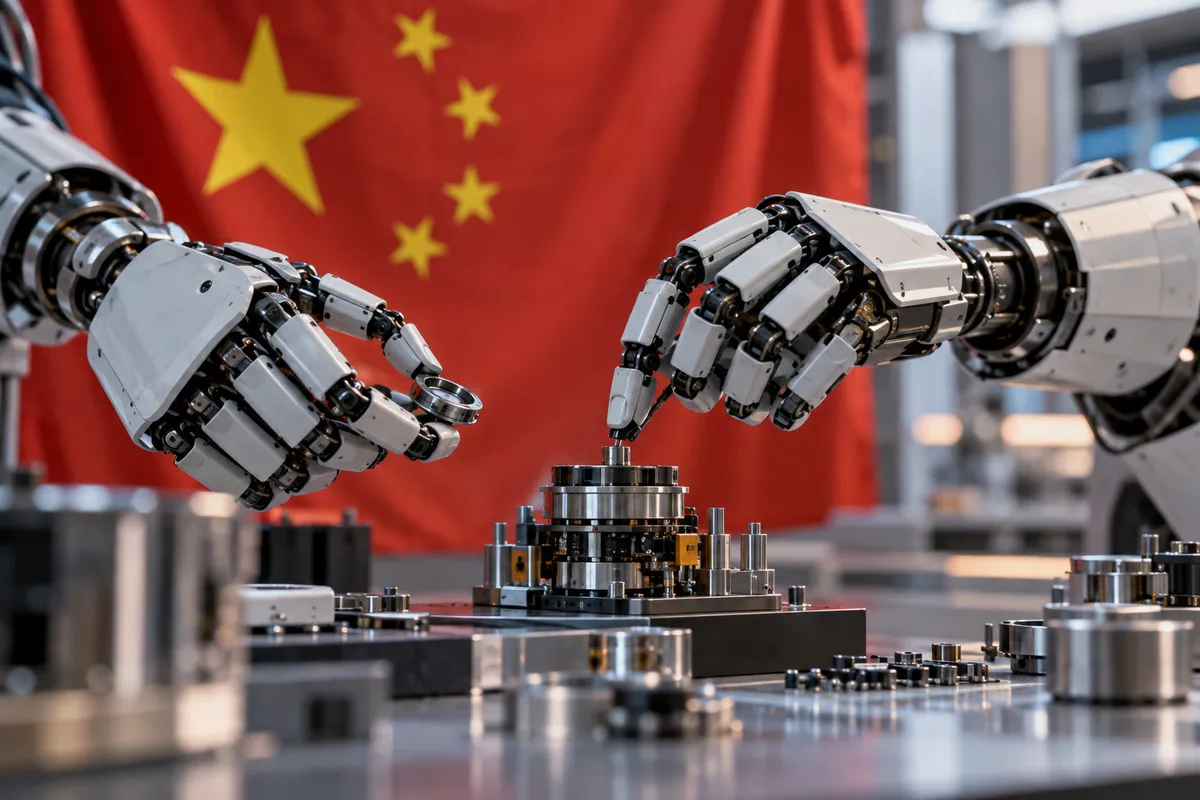
The race to build the best humanoid hand no longer has an obvious leader.
Inspire Robots has the strongest disclosed shipment evidence. LinkerBot is pushing high-degree-of-freedom hands toward higher production volumes. Sharpa has concentrated on dense tactile sensing and an integrated manipulation stack. Unitree is combining dexterous hands with its own widely available humanoid platforms. Figure AI is building sensing directly around its Helix AI system. Tesla remains one of the industry’s most closely watched hand programs, but public evidence around its latest hardware is unusually limited.
That makes “leadership” dependent on what is being measured.
For investors and corporate strategy teams, the useful question is not which company publishes the largest DoF number. It is which architecture can combine dexterity, touch, durability, cost, production scale and learned manipulation into a commercially useful system.
| Company | Current hand position | Dexterity and sensing | Scale evidence | Strategic model |
|---|---|---|---|---|
| Inspire Robots | RH5MK1 and broader RH series | 22 active DoF on RH5MK1, 6D fingertip tactile sensing | More than 10,000 hands reportedly delivered in 2025 | Specialist component supplier |
| LinkerBot | Linker Hand family | 11 to 42 DoF across models | Production expansion from about 5,000 toward 10,000 units per month reported | High-DoF component and data platform |
| Sharpa | Wave and W02 | 22 DoF Wave, 21 DoF W02, dense tactile sensing | Shipping stated, unit volumes undisclosed | Hands, robots, tactile data and AI |
| Unitree | Dex5-1 family | 20 DoF, 16 active plus 4 coupled; Dex5-1P adds pressure sensing | Commercial product, comparable hand shipment figures unavailable | Integrated humanoid OEM plus components |
| Figure AI | Figure 03 hand | DoF undisclosed; palm cameras and fingertip tactile sensing | In-house, not sold as a standalone hand | Vertically integrated humanoid and AI |
| Tesla | Optimus next-generation hand | 22 DoF targeted or reported; detailed current specifications limited | In-house, latest hand scale undisclosed | Vertically integrated humanoid manufacturing |
Inspire Robots has the clearest volume lead
If leadership is measured by disclosed shipments, Inspire Robots currently has the strongest case among the companies in this comparison.
GGII data cited by 36Kr puts China’s dexterous-hand shipments at roughly 19,200 units in 2025 and ranks Inspire Robots, also translated as Yinshi Robotics, first by shipment volume. The company reported more than 10,000 deliveries that year.
Its newest RH5MK1 also closes much of the specification gap with high-DoF competitors. Unveiled at IROS 2026, the hand has 22 active degrees of freedom, five independently moving fingers and 6D fingertip tactile sensors with published force resolution of 0.005 N.
That combination matters. Inspire is no longer simply the lower-DoF, higher-volume alternative to experimental hands. It is trying to pair its manufacturing position with human-scale dexterity.
The remaining question is how quickly the new 22-DoF architecture moves from an IROS launch into repeatable production and customer deployment.
LinkerBot is making high DoF a scale business
LinkerBot occupies a different position. Its advantage is the breadth of its dexterous-hand portfolio and its focus on turning high-DoF hands into a standalone robotics business.
Reuters reported in May that LinkerBot was targeting an increase in monthly production from roughly 5,000 hands to 10,000. The company has also claimed more than 80% of the high-degree-of-freedom hand segment, although market definitions differ and that figure should not be treated as directly comparable with GGII’s broader shipment data.
That inconsistency is one of the central problems in evaluating this market. Inspire can lead total dexterous-hand shipments while LinkerBot claims leadership in a narrower high-DoF category. Both statements can potentially describe different segments.
LinkerBot’s broader strategy also extends beyond hardware. Its LinkerSkillNet platform is intended to accumulate manipulation skills, giving the company a hardware-plus-data thesis that increasingly resembles the strategies of vertically integrated humanoid developers.
Sharpa is strongest on tactile integration
Sharpa’s case for leadership rests less on volume and more on touch.
Its Wave hand has 22 active DoF and more than 1,000 tactile pixels per fingertip, while W02 reduces the count to 21 DoF but extends tactile sensing across more of the hand. The company has also developed the AE01 data glove and CraftNet model around tactile manipulation.
Wave’s use in NVIDIA’s Isaac GR00T Reference Humanoid gives Sharpa an important third-party integration reference. The company’s Shanghai Dairy Queen deployment is also testing the broader hand-plus-model thesis in a public commercial environment.
But Sharpa has not disclosed the unit shipments required to claim volume leadership. Its supplied evidence is therefore strongest on capability and integration, not scale.
Unitree connects hand development to a large humanoid ecosystem
Unitree represents another competitive model. Rather than building a hand business in isolation, it can connect hand development directly to its humanoid platforms.
Its Dex5-1 has 20 degrees of freedom, including 16 active DoF. Unitree emphasizes backdrivability, replaceable fingers and reinforcement-learning compatibility. The tactile Dex5-1P configuration adds 94 pressure-sensing points per hand.
Unitree’s advantage is therefore not a headline 22-DoF specification. It is integration.
A hand developed alongside the robot body, controls and training environment can generate a tighter hardware-software loop than an externally sourced component. That could matter more as humanoid competition shifts from mechanical capability toward manipulation policies trained on large amounts of interaction data.
Public evidence does not, however, provide a directly comparable shipment number for Dex5-1 itself.
Figure AI is treating the hand as an AI sensor
Figure’s approach makes the distinction between “hand” and “AI system” increasingly difficult to maintain.
Figure 03 introduced palm cameras for close-range visual feedback and internally developed tactile sensors in the fingertips. Figure says those sensors can detect forces as small as three grams.
More importantly, Figure has demonstrated Helix 02 using those modalities for manipulation tasks including unscrewing a bottle cap, extracting a pill, operating a syringe and picking small metal pieces from clutter. Figure states that the demonstrations are fully autonomous rather than teleoperated.
These remain company demonstrations rather than independent operating evidence, but they show where the competition is moving. A hand’s value increasingly depends on whether an AI policy can use its tactile and visual signals in closed-loop manipulation.
Figure does not disclose a directly comparable DoF figure for Figure 03’s hand, making specification rankings inappropriate.
Tesla remains influential, but unusually hard to benchmark
Tesla has helped make dexterous hands central to the humanoid investment narrative. Its next-generation Optimus hand has been associated with a 22-DoF target, double the 11 DoF disclosed for the earlier design.
The problem is verification.
The supplied Humanoid Analytics research notes that the latest Optimus hand had not received a full public reveal by late September 2026. Recent reporting continues to emphasize Tesla’s limited public disclosure around the current Optimus system.
Tesla therefore belongs in the leadership discussion because of its engineering ambition, resources and vertical manufacturing strategy, but not because the available evidence establishes a present hand-performance lead.
There is no single dexterous-hand leader
The market now has several kinds of leadership.
Inspire Robots has the strongest disclosed volume position. LinkerBot is pushing high-DoF hands toward industrial-scale production. Sharpa stands out for tactile density and integration around touch. Unitree combines dexterous hardware with its own humanoid ecosystem. Figure is tightly coupling tactile sensing and in-hand vision to learned control. Tesla is pursuing an ambitious human-like architecture but provides less current evidence than several competitors.
This fragmentation is likely more meaningful than a simple ranking.
Degrees of freedom are converging. Inspire has now reached 22 active DoF, putting it alongside Sharpa’s Wave on the headline specification. The supplied research also cautions that vendors measure tactile performance differently, making raw sensor specifications difficult to compare directly.
The next leadership test will therefore be harder: durability, hand cost, manipulation success rates, intervention frequency, operating hours and production yield.
Those metrics will show whether the best humanoid hand is the one with the most joints, the most sensors, the largest factory, or the system that can keep using all three reliably in real work.
Sources:
- 36Kr, “250 Billion Yuan Financing Raised in Half a Year: The Dexterous Hand Industry Still Lacks a Widely Recognized ‘Standard Hand’”
Source type: Tier 2, strong independent evidence
https://eu.36kr.com/en/p/3934402091351433 - Gasgoo, “Inspire Robots Debuts 22-DOF Fully Direct-Drive Dexterous Hand at IROS 2026”
Source type: Tier 2, independent reporting
https://autonews.gasgoo.com/articles/other/inspire-robots-debuts-22-dof-fully-direct-drive-dexterous-hand-at-iros-2026-2108529909101449216 - Reuters, “China robot-hand-building unicorn Linkerbot targets $6 billion valuation”
Source type: Tier 2, strong independent evidence
https://www.reuters.com/world/china-robot-hand-building-unicorn-linkerbot-targets-6-billion-valuation-2026-05-04/ - Sharpa, “Sharpa Launches Three Flagship Products at IROS 2026, Pushing the Boundaries of Dexterous Manipulation”
Source type: Tier 3, detailed first-party disclosure, company-controlled
https://www.sharpa.com/blogs/news/sharpa-launches-three-flagship-products-at-iros-pushing-the-boundaries-of-dexterous-manipulation - Unitree Robotics, “Unitree Dex5-1”
Source type: Tier 3, company product documentation, company-controlled
https://www.unitree.com/Dex5-1/ - Figure AI, “Introducing Figure 03”
Source type: Tier 3, detailed first-party disclosure, company-controlled
https://www.figure.ai/news/introducing-figure-03 - Figure AI, “Introducing Helix 02: Full-Body Autonomy”
Source type: Tier 3, company-controlled technical demonstration
https://www.figure.ai/news/helix-02 - Teslarati, “Tesla Optimus to receive hands with 22 degrees of freedom later this year”
Source type: Tier 2, secondary reporting of executive disclosure
https://www.teslarati.com/tesla-optimus-hands-22-degrees-of-freedom-upgrade-2024/ - Barron’s, “Tesla’s Secrecy Surrounding Optimus Robot Is Making Wall Street Nervous”
Source type: Tier 2, independent reporting
https://www.barrons.com/articles/tesla-stock-optimus-robot-c2377ec0