
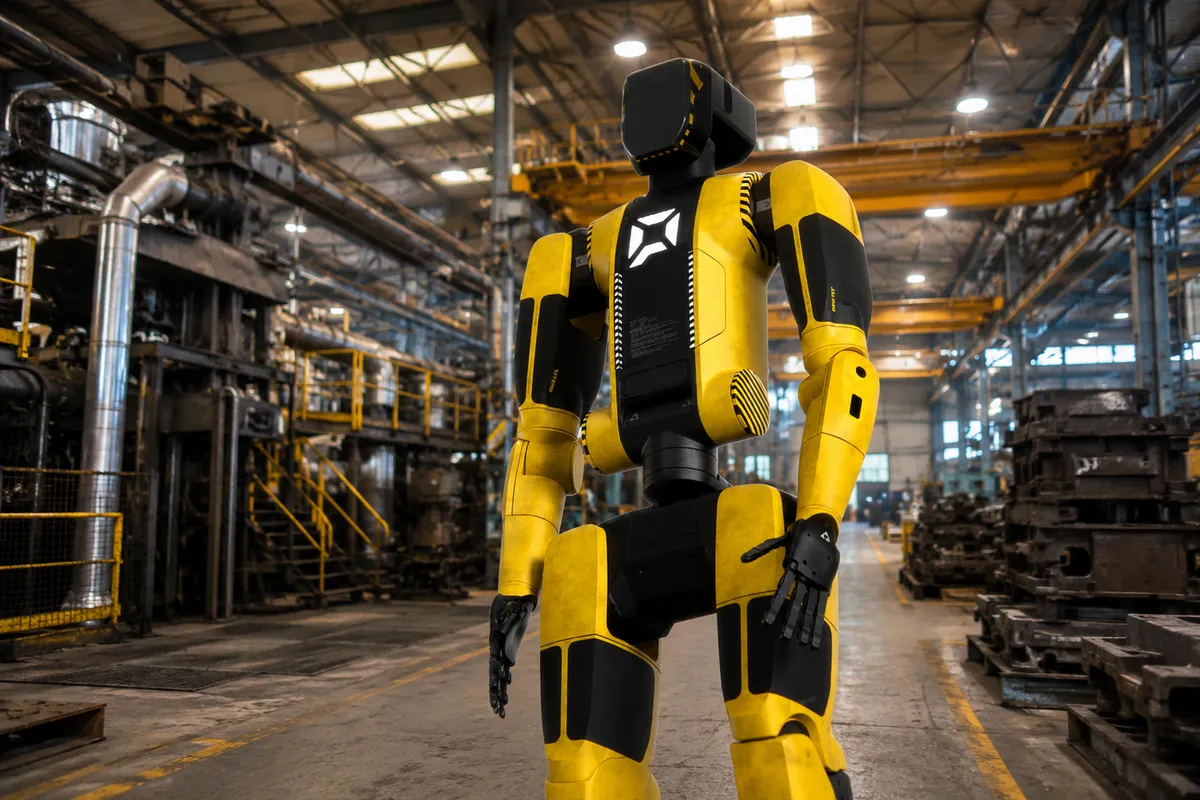
Persona AI is making a useful bet in a crowded humanoid robotics market: start with heavy industry, not homes or generic warehouse work. The Houston-based startup is targeting shipyards, energy infrastructure, construction and industrial manufacturing, where labor shortages, safety risk and skilled-trade bottlenecks may create stronger demand for humanoid automation if the technology can be made reliable enough.
The commercial logic is compelling, but the evidence is still early. Persona AI has raised $27 million in pre-seed funding, signed a shipyard-focused agreement with HD Korea Shipbuilding & Offshore Engineering, HD Hyundai Robotics and Vazil, and positioned its robots for welding, inspection and fabrication work. It has not yet publicly shown repeat deployment, paid operational use, production-scale manufacturing or field performance data.
That makes Persona AI important, but still unproven. The company’s use-case selection deserves attention because heavy industry may offer one of the clearest economic reasons to use humanoid robots. The current evidence, however, points to a customer development pathway, not commercial deployment.
Why Heavy Industry Is A Serious Use Case
Much of the humanoid robotics market is still framed around general-purpose labor. Companies show robots folding laundry, sorting objects, carrying boxes or walking through labs. Those demonstrations can be technically interesting, but they often leave the commercial question unanswered: what customer problem is urgent enough to justify an expensive, complex humanoid robot?
Persona AI’s answer is heavy industry.
The company says it is building industrial humanoid robots for shipyards, energy facilities, construction projects and other complex worksites. Its website describes a platform intended for “4D jobs,” meaning dull, dirty, dangerous and declining work. The company also says it is commercializing NASA robotic hand intellectual property and adapting one hardware base into roles such as welder, inspector or builder.
That positioning is commercially different from the warehouse-first strategy used by Agility Robotics or the automotive-factory pilots pursued by Figure AI and Apptronik. Shipyards and heavy manufacturing environments are less standardized, more physically demanding and often harder to automate with fixed robotic systems. If humanoids can operate safely in those environments, the value case could be stronger than in workflows already served by conveyors, robot arms or autonomous mobile robots.
But the word “if” matters. Shipyards are harsh operating environments. Robots must handle heat, vibration, dust, uneven surfaces, confined spaces, variable part geometry, safety constraints and human co-workers. Welding adds another layer of difficulty: precision, tool handling, path planning, inspection, quality assurance and certification.
This is why Persona AI’s market focus is interesting but not yet validated. Heavy industry may have stronger labor pull. It also has a higher operational bar.
| Area | Current Public Signal | Evidence Still Missing |
|---|---|---|
| Funding | Persona AI announced a $27 million oversubscribed pre-seed round | Runway, burn rate and future capital needs |
| Shipyard customer pathway | HD KSOE, HD Hyundai Robotics, Persona AI and Vazil signed an MOU for humanoid welding robots | Field results, robot count, paid terms and repeat deployment |
| Timeline | Prototype completion targeted for end-2026, with field testing and commercialization planned for 2027 | Whether those milestones are met in real shipyards |
| Technology direction | Persona says it is using NASA robotic hand IP and building industrial humanoids | Independent validation of dexterity, durability and autonomy |
| ABS collaboration | ABS and Persona AI are exploring humanoid use in shipbuilding and inspection | Standards, certification requirements and operational acceptance |
| Commercial readiness | Heavy industry has real safety and labor needs | Uptime, intervention rate, welding quality, ROI and service cost |
HD Hyundai Gives Persona AI A Credible Testbed
Persona AI’s strongest public signal is its shipbuilding agreement with HD Hyundai-related entities and Vazil.
In May 2025, HD Korea Shipbuilding & Offshore Engineering and HD Hyundai Robotics announced an MOU with Persona AI and Vazil Company to develop humanoid robots for shipyard welding. The announcement said Persona AI would lead humanoid hardware development and AI-based control and learning algorithms, while Vazil would design specialized welding tools and testing environments. It targeted prototype completion by the end of 2026, with field testing and commercialization starting in 2027.
That is meaningful because HD Hyundai is not a generic logo. Shipbuilding is a demanding industrial environment, and a real shipyard partner can provide task data, workflow constraints and operational feedback that a lab cannot.
The evidence level should still be kept in perspective. The agreement points to a customer development program and future field testing. It is not proof that Persona robots are already welding in production. It is also not yet clear whether the agreement includes paid deployment terms, how many units are planned, what autonomy level is expected, or what performance metrics will determine success.
Houston Chronicle reporting described the same collaboration and said the aim was to build prototypes by the end of 2026, with robots expected to do shipyard welding in 2027. That reporting also noted Persona AI’s role in developing humanoid hardware and AI-based control and learning algorithms.
For Humanoid Analytics, this supports a Customer Pilot classification if treated as a named customer development pathway. It does not support Operational Deployment.
ABS Adds A Standards Dimension
Persona AI’s work with the American Bureau of Shipping adds another useful layer. ABS has partnered with Persona AI to explore humanoid robots in shipyards, including inspection and certification-related workflows. MarineLink reported that the initiative focuses on adapting Persona AI’s humanoid robots, based partly on NASA robotic hand technology, for shipyard tasks and for data collection that could support remote and digital survey methods.
This matters because shipyards are not only operationally difficult. They are also regulated, safety-sensitive environments. A humanoid robot that performs inspection or welding work may need to produce data that customers, insurers, class societies and regulators can trust.
For Persona AI, that could become a strategic advantage if it builds safety, certification and data quality into the platform early. It could also become a bottleneck. Standards work can clarify requirements, but it does not remove the need for field reliability.
The Economics Could Be Stronger Than The Evidence
The economic case for heavy-industry humanoids is stronger than the public deployment evidence because the pain points are real. Shipyards and energy sites often depend on skilled trades that are difficult to hire, physically demanding and safety-critical. If a robot could assist with welding, inspection, maintenance or fabrication in places designed for people, customers may have a clearer reason to test it.
Persona AI’s website cites severe shipyard labor pressure, including attrition and first-year retention challenges, and frames robots as a way to reduce physical strain while supporting workforce stability. These claims come from the company’s own material and should be treated as company framing unless independently verified in each customer context.
The important point is not whether humanoids will replace shipyard workers. That is too broad and premature. The more realistic near-term question is whether humanoids can take on narrow, high-burden tasks under supervision, especially tasks where conventional automation struggles because the environment is too variable or the work area is difficult to fixture.
A useful early Persona deployment would not need to prove general-purpose labor. It would need to prove a specific workflow: a robot reaching a weld location, handling or positioning a tool, executing a validated path, producing quality data, operating safely near humans, and repeating the job with acceptable maintenance and oversight.
The Proof Will Come In The Yard
Persona AI’s heavy-industry focus is strategically coherent. It avoids some of the weaker consumer humanoid narratives and starts where the need for skilled physical automation is easier to understand. It also aligns with the broader humanoid robotics lesson that structured industrial environments are likely to come before general-purpose household use.
The risk is that the environments Persona AI is targeting are among the hardest. Shipyards and energy facilities may offer stronger economic pull, but they also impose harsh durability, safety and certification requirements. The company’s NASA-linked robotics pedigree and industrial partnerships are useful signals. They are not field proof.
The next evidence to watch is specific and measurable: prototype delivery by the end of 2026, field testing in shipyards in 2027, named tasks, robot counts, welding quality data, human intervention rates, operating hours, safety incidents, maintenance burden and whether HD Hyundai or another customer expands the program.
Persona AI has chosen a serious use case, and that alone separates it from more generic humanoid narratives. But the company is still early. Its commercial credibility will depend less on the ambition of putting humanoids into heavy industry and more on whether those robots can survive, work and create measurable value in the places where industrial labor is hardest to replace.
Sources:
Persona AI, “Industrial Humanoid Robotics”:
https://persona.ai/
PR Newswire, “Persona AI Raises $27M Oversubscribed Pre-Seed To Deliver The Future Of Humanoid Robotics”:
https://www.prnewswire.com/news-releases/persona-ai-raises-27m-oversubscribed-pre-seed-to-deliver-the-future-of-humanoid-robotics-302455330.html
PR Newswire, “HD Hyundai And Persona AI Sign Agreement To Deploy Humanoid Welding Robots For Shipbuilding Automation”:
https://www.prnewswire.com/news-releases/hd-hyundai-and-persona-ai-sign-agreement-to-deploy-humanoid-welding-robots-for-shipbuilding-automation-302449258.html
Houston Chronicle, “Houston AI Company Part Of Joint Agreement To Build Humanoid Robots For Shipyards”:
https://www.houstonchronicle.com/news/houston-texas/trending/article/persona-ai-humanoid-robots-shipyards-20319212.php
MarineLink, “ABS, Persona AI Partner To Bring Humanoid Robotics To Shipyards”:
https://www.marinelink.com/news/abs-persona-ai-partner-bring-humanoid-531980
Humanoid Analytics, “Humanoid Company Tracker”:
https://humanoidanalytics.com/humanoid-company-tracker/
Related: The Humanoid Robot Market Is Splitting Between Evidence And Hype.