
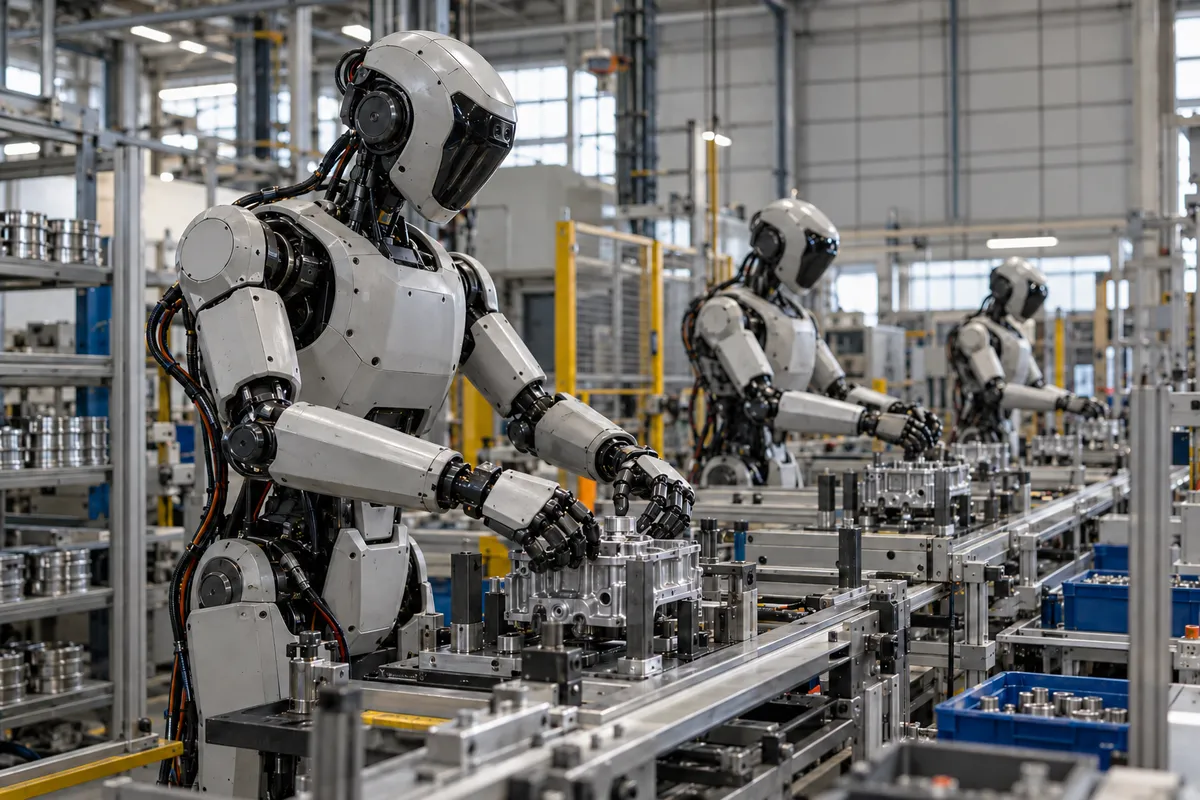
Avatar Robotics is pitching a model that could change who gets hired for physical work: put a robot inside a local facility and connect it to operators elsewhere. For investors, the proposition is commercially significant even before full autonomy arrives. The immediate question is whether remote labor can cover the machine’s cost and deliver useful output reliably.
Imagine a warehouse that keeps its building, inventory, and customers in the same country, while some packing or sorting is performed by a person abroad through a robot. The workplace stays local. Access to the work becomes international.
That possibility appeared in section 10.3 of Humanoid Analytics’ September 27 analysis of general-purpose physical AI. It deserves closer examination because it challenges an assumption behind many physical jobs: the worker has to live within commuting distance.
The evidence supports teleoperation as a real capability. It leaves the broader claim of economical, scalable cross-border labor substitution unverified. That gap separates a compelling business model from a proven labor-market shift.
Who Is Actually Doing the Work?
A robot moving products tells an observer little about where the intelligence comes from. Buyers need to distinguish the control mode because each arrangement has different staffing requirements and economics. Humanoid Analytics’ Evidence Standards explicitly separate autonomy, remote intervention, and continuous teleoperation.
| Control mode | Who performs the task? | Commercial question |
|---|---|---|
| Fully autonomous operation | The robot executes the task within defined conditions. | What human support remains outside task execution? |
| Remote intervention | A person helps when the system needs assistance. | How often, and for how long? |
| Continuous teleoperation | A person directly controls the robot throughout the task. | Does accepted output justify both labor and hardware costs? |
Avatar’s platform page describes a globally distributed operator pool that can intervene when AI encounters difficult cases. It also says operational data trains models to take over more work. Those statements describe the company’s intended combination of human control and autonomy; the page does not establish how much customer work is completed under each mode.
In an August 5 release, Avatar claimed its robots had packed, sorted, and helped ship more than 900,000 products since December 2025. It also claimed a post-pilot expansion with a warehouse operator. Neither that operator nor the beauty retailer mentioned in the release was named. The claims therefore offer leads for customer verification, with sustained performance and economics still unresolved.
Business Insider’s August report described a wheeled, two-arm warehouse robot and a hands-on trial at Avatar’s headquarters. It reported that operation remained mostly human-controlled and that Avatar declined to disclose robot, paying-customer, or facility counts. Webb said operators worked in Mexico, Colombia, and the Philippines. These details combine reporter observation with company statements.
The distinction also limits the headline’s scope. Remote physical labor can use wheeled manipulators as well as walking humanoids. The business model depends on completing tasks in existing facilities.
The Economics Turn on Completed Work
A wage difference between countries creates a possible opening. Whether a robot service can exploit it depends on productivity, reliability, and everything required to keep the work moving.
Continuous control still requires a worker while adding a machine, communications, maintenance, and support. Occasional intervention has a different cost structure, especially if an operator can support multiple machines safely. Those models need separate financial assumptions.
The useful comparison is total cost per customer-accepted task. That includes robot purchase or lease costs, paid operator time, training, supervision, connectivity, spare parts, repairs, and local assistance. Charging, downtime, mistakes, and rework affect the output over which those costs are spread.
A new construction study shows how demanding that comparison can be. Submitted to arXiv on September 30, the paper tested a teleoperated Unitree G1 on tool transport and painting. Two operators performed ten trials each per task.
| Task | Reported success | Average teleoperation time | Average manual time |
|---|---|---|---|
| Tool transport | 100% | 72 seconds | 4 seconds |
| Painting | 80% | 149 seconds | 47 seconds |
Painting meant applying a coating to paper, with success defined as covering at least 90%. The authors also reported motor overheating during extended operation. The paper lists acceptance at an IROS 2026 workshop and construction-industry support. These are preliminary feasibility results, with no evidence of economical customer deployment. They also do not measure Avatar’s performance.
The study makes the economic hurdle tangible: lower hourly labor costs can be consumed by slower execution and hardware overhead. Each use case needs its own comparison with manual work and task-specific automation.
There may still be viable niches. An employer struggling to cover an overnight shift could value availability and flexibility. Hazardous work could justify costs that routine packing would not. Customer renewals and disclosed service margins would help distinguish those cases from subsidized trials.
Who Gets the New Jobs?
If the service becomes competitive, it could widen the pool of people eligible for a physical task. A worker overseas might access work in a facility they could never reasonably commute to. Someone unable to sustain an on-site physical role could potentially contribute through a suitable remote interface.
That possibility depends on the interface and working conditions. A headset does not automatically make a job comfortable or accessible. Buyers and workers would need evidence about fatigue, training, shift length, equipment requirements, and the physical demands of control.
For local workers, wage pressure is a plausible mechanism, not a measured outcome established by these sources. It would arise where remote operators become credible substitutes for particular tasks. Jobs containing repair, coordination, judgment, and unpredictable physical interaction may be harder to transfer as a package.
Remote operation could also complement local employment. A facility might use it to fill vacancies, extend operating hours, or support expansion, while retaining on-site technicians and staff who recover machines from failures.
For overseas operators, the important question is how much of the value reaches them. Pay, predictable hours, equipment costs, worker protections, and routes to advancement would determine whether access becomes a durable opportunity. The reviewed evidence does not establish those outcomes or a broader effect on local wages.
When the Robot Learns, the Job Changes
Avatar says each shift generates synchronized video, sensor, motion-control, and success or failure data for training its models. Its operators would therefore contribute both immediate work and demonstrations that could reduce future demand for direct control.
For investors, that creates two propositions to test: a labor service that delivers value today, and an autonomy system that may improve tomorrow. Revenue from the first would not, by itself, establish progress in the second.
The informative metric is paid human support per accepted task, measured alongside throughput, quality, and total cost. A credible transition would show those support requirements falling without pushing more recovery work onto customer staff.
Operators could move into fleet supervision, training, or difficult interventions. Whether those roles absorb the existing workforce depends on deployment growth, the pace of automation, and how many machines each person can support. A promise of future supervisory jobs cannot establish that balance.
The next evidence should come from a named paying customer: sustained output across representative shifts, disclosed remote and local assistance, full operating costs, and a renewal or expansion. Worker-side evidence should show compensation and working conditions alongside the productivity figures.
If those tests are met, some physical tasks could enter a global labor market while production remains local. The question is then as personal as it is commercial: if a job can be done through an internet connection, who gets hired, and what are they paid?
Sources:
- Avatar Robotics, “Reliable Robotics Platform | Hardware, AI, & Fleet Management”
Source type: Tier 4, promotional or incomplete evidence. Company-controlled platform page; control shares and customer economics are not disclosed. https://www.avatarrobotics.com/platform - Humanoid Analytics, “The Race for General-Purpose Physical AI”
Source type: Tier 3, detailed first-party disclosure of Humanoid Analytics’ analysis. Used as editorial context, with no independent deployment corroboration implied. Published September 27, 2026; updated September 28, 2026. https://humanoidanalytics.com/2026/09/27/the-race-for-general-purpose-physical-ai/ - Humanoid Analytics, “Evidence Standards”
Source type: Tier 1, direct or official evidence of Humanoid Analytics’ own methodology; not evidence of a company’s operating performance. https://humanoidanalytics.com/evidence-standards/ - Avatar Robotics via PR Newswire, “Avatar Robotics Raises $6.5 Million Seed to Build the Unlimited Industrial Workforce”
Source type: Tier 3, detailed first-party disclosure. Company-controlled release, published August 5, 2026; deployment claims lack named-customer confirmation. https://www.prnewswire.com/news-releases/avatar-robotics-raises-6-5-million-seed-to-build-the-unlimited-industrial-workforce-302843349.html - Business Insider, “This startup that just raised $6.5 million bets the next big side hustle is controlling robots with VR headsets”
Source type: Tier 2, strong independent evidence for the reporter’s observations. Attributed company statements remain first-party claims. Published August 5, 2026. https://www.businessinsider.com/avatar-robotics-raises-6-5m-to-expand-robot-workforce-2026-8 - Ali Pour et al., arXiv, “Toward Humanoid Robots in Construction: A Teleoperation Feasibility Study”
Source type: Tier 2, strong independent evidence. Primary academic feasibility research; the paper discloses construction-industry support. Submitted September 30, 2026; version 1 reviewed. https://arxiv.org/html/2610.00718v1