
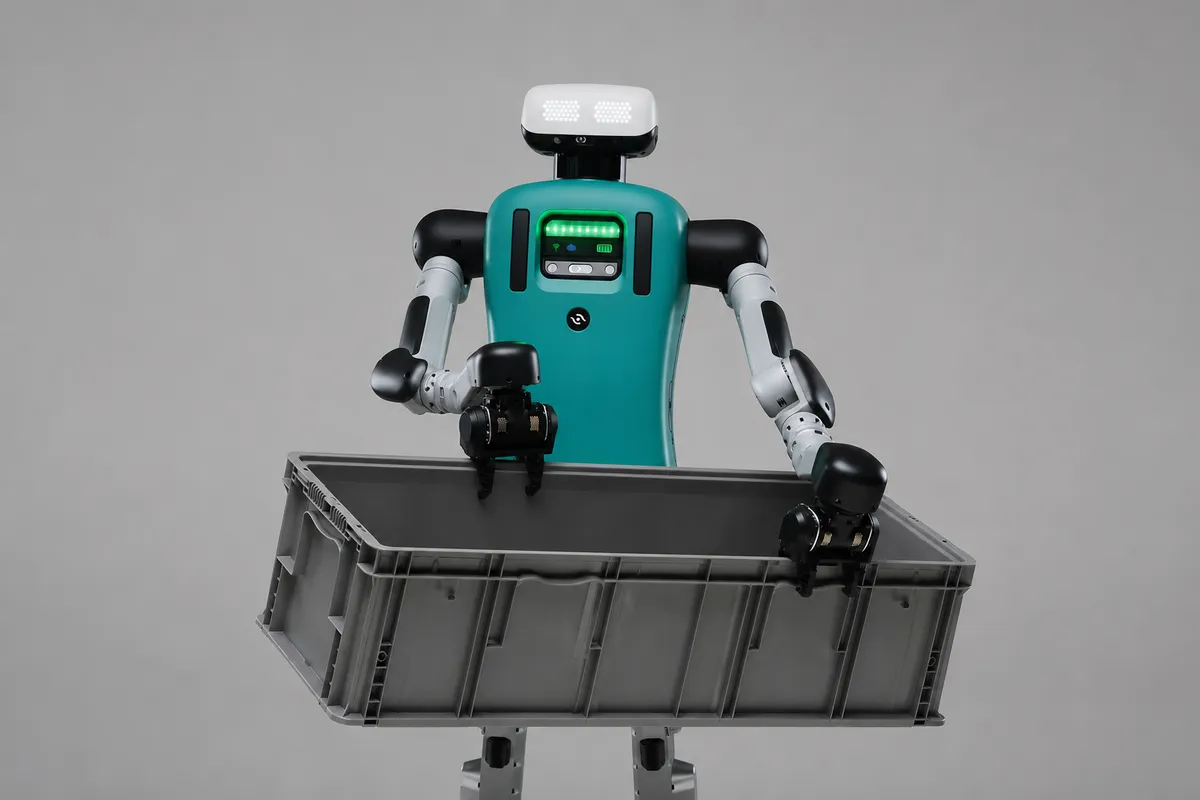
Agility Robotics has built one of the clearest public deployment cases among Western humanoid robot developers. Its Digit robots are performing material-handling work under a multi-year commercial agreement with GXO Logistics, while subsequent agreements with Mercado Libre and Toyota Motor Manufacturing Canada indicate that the company is beginning to convert one operational reference into a broader customer pipeline.
The evidence is stronger than a staged demonstration or an unnamed pilot. GXO has confirmed that Digit is operating in a live warehouse environment under a Robots-as-a-Service agreement, and Agility says the robots have moved more than 100,000 totes at the facility. However, the companies have not publicly disclosed the number of deployed robots, uptime, intervention rates, contract value, operating cost, or whether the deployment has produced a clear return on investment.
That distinction is important. Agility has credible evidence that Digit can perform repetitive logistics work in an actual customer operation, but there is not yet enough public information to describe the deployment as commercial scale.
GXO Provides The Strongest Evidence
Agility’s most important customer reference is GXO Logistics, a large contract logistics operator. In June 2024, GXO announced a multi-year agreement to deploy Digit at a facility serving apparel company Spanx in Flowery Branch, Georgia.
The agreement followed a proof-of-concept pilot conducted in 2023. GXO said the commercial deployment placed fully operational Digit robots in a live warehouse environment, where they move totes from autonomous mobile robots and place them onto conveyors. The deployment also uses Agility Arc, the company’s software platform for mapping facilities, defining workflows, managing robots, and troubleshooting operations.
The customer-side confirmation makes the GXO project unusually valuable as evidence. Many humanoid announcements are issued only by the robot developer, provide no named operating site, or describe future deployment intentions. GXO has publicly identified the workflow, customer facility, commercial structure, and progression from pilot to a multi-year agreement.
Agility reported in November 2025 that Digit had moved more than 100,000 totes at GXO’s Flowery Branch operation. The milestone offers a more useful measure than a short demonstration because it suggests repeated task execution over time in a working logistics environment.
However, the figure should be interpreted carefully. A cumulative tote count does not reveal how many robots were required, how long the work took, how often humans intervened, or how performance compared with conventional automation. It also does not show whether the deployment has expanded materially since the original agreement.
The GXO arrangement therefore supports an evidence level of operational deployment. It may also qualify as a paid pilot or early commercial deployment because GXO described it as a commercial Robots-as-a-Service agreement. The available evidence is not sufficient to classify it as a repeat deployment or commercial-scale deployment across multiple facilities.
| Evidence Area | What Is Publicly Supported | What Remains Unclear |
|---|---|---|
| Customer | GXO publicly confirmed the agreement and operating workflow | Full customer expansion plan |
| Commercial status | Multi-year Robots-as-a-Service agreement | Contract value and revenue contribution |
| Operating environment | Live logistics facility serving Spanx | Fleet size and utilization |
| Task | Moving totes from mobile robots to conveyors | Range of additional production tasks |
| Throughput | Agility reports more than 100,000 totes moved | Time period, productivity and comparison with alternatives |
| Reliability | Repeated operation is implied by cumulative throughput | Uptime, failure rate and human intervention |
| Economics | GXO continued beyond the proof-of-concept stage | Payback period, cost per move and return on investment |
Amazon Was Important, But It Was A Test
Amazon helped establish Agility’s visibility in warehouse robotics, but its public work with Digit should not be described as a commercial deployment.
In October 2023, Amazon said it would begin testing Digit in its operations, initially exploring tote recycling. Amazon had also invested in Agility through its Industrial Innovation Fund. The announcement demonstrated interest from one of the world’s largest warehouse automation users, but Amazon characterized the activity as testing rather than a paid operational rollout.
The distinction between Amazon and GXO illustrates why deployment classification matters. A pilot with a prominent customer is useful evidence of customer interest. A multi-year commercial agreement in a live workflow is stronger because it shows that the customer has chosen to continue beyond initial testing.
There is no clear public evidence that Amazon has expanded Digit into a larger operational deployment. The Amazon work therefore remains relevant to Agility’s development history, but GXO is the stronger indicator of commercial readiness.
New Agreements Could Broaden The Deployment Base
Agility’s next challenge is to show that the GXO project can be repeated with other customers and in other operating environments.
In December 2025, Agility and Mercado Libre announced a commercial agreement to introduce Digit at a fulfillment facility in San Antonio, Texas. The companies said the initial work would focus on commerce fulfillment, with the possibility of exploring additional logistics applications in Latin America.
The announcement is commercially relevant because Mercado Libre operates a substantial e-commerce and logistics network. However, the public material does not yet provide the operating history, throughput data, fleet size, or evidence of expansion available from the GXO deployment.
Agility announced another commercial agreement in February 2026 with Toyota Motor Manufacturing Canada. According to Agility, the agreement followed a successful pilot and is intended to place Digit in manufacturing, supply chain, and logistics operations at Toyota facilities.
Toyota’s involvement could be more significant than a conventional warehouse trial. Automotive plants impose strict requirements around safety, uptime, cycle time, quality, and integration with existing production systems. A successful deployment could provide evidence that Digit can operate under more demanding manufacturing conditions.
For now, most details come from Agility’s announcement. Public evidence confirming fleet size, operating workflows, commercial terms, or sustained production use remains limited.
Agility has also announced that Schaeffler intends to purchase Digit robots for use across its global plant network. Schaeffler described the potential to deploy a significant number of humanoids across its plants by 2030, but the statement remains a future intention rather than evidence of completed deployment.
Together, the agreements show a customer pipeline forming around Agility. They do not yet prove that the company has replicated the GXO deployment at scale.
A Narrow Workflow Can Still Be Commercially Meaningful
Digit’s current work is less dramatic than many humanoid demonstrations. The robot moves containers between existing automation systems rather than performing a wide range of unpredictable tasks.
That narrowness may be an advantage.
Warehouses and factories generally adopt automation to solve specific operational problems, not to demonstrate general intelligence. A defined tote-handling workflow can be measured through throughput, availability, safety, labor requirements, and cost per move. It can also be integrated into a broader system that includes conveyors, mobile robots, warehouse software, and human workers.
Agility’s approach suggests that early humanoid deployment may depend less on general-purpose autonomy than on fitting a mobile manipulation platform into a controlled workflow. Digit’s bipedal form allows it to navigate spaces built for people, while its arms allow it to move objects between pieces of fixed and mobile automation.
The unresolved question is whether a humanoid is the most economical solution. Conventional robotic arms, conveyors, autonomous mobile robots, and redesigned work cells can often perform warehouse tasks more cheaply and reliably. Digit must justify its additional mechanical complexity by working in spaces or workflows where less flexible systems are impractical.
Agility Arc is also part of the commercial proposition. Managing a fleet requires more than robot hardware. Customers need workflow configuration, monitoring, exception handling, software integration, maintenance, and service support. GXO’s confirmation that Arc is part of the deployment suggests Agility is building a system around Digit rather than selling an isolated machine.
Deployment Leadership Still Needs Scale
Agility’s position is stronger than that of companies whose evidence consists mainly of internal factory videos, prototype demonstrations, non-binding partnerships, or future production targets. GXO has confirmed commercial activity, the robot has a defined operating task, and Agility has reported cumulative throughput.
That makes Agility one of the more credible Western humanoid deployment stories. It does not make Digit a proven mass-market automation platform.
The company has not publicly disclosed enough data to evaluate the deployment’s economics or technical performance. Investors and customers still need to know the size of the installed fleet, average operating hours, intervention frequency, maintenance requirements, safety record, useful life, and whether GXO has expanded the program beyond its initial location.
The next decisive evidence would be repeat orders from existing customers, expansion to additional GXO facilities, sustained operation at Mercado Libre and Toyota, and independently confirmed performance data. Disclosure of pricing or measurable labor and productivity outcomes would further clarify whether Digit is creating value beyond proving that humanoid robots can work in a warehouse.
Agility has crossed an important threshold by moving Digit from a pilot into a named commercial operation. The harder test is now replication. Its advantage will become durable only if one live deployment develops into a repeatable business across customers, facilities, and workflows.
Sources:
GXO, “GXO Signs Industry-First Multi-Year Agreement with Agility Robotics”:
https://gxo.com/news_article/gxo-signs-industry-first-multi-year-agreement-with-agility-robotics/
Agility Robotics, “Digit Moves Over 100,000 Totes in Commercial Deployment”:
https://www.agilityrobotics.com/content/digit-moves-over-100k-totes
Amazon, “Amazon Announces Two New Ways It Is Using Robots to Assist Employees”:
https://www.aboutamazon.com/news/operations/amazon-introduces-new-robotics-solutions
Agility Robotics, “Mercado Libre and Agility Robotics Announce Commercial Agreement to Deploy Humanoid Robots”:
https://www.agilityrobotics.com/content/mercado-libre-and-agility-robotics-announce-commercial-agreement
Agility Robotics, “Agility Robotics Announces Commercial Agreement with Toyota Motor Manufacturing Canada”:
https://www.agilityrobotics.com/content/agility-robotics-announces-commercial-agreement-with-toyota-motor-manufacturing-canada
Agility Robotics, “Agility Robotics Announces Strategic Investment and Agreement with Motion Technology Company Schaeffler Group”:
https://www.agilityrobotics.com/content/agility-robotics-announces-strategic-investment-and-agreement-with-motion-technology-company-schaeffler-group
Humanoid Analytics Company Tracker:
https://humanoidanalytics.com/humanoid-company-tracker/
The 100,000-tote figure and details of the Toyota, Mercado Libre, and Schaeffler relationships are primarily supported by Agility Robotics announcements. GXO independently confirms the commercial agreement and live warehouse workflow, while Amazon confirms its earlier test.