
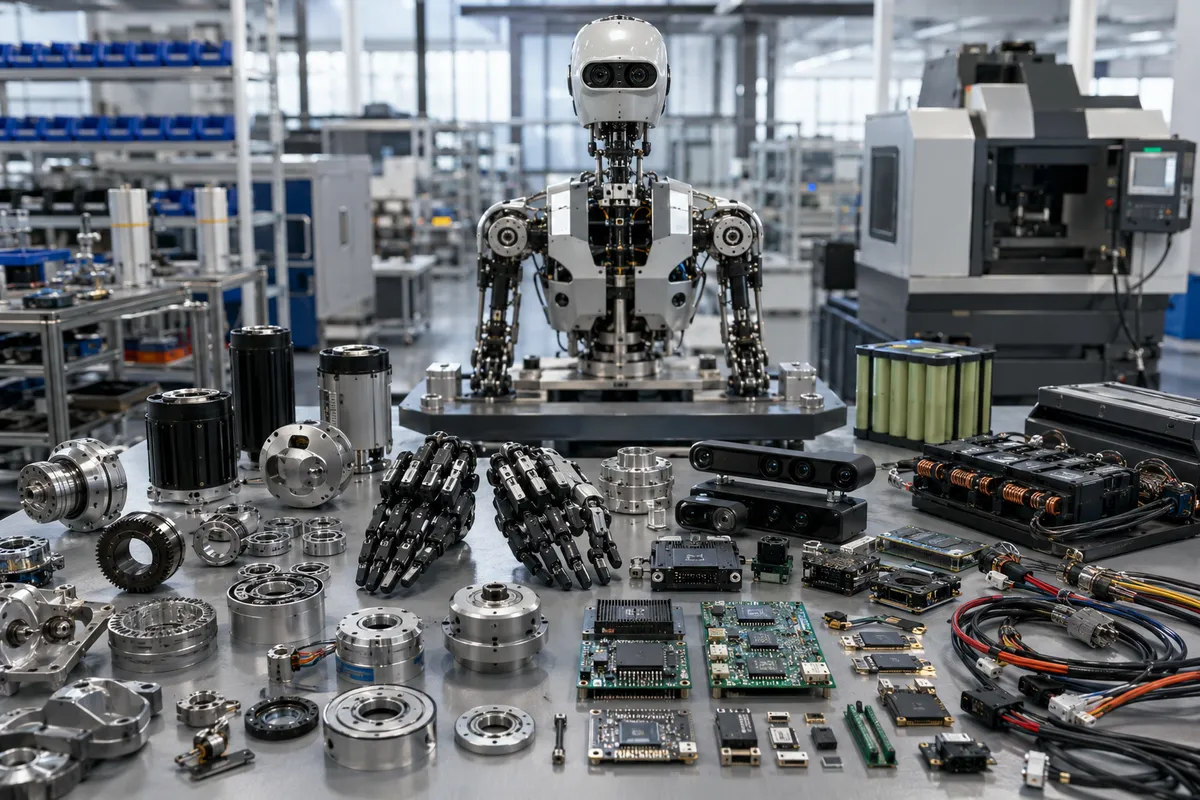
Humanoid robotics is usually framed as a race among companies building complete robots. Humanoid Analytics’ July 2026 market snapshot shows a broader competitive structure.
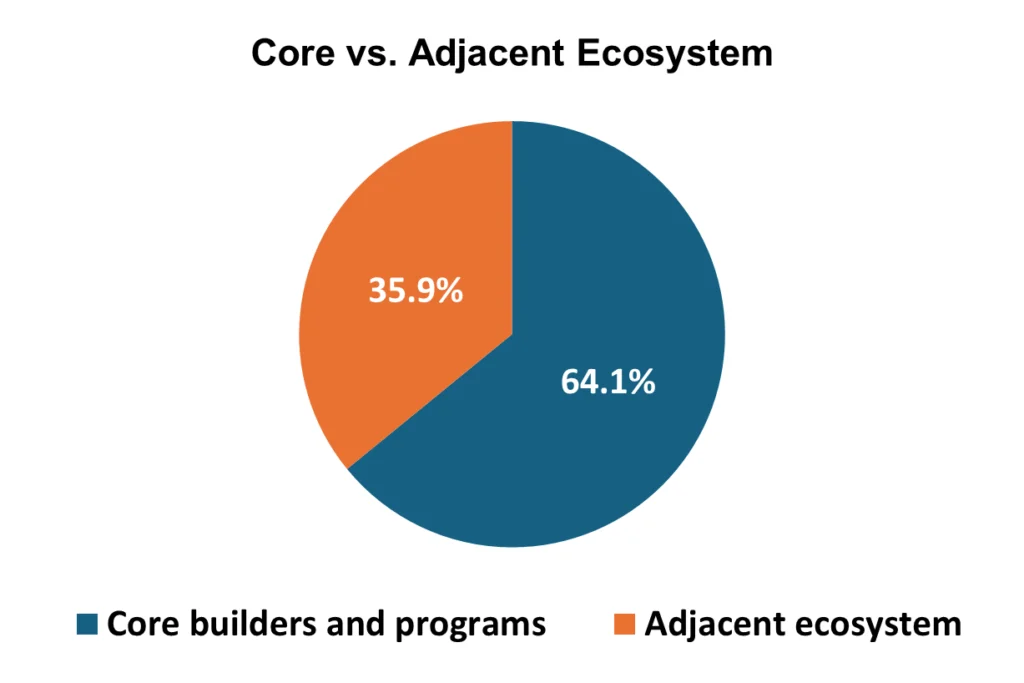
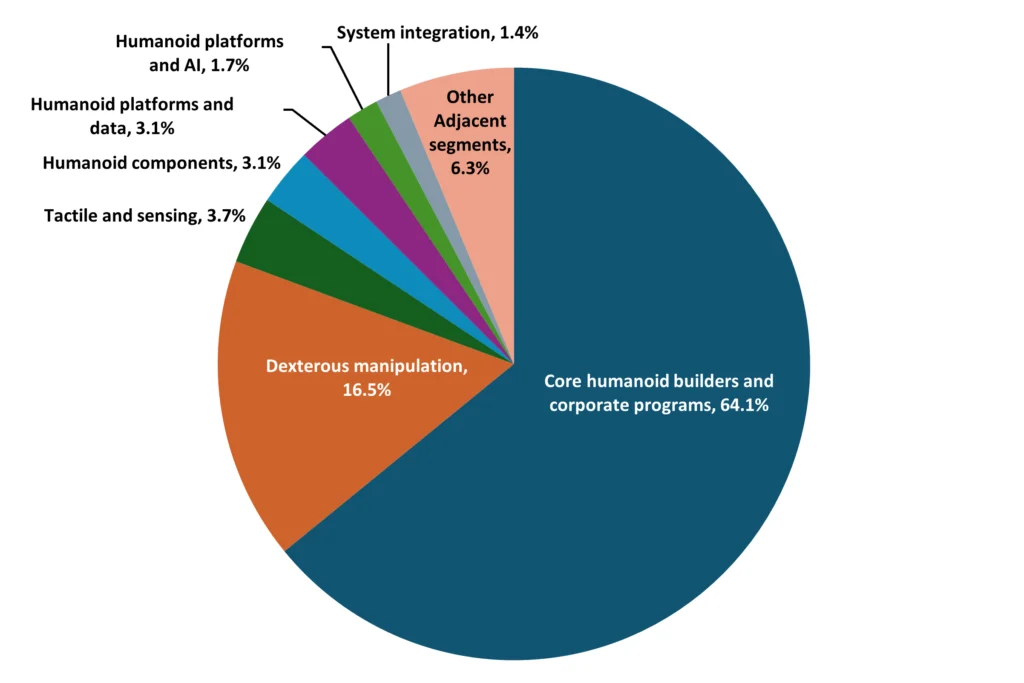
Of 351 tracked Core and Adjacent entities, 225 are core humanoid builders or substantial corporate programs. Another 126 sit in Adjacent segments including dexterous manipulation, sensing, components, AI, data infrastructure and system integration. Adjacent companies therefore represent 35.9% of the tracked Core and Adjacent universe.
That number is the useful finding. It is not market share. It does not measure revenue, adoption, maturity, technical quality or market value. It shows that more than one-third of the tracked ecosystem is attempting to participate in humanoid robotics without building the complete robot.
For strategy teams, that changes the question. The market is not only about which robot brand wins. It is also about which technologies can be sold across several competing robot platforms, and whether those suppliers can turn technical participation into repeat commercial business.
A Global Ecosystem, but Not a Market-Share Chart
The Adjacent group is unevenly distributed.
Dexterous manipulation is the largest identified Adjacent segment, with 58 entities. That is 16.5% of the complete 351-entity universe and about 46% of the Adjacent group. Tactile and sensing accounts for 13 entities, humanoid components and platforms and data contain 11 each, platforms and AI six, system integration five, and other Adjacent segments 22.
The geographic distribution adds another useful constraint to the “global” description. Of the 351 Core and Adjacent entities in the July snapshot, 251 were based in Asia. China alone accounted for 215. North America contained 55 and Europe 38. These are tracker counts, not measures of regional leadership, production output or customer adoption.
Other research maps the value chain differently but reaches a similar structural conclusion. Morgan Stanley’s Humanoid 100 separates public companies into layers including the robot “Brain,” “Body” and Integrators, with categories ranging from foundational models and semiconductors to sensors, motors, gears, batteries and actuators. Its universe and methodology differ from Humanoid Analytics, so the datasets should not be combined. The relevant corroboration is narrower: both approaches find economically relevant participants well beyond complete-robot manufacturers.
The harder issue is whether being in an important layer translates into bargaining power.
A category can contain many companies because a technical problem is difficult, because architectures remain unsettled, or because entry is crowded before production volumes materialize. The 58-company manipulation segment, for example, can support a bottleneck interpretation and a fragmentation interpretation at the same time.
Entity density alone cannot resolve which one is correct.
Schaeffler Makes the Cross-OEM Thesis Concrete
Schaeffler provides a more tangible example of what the shared-layer thesis could look like.
McKinsey highlighted three humanoid actuator partnerships signed by the industrial supplier within roughly five months, involving NEURA Robotics, UK-based Humanoid and China’s Leju Robotics. The same analysis estimates that actuators can represent roughly 40% to 60% of a humanoid robot’s bill of materials. That estimate is not operating data from Humanoid Analytics, but it helps explain why a repeat cross-OEM position in actuation could become commercially significant.
The relationships are more specific than simple ecosystem logos.
Reuters reported in November 2025 that Schaeffler and NEURA Robotics had agreed to jointly develop and supply key components for humanoid robots, while Schaeffler planned to integrate several thousand NEURA humanoids into its own production network by 2035.
In May 2026, Reuters reported a separate five-year actuator agreement between Schaeffler and Humanoid. Under the agreement, Schaeffler was to become the preferred supplier for more than half of Humanoid’s joint-actuator demand for its wheeled platforms through 2031. Humanoid CEO Artem Sokolov told Reuters that expected supply over the agreement could reach at least one million actuators. Those are forward-looking contract volumes, not evidence that one million actuators have been produced, delivered or installed.
This is much closer to the signal that matters than an ecosystem headcount. The same supplier is appearing across unrelated humanoid developers around a commercially important subsystem.
There is also an analytical complication.
Schaeffler is not acting only as a supplier. In both the NEURA and Humanoid relationships, it also plans to use the partners’ robots inside its own manufacturing network. That can create a useful industrial feedback loop: the supplier gains access to robot requirements and operating environments while the robot developer gains a prospective customer and industrial partner.
But it also means these are not yet clean examples of an independent component supplier repeatedly winning business solely because unrelated OEMs selected the same technology in open production programs.
That distinction is important.
Cross-OEM agreements establish stronger supplier positioning than a single prototype partnership. They still do not establish repeat shipment, recurring humanoid revenue, field reliability or long-term design lock-in.
The Signal to Watch Is Qualification, Not Participation
The commercial test for the Adjacent ecosystem can therefore be stated more simply.
The next meaningful signal is not another partnership announcement. It is the same component, platform or service being qualified by unrelated OEMs, ordered repeatedly, installed in robots that reach customers, and retained as those robot designs move from prototypes toward production.
For suppliers, that would show that a technology is becoming reusable infrastructure rather than project-specific engineering.
For OEMs, the same evidence would reveal which parts of the stack are becoming easier to source and which remain strategically important to control internally.
For investors, it would help distinguish nominal exposure to humanoid robotics from revenue that is genuinely diversified across several robot programs.
The opposite evidence matters too. OEM insourcing, supplier replacement after prototype stages, incompatible interfaces, cancelled programs or designs that change substantially before production would weaken the shared-layer thesis.
This is why the 35.9% figure should be treated as a map, not a valuation argument.
Humanoid Analytics can already verify that a substantial global Adjacent ecosystem exists around complete-robot builders. Independent value-chain research supports the idea that components, compute, sensing and integration are commercially important layers. Schaeffler’s relationships show that cross-OEM supplier positioning is moving beyond theory into identifiable agreements.
What public evidence does not yet establish is which of those positions will survive production qualification and generate durable economics.
That is the more consequential market signal.
The companies that ultimately capture substantial value from humanoid robotics may not all sell a complete humanoid under their own brand. Some may supply the motion, sensing, intelligence or deployment infrastructure used across competing machines.
The evidence threshold should be higher than appearing in the ecosystem.
It should be repeat qualification, repeat orders and repeat use.
Sources:
- Humanoid Analytics, “The Hidden Humanoid Robotics Market”
Source type: Tier 3, detailed first-party disclosure, Humanoid Analytics research
https://humanoidanalytics.com/2026/07/17/the-hidden-humanoid-robotics-market/ - Humanoid Analytics, “Humanoid Company Tracker”
Source type: Tier 3, detailed first-party disclosure, Humanoid Analytics tracker
https://humanoidanalytics.com/humanoid-company-tracker/ - Morgan Stanley Research, “The Humanoid 100: Mapping the Humanoid Robot Value Chain”
Source type: Tier 2, strong independent evidence
https://advisor.morganstanley.com/john.howard/documents/field/j/jo/john-howard/The_Humanoid_100_-_Mapping_the_Humanoid_Robot_Value_Chain.pdf - McKinsey & Company, “Turning Humanoid Supply Chain Constraints Into Billion-Dollar Wins”
Source type: Tier 2, strong independent evidence
https://www.mckinsey.com/industries/industrials/our-insights/turning-humanoid-supply-chain-constraints-into-billion-dollar-wins - Reuters, “Schaeffler Partners With Neura Robotics to Develop and Supply Humanoids”
Source type: Tier 2, strong independent evidence
https://www.reuters.com/world/china/schaeffler-partners-with-neura-robotics-develop-supply-humanoids-2025-11-04/ - Reuters, “Humanoid to Deploy Up to 2,000 Robots at Schaeffler Plants”
Source type: Tier 2, strong independent evidence
https://www.reuters.com/business/humanoid-deploy-up-2000-robots-schaeffler-plants-2026-05-13/