
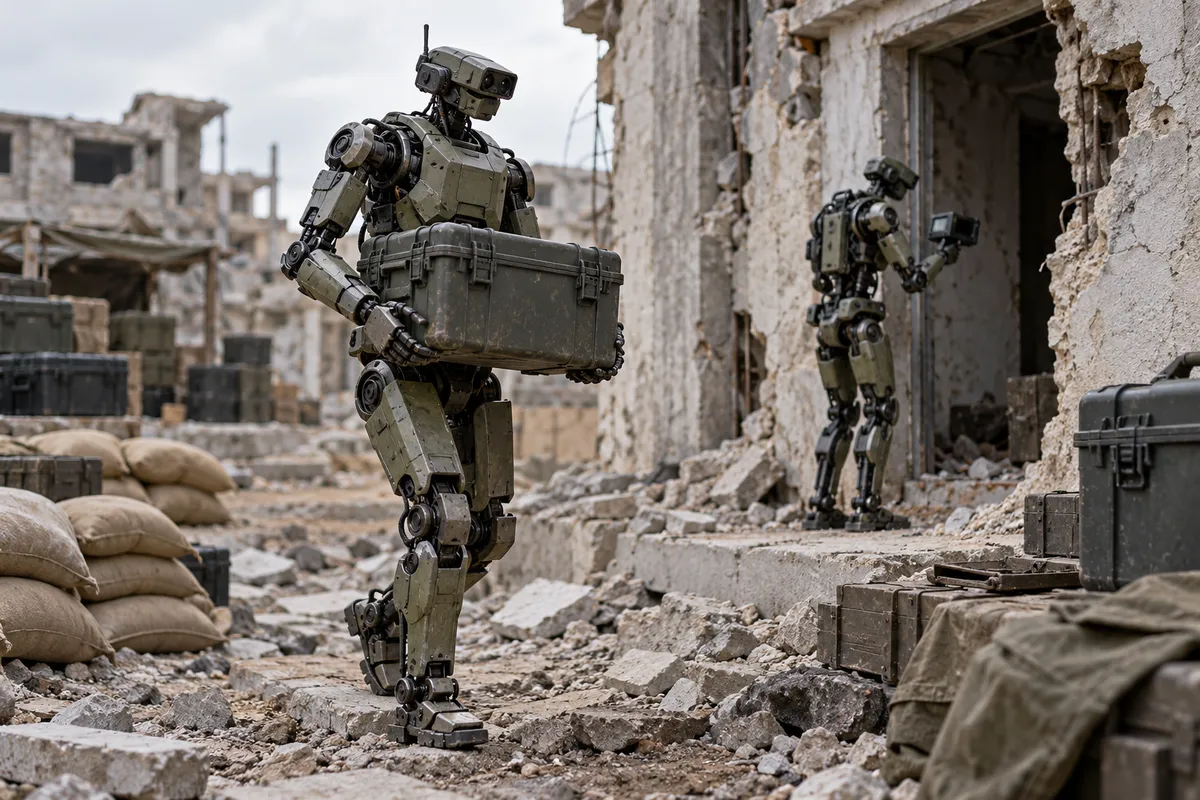
Military trials are opening a new market, but the strongest early case rests on dangerous support work, human oversight and measurable results.
The first humanoid to earn a lasting place on the battlefield may spend its day moving supplies, inspecting damaged infrastructure or handling equipment where sending a person carries serious risk.
That is the most plausible near-term opportunity suggested by the evidence available today. It could also become a meaningful business before humanoids are capable of replacing soldiers across complex combat roles.
Military interest is becoming concrete. The U.S. Army selected five xTechHumanoid winners on September 11, 2026, following demonstrations at Quantico. Its September 30 report identifies IHMC’s Alex robot alongside suppliers of power, sensing and control technology. This was an evaluation milestone, with battlefield effectiveness still to be established.
For investors, the distinction matters. Military interest can create opportunities for research and trials. A durable market requires useful work, supportable machines and customers who come back for more.
Foundation Future Industries offers a more direct battlefield claim. In a July interview with Euronews, CEO Sankaet Pathak said its Phantom robots had been tested in Ukraine for material handling and reconnaissance. He also described possible weapons testing in 2027.
Those are attributable company statements. The reviewed account does not establish named-unit confirmation, intervention frequency or independently verified sustained performance. A reported trial leaves substantial distance to routine operational use.
The demand for robots that reduce soldiers’ exposure is already visible. Ukraine’s Ministry of Defence reported 25,143 logistics and evacuation missions by unmanned ground vehicles in August 2026, drawing on its DELTA system. These figures cover ground vehicles generally. They do not measure humanoid adoption.
That distinction creates the central commercial challenge: humanoids must compete for jobs that other machines can already perform.
A human-shaped body needs to earn its extra complexity. Its strongest potential advantage is compatibility with places and equipment built for people. IHMC describes Alex’s development around indoor structures, stairs, ladders and debris, with the goal of extending human presence into dangerous settings. These are development objectives, not proof of reliable performance across all those conditions.
The commercial implication is straightforward. A humanoid could be useful where mobility and manipulation must work together, such as reaching a location and then handling ordinary equipment. Where a simpler ground robot can complete the same job reliably, the humanoid has a harder sale.
Human assistance will be part of that calculation. The Army describes Alex as combining AI with human control. A remotely supervised robot can still be valuable if it reduces a person’s exposure to danger. But buyers need to know how much supervision, recovery and maintenance each useful hour requires.
Cost should therefore include the whole service: the machine, operators, batteries, spare parts, repairs and transport. A low purchase price means little if keeping the robot working creates a large support burden.
Our forecast for 2027 and 2028 is an expansion of small, supervised military humanoid trials, with support work offering the clearest path to practical value. Equipment handling, inspection and work in hazardous facilities are plausible starting points. This is an analytical forecast based on the trials and development priorities above, not an announced procurement schedule.
The reason is that a narrowly defined task gives a buyer something measurable to test. Buyers can assess repeatability, reductions in human exposure and intervention frequency. Progress on those measures would make a follow-on order more credible.
For 2029 and 2030, selective repeat deployments become a plausible next step if durability, endurance and support costs improve. The strongest candidates would be tasks where access to human-built environments produces a clear advantage. Broad replacement of infantry remains a much less supported forecast.
Suppliers could benefit along the way. Power systems, sensing, actuators and supervision software may find demand across several robot platforms. That is a possible route to revenue, but participation in a military evaluation does not establish a profitable product or a production contract.
An alternative outcome is that humanoid trials increase while recurring orders remain scarce. Militaries may value experimentation and still choose other robot designs for most operational jobs. Research demand and deployment demand can develop at very different speeds.
Combat autonomy adds a separate barrier. A machine that can navigate a building has not thereby demonstrated the judgment required to use force lawfully. The International Committee of the Red Cross distinguishes autonomy in movement from autonomy in selecting and attacking targets. It says existing international humanitarian law applies, while calling for new prohibitions and restrictions on autonomous weapons. Those proposed rules should not be confused with an already adopted blanket ban.
That makes responsible human control, civilian protection and accountability central to any armed application. Improving balance or battery life cannot resolve those questions by itself.
The assessment would strengthen with customer-confirmed results from repeated use: completed tasks, operating hours, failures, human interventions, maintenance effort and evidence of reduced exposure. Paid renewals or follow-on orders would then show whether a successful experiment had become something a military actually wanted to keep using.
Some results may remain confidential. Their absence from public reporting does not prove failure, but it limits what outside observers can responsibly conclude.
The milestone to watch is a military unit finding a humanoid useful enough to depend on, support and order again. That would give the battlefield story something far more valuable than an impressive demonstration: evidence of a lasting role.
Sources:
- U.S. Army, “Robotics competition winners advance military exploration of humanoid capabilities”Source type: Tier 1, direct or official evidence. Official confirmation of the competition and evaluations, not evidence of sustained battlefield operation.Publication date: September 30, 2026. Competition selection date: September 11, 2026. https://www.army.mil/article/295812/
- Euronews, “When could humanoid robots go to war? Sooner than you think, says firm testing them in Ukraine”Source type: Tier 2, strong independent evidence for the attributed interview. Foundation’s trial descriptions and forecasts remain Tier 3, detailed first-party disclosure, rather than independent confirmation of operating effectiveness. The publisher is independent; the company controls the underlying claims.Published July 16, 2026; updated July 21, 2026. The cited report does not specify the trial dates. The 2027 weapons-testing timeline is a company expectation. https://www.euronews.com/2026/07/16/when-could-humanoid-robots-go-to-war-sooner-than-you-think-says-firm-testing-them-in-ukrai
- Ministry of Defence of Ukraine, “Robots at work: Defence Forces of Ukraine more than triple their use of UGVs”Source type: Tier 1, direct or official evidence. Official operating-organization disclosure based on DELTA records; the figures were not independently audited for this article and do not isolate humanoids.Publication date: September 7, 2026. Measurement period cited: August 2026. https://mod.gov.ua/en/news/robots-at-work-defence-forces-of-ukraine-more-than-triple-their-use-of-ug-vs
- IHMC Robotics, “Humanoid Robot Design”Source type: Tier 3, detailed first-party disclosure. Developer-controlled description of Alex’s research objectives, not independent deployment validation.Publication date: Not disclosed on the reviewed page. Reviewed October 30, 2026. https://robots.ihmc.us/humanoid-design
- International Committee of the Red Cross, “Frequently asked questions: Autonomous weapon systems”Source type: Tier 1, direct or official evidence for the ICRC’s institutional position and legal explanation. Its calls for additional rules are policy recommendations, not evidence that those rules have been adopted.Publication date: October 8, 2026. https://www.icrc.org/en/article/faq-autonomous-weapon-systems
Related reading: Five Segments Define the Humanoid Robot Market Opportunity.