
Research position paper. Author: Rinat Mirzaitov.
Abstract
This paper argues that artificial general intelligence cannot be achieved without general-purpose physical AI. The claim concerns an integrated system’s capacity to learn and perform physical tasks, rather than a requirement for a humanoid body or a particular training architecture. It also proposes that humanoid robots could become the primary interface for this intelligence in environments built for people. If general intelligence includes adapting to the environments in which human goals arise, it must cover physical interaction as well as digital reasoning. A system that cannot connect its plans to perception, action and corrective feedback leaves a major class of problems outside its competence. Drawing on research into grounding, world models and robot generalization, the paper develops a necessity argument and proposes evidence that would test the resulting capability requirement. Current studies demonstrate progress in components of physical generality, but do not establish complete AGI. The argument is conditional on a conception of generality that includes adaptive physical agency. Cognition-only definitions use a narrower scope and therefore reach a different conclusion. General-purpose physical AI is defended here as necessary, but not sufficient, for AGI.
Introduction
Artificial general intelligence should be able to connect knowledge with effective action across unfamiliar problems. Human goals routinely involve physical objects, changing environments and consequences that cannot be resolved through a digital answer alone. This paper argues that excluding those problems creates an incomplete account of generality.
The central thesis is that AGI is impossible without general-purpose physical AI. An intelligent system must be capable of learning and performing a broad range of physical tasks, using suitable interfaces and feedback. It need not possess a human-shaped body, master every profession or perform every movement itself. It must, however, be able to adapt when a physical goal exceeds the routines already supplied to it.
The paper advances a second hypothesis: humanoids could become the primary physical interface for general-purpose AI in spaces designed for people. This is a prediction about embodiment and adoption, distinct from the necessity argument about physical competence.
This position differs from the Levels of AGI framework proposed by Morris and colleagues, which concentrates on cognitive and metacognitive tasks and does not require physical capability. Their framework acknowledges that embodiment could contribute knowledge needed for some cognitive tasks, while treating physical competence as an extension of generality. [1]
The disagreement concerns what an AGI claim should cover. This paper defends a broader scope because an agent’s ability to reason about a goal and its ability to pursue that goal should be evaluated together. It develops a conceptual argument supported by selected research. It reports no new experiments and is not a systematic review.
Working definitions and system boundaries
AGI is used here to mean a system capable of learning, reasoning and adapting across a broad range of cognitive and physical problems, with competence assessed against appropriately trained humans using comparable tools and learning opportunities. Generality requires transfer beyond a fixed catalogue of tasks. It does not require unlimited knowledge or universal success.
General-purpose physical AI means the capacity to perceive relevant physical conditions, acquire and combine skills, execute actions through suitable equipment, and use feedback to correct performance across unfamiliar tasks and environments. A collection of unrelated scripts does not meet this requirement simply because its catalogue is large.
The unit of assessment is the integrated system. A reasoning model connected to robot controllers, sensors and laboratory equipment may satisfy the physical requirement through those components. If so, physical AI is part of the assessed system. An isolated model cannot claim the full capabilities of equipment it cannot reliably direct or monitor.
A human operator may provide instructions, demonstrations or assistance, provided that contribution is disclosed. When the operator repeatedly interprets the scene, chooses the next action or repairs the plan, the evaluation must distinguish the operator’s competence from the AI’s. The same principle applies when comparing humans who use tools or assistance. The requirement concerns adaptive agency, not anatomy or unaided motor performance.
The necessity argument
The argument rests on three premises.
Premise 1. A claim to general adaptive agency must include substantial classes of problems found in the environments where that agency is expected to operate. Physical problems cannot be excluded solely because they require interaction with matter.
Premise 2. Solving unfamiliar physical problems requires more than selecting a verbal description of a successful action. The system must connect its decisions to observations, act through an available interface, assess the resulting state and revise its behavior when necessary.
Premise 3. A system that can acquire and transfer those abilities across a broad range of tasks possesses general-purpose physical AI, as defined in Section 2.
It follows that an AGI meeting this account of general adaptive agency must include general-purpose physical AI. Physical competence alone is insufficient: a broadly capable robot could still lack the reasoning, communication or learning abilities needed for AGI.
This is a necessity argument under an explicit scope of generality. It is not an experimentally established impossibility theorem for every competing definition of AGI. Its substantive premise is that physical agency belongs inside the scope. The reason for that inclusion is practical: goals such as preparing a meal, investigating a material failure or conducting an experiment require decisions to remain effective as physical conditions change.
Consider a system asked to make coffee in an unfamiliar kitchen. A correct plan leaves unresolved whether the cup is stable, the container is empty, the lid is stuck or the appliance differs from its description. Effective performance requires the system to discover relevant conditions and adapt its actions. If a person must resolve every such uncertainty, that person supplies a material part of the general intelligence being evaluated.
Research evidence and its limits
Grounding provides a conceptual starting point. Harnad’s symbol grounding problem asks how a system’s symbols acquire a connection to what they represent, rather than depending entirely on a human interpreter. His proposed approach links symbolic functions with nonsymbolic sensory representations. [2] This supports examining the relationship between descriptions and environmental competence, but it does not prove that modern neural models require a particular body or learning history.
Evidence about world models also cautions against equating prediction with transferable understanding. Vafa and colleagues found that foundation models could perform well on their training tasks while failing to acquire inductive biases that supported new tasks generated from the same underlying world model. In their physics experiments, models trained on orbital trajectories failed to apply Newtonian mechanics when adapted to new physics tasks. [3]
IntPhys 2 provides another bounded result. The 2025 benchmark tested models’ ability to distinguish physically possible and impossible events in synthetic videos. The researchers reported that most evaluated models performed near chance across its challenging physical principles, while humans performed near perfectly. [4] This concerns the models and conditions tested, not every model available today or a permanent limit on neural learning.
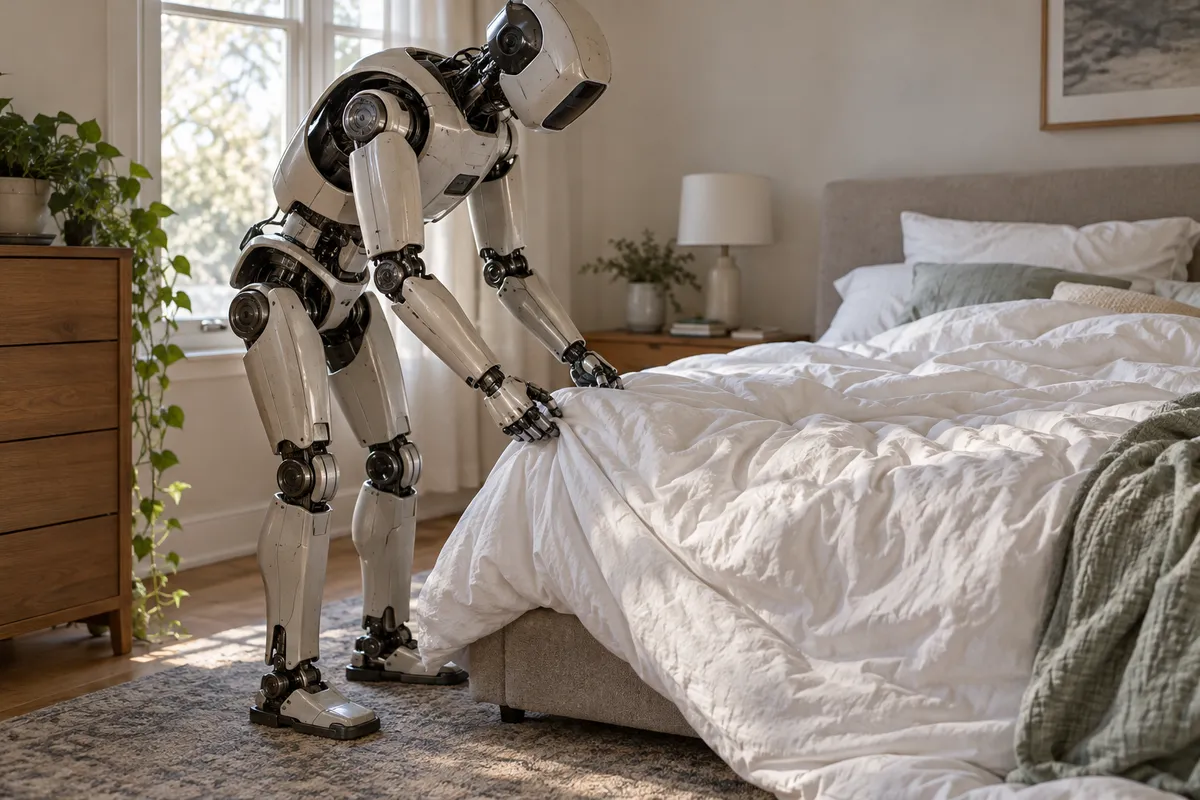
Robotics studies show progress toward the missing capabilities. Figure reported that Helix 2.5 achieved 56% full-task success on tidying, towel folding and bed making across 30 unfamiliar homes, compared with 9% without Index pretraining. The behaviors had been trained elsewhere; the unfamiliar elements were the evaluation homes and manipulated objects. One fixed checkpoint per task was used across homes, and safety interventions caused trials to fail. [5]
Generalist reported that GEN-1.5 achieved 59% average success across ten simple, short tasks with a single demonstration, rising to 83% with additional demonstrations and fine-tuning. [6] These developer-reported results concern different forms of transfer and cannot be combined into a common ranking. They show components of physical generality without establishing broad autonomous competence or dependable commercial service.
Collectively, the studies motivate the proposed requirement: evaluate whether knowledge transfers into effective physical behavior. They do not independently prove the necessity thesis. That thesis depends on the account of generality defended in Section 3.
Learning routes and counterarguments
A physical capability requirement does not mean that every system must learn through its own movements. Recorded human activity, other robots’ trajectories, simulation and language may contribute useful knowledge. What matters is whether the resulting integrated system can use that knowledge effectively.
Meta’s V-JEPA 2 research illustrates a route based heavily on observation. The researchers pretrained on more than one million hours of internet video, then used fewer than 62 hours of robot video to develop an action-conditioned model. They reported pick-and-place planning on robot arms in two laboratories without collecting training data in those evaluation environments. [7] These were limited tasks, but the result challenges any claim that all physical knowledge must arise from a learner’s own embodiment.
Physical Intelligence’s π0.5 research similarly combined robot action data with language, images and other sources. Its experiments found that removing web data impaired generalization to unfamiliar object categories, while data from other robots contributed across evaluation conditions. [8] Grounded competence can therefore be investigated through mixtures of information rather than a strict division between language and physical experience.
The strongest counterargument is that cognition alone may deserve the name AGI. A system could perform sophisticated research and digital work while lacking physical control. That would be a consequential achievement. Under a cognition-only definition, its physical limitations would not disqualify it. This paper disputes the completeness of that definition; it does not suggest that the terminology is already settled.
A second objection is that a sufficiently capable digital intelligence could design robots later. That possibility concerns development order. Designing hardware would not itself demonstrate an integrated ability to use it. If the resulting system can learn, control and evaluate physical activity, it has acquired the capability required by this thesis.
Nor does the argument rule out transformers or language-centered architectures. A model trained primarily on text might eventually develop the physical competence described here. If it did, that would challenge claims about necessary training methods, while satisfying the physical capability requirement. Present limitations cannot establish architectural impossibility.
Humanoids as the primary physical interface
Humanoid robots could become the primary interface for general-purpose physical AI in environments built for people. Here, primary interface means a common platform for varied work in those environments. It does not imply that humanoids will outnumber every other form of robot or that AGI requires human anatomy.
The rationale is compatibility. Human-scale reach, coordinated arms and mobility could allow one platform to work across existing tools, shelves and workstations with fewer changes to the site. Boston Dynamics describes Atlas as designed to use the same workstations and equipment as human staff. [9] Apptronik similarly positions Apollo for environments built for people and describes both bipedal and wheeled mobility options. [10] These statements establish manufacturers’ design intentions, rather than comparative proof of superiority.
The hypothesis is most relevant where tasks vary and rebuilding the environment would be difficult. It is less persuasive where a fixed arm or wheeled manipulator can perform the required work with lower cost, complexity or risk. Physical AI can operate through all of these forms; the humanoid’s proposed advantage is combining a broad range of actions within an interface compatible with human surroundings.
Evidence for a primary role would require repeated customer use across different task families and comparisons that include site modification, human support, maintenance and accepted output. If simpler bodies deliver equivalent breadth at lower total cost, the hypothesis would weaken. Humanoid prominence is therefore a testable expectation about how physical intelligence may be deployed, while general-purpose physical competence remains the paper’s proposed requirement for AGI.
Proposed evaluation requirements
Physical generality should be assessed through tests that separate preparation, adaptation and independent performance. This section proposes evaluation requirements; it does not present a validated benchmark or a new scoring system.
Before testing, evaluators should specify the task families, environments, learning budget, permitted tools and success criteria. Training exposure must be documented. Tests of familiar tasks in new settings should be reported separately from tests of unfamiliar skills. Human comparison groups should receive comparable equipment and opportunities to learn.
| Capability | Evidence required | Important control |
|---|---|---|
| Task breadth | Learning and completing unfamiliar tasks across several families | Separate newly acquired skills from trained routines |
| Environment transfer | Performance with unfamiliar layouts, objects and materials | Audit training exposure and on-site preparation |
| Feedback and recovery | Detecting errors and changing behavior to complete the goal | Count resets, interventions and repeated failures |
| Sustained performance | Complete task outcomes over repeated, extended operation | Publish trial counts, durations and uncertainty |
| Appropriate assistance | Seeking help or refusing unsafe actions when warranted | Report assistance and refusals separately from independent completion |
No single demonstration can establish this breadth. Independent evaluation should report performance per task, failure causes and the proportion of work completed with assistance. A frozen-system test can assess transfer; a separate adaptation test can assess learning under a disclosed budget. Combining those conditions into one headline rate would conceal an important difference.
Testing the interface hypothesis additionally requires comparisons between humanoids and alternative bodies on the same customer tasks. Evaluators should include the cost of adapting the site and the work each form can cover, rather than treating resemblance to a person as evidence of generality.
Conclusion
This paper defends general-purpose physical AI as a necessary condition for AGI. A system cannot claim the full generality of adaptive agency while excluding the physical situations in which many goals must be pursued. It must be able to connect knowledge with perception, action and correction across unfamiliar tasks.
The requirement leaves the architecture, training route and body design open. It also leaves room for powerful digital systems that precede complete physical competence. Under the account of AGI advanced here, however, those systems remain incomplete until they acquire general-purpose physical AI.
Humanoids could provide the primary physical interface for that intelligence in environments designed for people. Their eventual role must be established through task breadth, operating reliability and comparative economics, rather than inferred from human-like form alone.
Sources
- Morris, M. R., and colleagues. “Levels of AGI for Operationalizing Progress on the Path to AGI.” ICML, 2024. Reviewed arXiv version 5, revised 24 September 2025. Source type: Tier 3, detailed technical position paper by Google DeepMind researchers; company-affiliated. https://arxiv.org/abs/2311.02462
- Harnad, S. “The Symbol Grounding Problem.” Physica D, 42, 335-346, 1990. Source type: Tier 2, peer-reviewed academic conceptual research; author’s full-text copy. https://www.southampton.ac.uk/~harnad/Papers/Harnad/harnad90.sgproblem.html
- Vafa, K., Chang, P. G., Rambachan, A., and Mullainathan, S. “What Has a Foundation Model Found? Using Inductive Bias to Probe for World Models.” Proceedings of the 42nd International Conference on Machine Learning, PMLR 267, 60727-60747, 2025. Source type: Tier 2, peer-reviewed academic research; official conference proceedings. https://proceedings.mlr.press/v267/vafa25a.html
- Bordes, F., Garrido, Q., Kao, J. T., Williams, A., Rabbat, M., and Dupoux, E. “IntPhys 2: Benchmarking Intuitive Physics Understanding In Complex Synthetic Environments.” arXiv:2506.09849, 2025. Source type: Tier 3, company-affiliated technical research preprint, Meta-led. https://arxiv.org/abs/2506.09849
- Figure. “Helix 2.5: Zero-Shot 30-Home Generalization.” 17 September 2026. Source type: Tier 3, detailed first-party disclosure, company-controlled; evaluation outcomes are developer-reported. https://www.figure.ai/news/helix-2-5-zero-shot-30-home-generalization
- Generalist. “GEN-1.5: Embodied Foundation Models are One-Shot Learners.” 19 August 2026. Source type: Tier 3, detailed first-party disclosure, company-controlled; evaluation outcomes are developer-reported. https://generalistai.com/blog/gen-1.5
- Assran, M., and colleagues. “V-JEPA 2: Self-Supervised Video Models Enable Understanding, Prediction and Planning.” arXiv:2506.09985, 2025. Source type: Tier 3, company-affiliated technical research preprint, Meta-led. https://arxiv.org/abs/2506.09985
- Physical Intelligence. “π0.5: a VLA with Open-World Generalization.” 22 April 2025. Source type: Tier 3, detailed first-party technical disclosure, company-controlled. https://www.pi.website/blog/pi05
- Boston Dynamics. “Atlas.” Product page, accessed 2 November 2026. Source type: Tier 3, detailed first-party product disclosure, company-controlled; cited for design intentions, not independently verified operating performance. https://bostondynamics.com/products/atlas/
- Apptronik. “Robots for Humans.” Company homepage, accessed 2 November 2026. Source type: Tier 3, detailed first-party product disclosure, company-controlled; cited for intended environments and mobility options. https://apptronik.com/