
Evidence cutoff: 30 September 2026, following the supplied month-end rule. Research completed: 16 October 2026. [1]
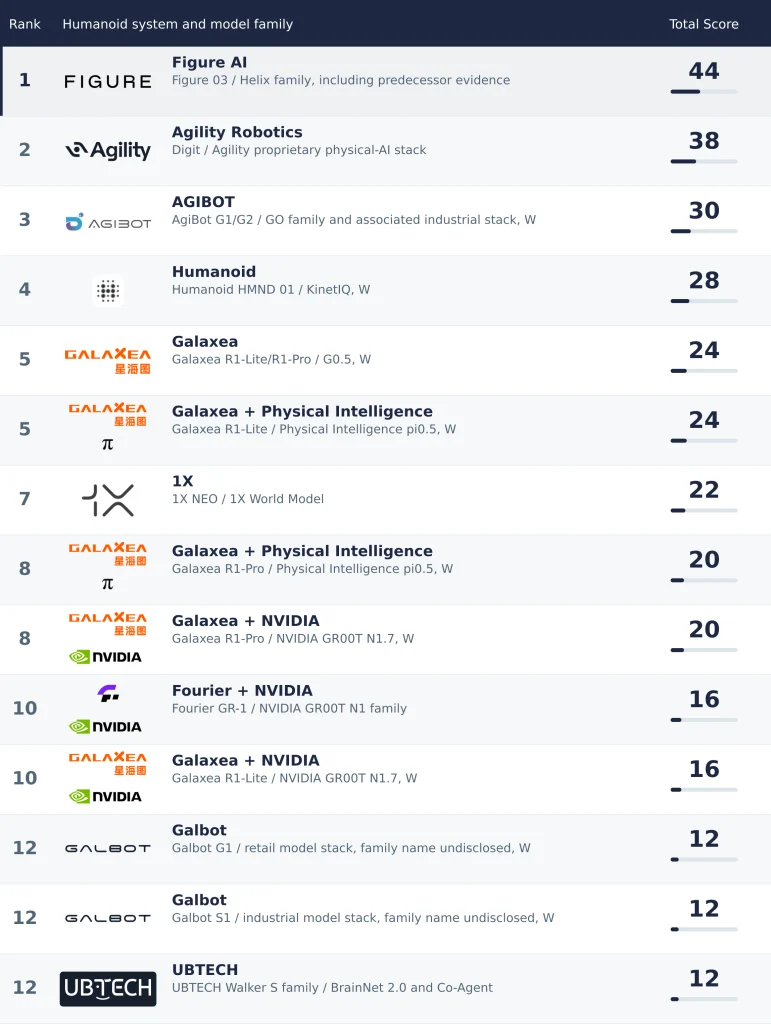
Figure leads this public-evidence comparison, while Agility’s Digit has the stronger commercial operating record. Those are different achievements. Figure’s advantage comes from measured work in unfamiliar homes. Digit’s comes from customer operations that have moved beyond an initial demonstration. Neither has published the combination of breadth, independence from human help, reliability and economics needed to establish general-purpose physical AI. [1,2,3,4]
Applying the supplied Humanoid Leaderboard methodology produces a leading score of 44 for Figure and 38 for Digit. These are calculations from the evidence below, not company ratings or percentages of human capability. Figure reaches the Contender band; Digit remains a Specialist. No entry reaches the methodology’s 60-point Frontrunner threshold. [1]
This is a researched baseline for the systems in the table, not an exhaustive census of every humanoid developer. It measures what has been publicly demonstrated under the specified rules. A low score, or exclusion, does not establish that a robot lacks undisclosed capabilities.
The cutoff follows the requirement to use the last day of a completed month. The evidence window runs from 1 October 2024 through 30 September 2026; deployment confirmation must fall within the final 12 months. October developments receive no points.
The leaderboard
Each pillar contributes up to 20 points. B is Breadth, T Transfer, A Autonomy, R Reliability and D Deployment. Average level is total divided by 20, rounded to one decimal place. W identifies a wheeled humanoid. All scores and bands below are this article’s calculations under the supplied method; the final column identifies the underlying evidence. [1]
| Rank | Humanoid system and model family | B | T | A | R | D | Total | Band | Confidence |
|---|---|---|---|---|---|---|---|---|---|
| 1 | Figure 03 / Helix family, including predecessor evidence | 8 | 14 | 8 | 8 | 6 | 44 | Contender | High |
| 2 | Digit / Agility proprietary physical-AI stack | 4 | 8 | 8 | 8 | 10 | 38 | Specialist | High |
| 3 | AgiBot G1/G2 / GO family and associated industrial stack, W | 8 | 4 | 8 | 4 | 6 | 30 | Specialist | High |
| 4 | Humanoid HMND 01 / KinetIQ, W | 4 | 8 | 6 | 4 | 6 | 28 | Specialist | High |
| 5 | Galaxea R1-Lite/R1-Pro / G0.5, W | 8 | 4 | 4 | 8 | 0 | 24 | Specialist | Low |
| 5 | Galaxea R1-Lite / Physical Intelligence pi0.5, W | 8 | 4 | 4 | 8 | 0 | 24 | Specialist | Low |
| 7 | 1X NEO / 1X World Model | 10 | 4 | 4 | 4 | 0 | 22 | Specialist | Low |
| 8 | Galaxea R1-Pro / Physical Intelligence pi0.5, W | 8 | 0 | 4 | 8 | 0 | 20 | Specialist | Low |
| 8 | Galaxea R1-Pro / NVIDIA GR00T N1.7, W | 8 | 0 | 4 | 8 | 0 | 20 | Specialist | Low |
| 10 | Fourier GR-1 / NVIDIA GR00T N1 family | 4 | 4 | 4 | 4 | 0 | 16 | Demonstrator | Low |
| 10 | Galaxea R1-Lite / NVIDIA GR00T N1.7, W | 4 | 0 | 4 | 8 | 0 | 16 | Demonstrator | Low |
| 12 | Galbot G1 / retail model stack, family name undisclosed, W | 0 | 4 | 2 | 0 | 6 | 12 | Demonstrator | High |
| 12 | Galbot S1 / industrial model stack, family name undisclosed, W | 0 | 4 | 2 | 0 | 6 | 12 | Demonstrator | High |
| 12 | UBTECH Walker S family / BrainNet 2.0 and Co-Agent | 0 | 4 | 2 | 0 | 6 | 12 | Demonstrator | High |
Equal totals share ranks. Ties are ordered by Transfer, then Autonomy, then confidence; otherwise their order has no significance. Every entry has a deduction of 0, because no qualifying open incident was established for that scored pairing in the reviewed evidence. Every monthly change is Not Applicable: no prior scored baseline was supplied. There are consequently no defensible “biggest movers” to report. Entry-specific records appear below. [1]
High confidence means at least half the awarded points rest on customer, official or strong independent evidence, with no major unresolved disagreement. It does not mean high performance. Galbot and UBTECH illustrate why confidence and score must remain separate. [1]
Figure’s transfer lead, Digit’s operating lead
Figure’s September home evaluation is the clearest qualifying transfer evidence in this cohort. Its chart reports 87 successful towel-folding trials out of 140, 56 toy-tidying successes out of 140 and 94 bed-making successes out of 140, across 30 previously unseen homes. Together, those counts produce 237 successes in 420 attempts, approximately 56%. The results are company-reported, not independently audited. [2]
That is substantial progress beyond a rehearsed room. It also remains well below dependable household work. Figure froze a checkpoint for each task; the disclosure does not establish that one instruction-conditioned checkpoint performed the entire task set. The home result therefore supports transfer more strongly than broad, interchangeable skills. [2]
Figure also benefits from permitted predecessor evidence. BMW confirms that Figure 02 supported production of more than 30,000 vehicles, moved over 90,000 components and accumulated approximately 1,250 operating hours during its completed factory pilot. Figure says those robots were subsequently retired and returned. This supports sustained-work evidence, but it must not be presented as a current Figure 03 deployment or proof of paid renewal. [3,5]
Digit presents the reverse pattern. Agility’s SEC-filed presentation reports 65,000 operating hours in its commercial-deployment discussion, without a site-by-site breakdown; its GXO account reports more than 100,000 tote movements. The filing also includes committed future deployments. Those commitments are excluded from the operating-site count. A filed management claim is not an independent performance audit. [4,6]
Schaeffler confirms actual use of Digit in its plants. Reporting on the Cheraw installation describes eight-hour working days with a human contractor watching the robot. Supervision is compatible with useful autonomy, but a person watching continuously is neither proof of frequent intervention nor proof of independence from human assistance. The missing number is how often that person acts. [7,8]
Digit’s contracted future robots and factory capacity add nothing to its score. Its narrowly defined work can be commercially valuable without proving generality. That distinction matters to buyers comparing a dependable material-handling installation with a research system capable of more varied but less reliable behavior. [1,4]
Factory progress and research progress need different evidence
Longcheer provides unusually useful customer evidence for AgiBot. It identifies the G2 robots and reports sustained production-line operation, while explaining that people handle inspection, coordination and exceptions. AgiBot separately reports 64,828 production-line tasks and 99.99% task success. Those figures do not establish autonomous whole-workflow acceptance: the published record does not adequately separate step completion, human-assisted recovery and final accepted output. [9,10]
Humanoid also has direct customer confirmation. Siemens reports 60 tote moves per hour, uptime exceeding eight hours and autonomous pick-and-place success above 90%. But uptime is availability, not necessarily time spent executing autonomous work. The more detailed vendor account documents continuous autonomous operation exceeding 30 minutes. The lower Autonomy score preserves that distinction; the success percentage lacks the trial denominator required for a higher Reliability award. [13,14]
The research entries show why a robot’s body and model must be named together. Galaxea tested its own model alongside Physical Intelligence and NVIDIA models on specified humanoids, reporting 15 episodes for each task and embodiment setting. Those pairings qualify, but Galaxea has a commercial stake in the comparison, so the report is company evidence rather than independent validation. A foundation-model brand receives no company-wide score. [15]
Likewise, 1X’s World Model earns credit for real NEO tests with 30 attempts per task, including unseen-object and task conditions. Generated videos alone earn nothing. The research supports learned physical skills, not independently confirmed customer delivery, full-shift autonomy or household economics. [16]
What the scores leave out
Some prominent names remain unranked in this baseline. Tesla’s reviewed update describes Optimus manufacturing preparation and training-data collection. Boston Dynamics describes Atlas training at Hyundai’s application center. Neither disclosure supplies the qualifying autonomous work evidence needed here. DeepMind publishes Apollo performance charts, but the reviewed reports do not provide the necessary physical-trial denominators. Sanctuary’s cited industrial performance belongs to conventional industrial arms, not Phoenix. Unitree’s task catalogue lacks qualifying evaluation counts, while X Square’s reviewed results do not establish a named qualifying humanoid pairing. These are evidence gaps, not capability verdicts. [22,23,24,25,26,27,28]
For the leading entries, the most valuable next disclosures concern human help and commercial acceptance. Figure and Digit need measured intervention rates. AgiBot needs confirmation of payment for the documented expanded customer operation. Humanoid needs operating-time and intervention records covering a full shift. The laboratory leaders need customer-confirmed paid work with operating output. The entry ledger states the corresponding score effects and unresolved gates. [1]
The investor implication is that impressive capability, recurring customer demand and economical accepted work are separate diligence questions. None should be inferred from the others. Under this methodology, the finish line requires a frozen system, broad task coverage, previously unseen customer settings and independent confirmation of quality, safety and cost. No reviewed system has supplied that audit. [1]
Figure is closest in this selected public-evidence comparison. Digit has the more developed commercial operating case. A future leader must combine both kinds of proof, then show that the human work needed to keep the robot productive is falling.
Scoring record
This appendix is part of the article’s evidence record. Levels, point arithmetic, bands, confidence and prospective point changes are analytical calculations under source [1], rather than vendor-supplied numbers.
Rules applied consistently
- A full level requires every lower gate. Partial credit is a single 2-point addition for a satisfied condition of the immediately following level, or the specified embodiment-transfer condition. It cannot bypass a missing lower level.
- A named, externally confirmed customer pilot receives Deployment L1 plus partial credit when payment is undisclosed. Confirmed customer identity/use is satisfied; paid status is not. No paid pilot is assumed.
- Explicitly autonomous named work without counts or operating hours receives only Autonomy partial credit, where the disclosure is Tier 3 or stronger. It does not reach L1. A rate without a denominator earns no Reliability credit merely because its percentage is high.
- Distinct objects or destinations do not automatically create distinct task families. Task-specific fine-tunes do not establish the single-model requirement for Breadth L3.
- Availability, training hours, planned capacity, shipments and sales revenue are not autonomous operating hours or accepted output.
- Vendor-owned industrial use would be capped at Deployment L1. A minority investment or supply relationship alone does not meet the attachment’s definition of an affiliate.
- For model providers, each named third-party humanoid pairing is separate. Galaxea’s own robots sharing its model family form one entry. Different fine-tunes and training on many embodiments do not establish the same-model embodiment-transfer bonus.
- Galbot’s retail and industrial entries are kept separate because a common model-family identity was not established. Their points are not pooled. The undisclosed labels are limitations, not invented model names. Proprietary industrial stacks are likewise not equated with similarly branded research checkpoints without evidence.
- Completed deployments confirmed within the allowed window can support the permitted predecessor record, but are explicitly marked completed. No claim is made that those retired units are still operating.
Gate-by-gate decisions
| System | Awarded levels and decisive gate decisions | Main source tiers |
|---|---|---|
| Figure / Helix | B L2: household tidying, laundry folding and bed making qualify. No single checkpoint across the task set is established. T L3+2: unseen-home counts qualify; the next level’s site-count condition is met, but its success and external-confirmation conditions are not. A L2: BMW shifts and hours; no measured intervention frequency. R L2: whole-task counts and customer factory hours/output; no quantified recovery record. D L1+2: named customer pilot confirmed, payment unknown. | [2] T3; [3] T1; [5] T3. The transferred factory evidence is a completed predecessor pilot. |
| Digit / proprietary stack | B L1: tote transfer and machine-related material handling remain below the multi-family threshold. T L2: distinct external workplaces. A L2: full shifts, no measured intervention rate. R L2: operating hours and output, reported in the commercial-deployment context; no qualifying recovery evidence. D L2+2: current commercial service/ownership deployment is documented in the filing; output satisfies part of the next gate, but a renewed or expanded paid installation is not established. | [4] T1 for the filed commercial record; operating assertions remain first-party. [6] T3; [7] T1; [8] T2, named-source reporting rather than an independently measured intervention study. |
| AgiBot G1/G2 / GO stack | B L2: restocking, cleaning, beverage pouring and laundry folding are supported by the GO research tests; factory loading adds useful work, not a separate family for every workstation. Task-specific fine-tuning prevents the L3 single-model award. T L1: Longcheer is confirmed; additional vendor-only customer lists do not establish another site. A L2: customer-confirmed sustained operation, without intervention frequency. R L1: real output; aggregate operational success is not a disclosed autonomous whole-task acceptance rate. D L1+2: customer-confirmed expansion, payment unconfirmed. | [9] T1; [10,11,12] T3. GO-family attribution is supported by the G2 disclosure; the exact factory checkpoint is undisclosed. |
| HMND 01 / KinetIQ | B L1: measured tote handling. T L2: Siemens and Schaeffler confirm separate tests. A L1+2: autonomous operating interval and real-site condition, but available time is not treated as a full worked shift. R L1: reported real throughput; no success denominator. D L1+2: named external pilot, payment unknown. | [7,13] T1; [14] T3. Pre-alpha evidence is inherited only as the documented predecessor. |
| Galaxea R1 family / G0.5 | B L2: laundry folding, carton assembly, pencil-case packing and box transfer/stacking. T L1: held-out object tests on R1-Lite, not external unseen-site proof. A L1: autonomous counted tests. R L2: full-task completion distinguished from process scores. D L0: no qualifying commercial operation established. | [15] T3, company-led research. |
| R1-Lite / pi0.5 | B L2: positive completions in laundry, carton assembly and packing. T L1: the separate pick-and-place benchmark includes held-out objects and counted trials for this model. A L1; R L2. D L0. | [15] T3. These are Galaxea’s implementations and tests, not independently verified PI customer deployments. |
| NEO / 1XWM | B L2+2: useful skill families include cleaning, garment care and plant watering, using a language-prompted model; the higher family-count gate is not met. T L1: new-object/task conditions in counted tests. A L1. R L1: short skills, not complete household workflows. D L0: neither demonstrations nor orders establish delivered household use. | [16] T3, including the page’s embedded evaluation-chart data. Human-selected best-of-several video generations are excluded. |
| R1-Pro / pi0.5 | B L2: positive completion in laundry, carton assembly and box transfer/stacking. T L0: the relevant tests do not establish new scenes/objects for this pairing. A L1; R L2. D L0. | [15] T3. |
| R1-Pro / GR00T N1.7 | B L2: positive completion in the same family set. T L0; A L1; R L2; D L0. No transfer evidence is borrowed from Fourier’s robot or R1-Lite. | [15] T3. |
| Fourier GR-1 / GR00T N1 | B L1: conservatively group most object rearrangement/packing variants; decanting does not bring the total to the next threshold. T L1: unseen-object trials. A L1. R L1: binary short-skill results qualify, while graded multi-step progress is not whole-task success. D L0. | [17] T3. Simulation results and training embodiment counts are excluded. |
| R1-Lite / GR00T N1.7 | B L1: laundry and pencil-case packing qualify; the reported carton-folding whole-task success is zero, so it is not a demonstrated completed family. T L0; A L1; R L2; D L0. | [15] T3, Figure 8 and the evaluation protocol. |
| Galbot G1 / retail stack | B L0 and R L0: no qualifying autonomous counts or actual output denominator in the scored customer record. T L1: named pharmacy. A L0+2: autonomous work described, operating hours unreported. D L1+2: customer identity/use confirmed, payment undisclosed. | [18] T1, official account quoting the pharmacy operator. Service availability and peak capacity are excluded from operating output. |
| Galbot S1 / industrial stack | B L0; T L1: CATL confirms operation. A L0+2: autonomous work stated without actual operating hours. R L0. D L1+2: named external user, payment unconfirmed. Battery runtime is a specification, not a work log. | [19] T1, customer-controlled announcement. CATL is also a strategic partner and battery supplier. |
| Walker S / BrainNet-Co-Agent | B L0: the filing’s task catalogue lacks qualifying autonomous trial/output counts. T L1: the Zeekr site test is corroborated. A L0+2: named autonomous capabilities, without qualifying hours/counts. R L0. D L1+2: external pilot confirmed, payment for that working installation unestablished. | [20] T1 filing, first-party technical claims; [21] T2, customer-named reporting. Shipment/revenue totals are excluded. |
Galaxea’s report is especially important to interpret correctly: it separates full-task success from graded progress, evaluates task-specific fine-tunes, and includes both successful and unsuccessful model/task combinations. Its benchmark is not an external-site deployment. No scoring credit is assigned for the simulated household benchmark or the separately adapted single-arm DROID model. [15]
For Figure, the home chart’s pooled trained-model result is calculated directly from its numerators and denominators. The text and chart differ in the rounded baseline comparison; that baseline is not used in scoring. The task-specific checkpoint disclosure is retained rather than implying a universal household checkpoint. [2]
Confidence arithmetic
The following conservative point allocations make the confidence labels reproducible. They count a pillar only where its awarded level has sufficient Tier 1 or Tier 2 support. An official filing qualifies under the supplied method even when the performance assertion remains first-party. These fractions describe sourcing, not independent audit coverage. [1]
| Entry or group | Points with Tier 1 or Tier 2 support | Confidence basis |
|---|---|---|
| Figure / Helix | 22 of 44: A 8, R 8, D 6 | Exactly half; BMW supplies the decisive predecessor-work evidence. [3] |
| Digit | At least 30 of 38: B 4, T 8, R 8, D 10 | More than half, even without counting the secondary shift report. [4,7] |
| AgiBot G1/G2 | 22 of 30: T 4, A 8, R 4, D 6 | More than half, supported by the customer production record. [9] |
| HMND 01 | 22 of 28: B 4, T 8, R 4, D 6 | More than half, supported by Siemens and Schaeffler. [7,13] |
| Galbot G1; Galbot S1; Walker S | 12 of 12 for each: T 4, A 2, D 6 | Official or customer records support the limited awards; substantial capability gaps remain. [18,19,20,21] |
| All other ranked pairings | 0 qualifying points from Tier 1 or Tier 2 | Low confidence because the decisive evidence is company-led research. [15,16,17] |
Deductions, monthly changes and key missing proof
“None established” means no qualifying open serious incident or critical flaw was established for that exact scored system in the reviewed sources. It is not a safety certification. A hypothetical future Level D audit could transform every entry; the actionable proof below identifies the largest next-stage disclosure judged useful for each entry, rather than repeating that universal endpoint. Point gains are conditional recalculations of the stated pillar, not forecasts. Additional pillars would be rescored only from the actual new evidence. [1]
| System | Deduction and reason | Change since prior month | Key missing public proof and conditional pillar gain |
|---|---|---|---|
| Figure / Helix | 0; none established | Not Applicable; first baseline | A defined intervention count per robot-hour for the documented real-work shifts: A 8 to 12, +4. This ties confirmation of a paid pilot with existing output; Autonomy wins the prescribed tie. |
| Digit / proprietary stack | 0; none established | Not Applicable; first baseline | Measured real-work intervention frequency with the counting protocol: A 8 to 12, +4. A published contract for future units does not establish an expanded working deployment. |
| AgiBot G1/G2 | 0; none established | Not Applicable; first baseline | Customer or official confirmation that the documented expanded Longcheer operation is paid: D 6 to 12, +6, using the already published expansion and operating record. |
| HMND 01 / KinetIQ | 0; none established | Not Applicable; first baseline | A full-shift operating log that defines and counts human interventions: A 6 to 12, +6. This resolves both worked-time and assistance gaps. |
| Galaxea / G0.5 | 0; none established | Not Applicable; first baseline | A customer-confirmed paid pilot with operating output: D 0 to 10, +10, including partial credit for the next level’s operating-metric condition. |
| R1-Lite / pi0.5 | 0; none established | Not Applicable; first baseline | The same kind of paid, output-documented customer pilot for this exact pairing: D 0 to 10, +10. |
| NEO / 1XWM | 0; none established | Not Applicable; first baseline | Independently confirmed paid household delivery/use, tied to this model, with operating output: D 0 to 10, +10. A preorder is insufficient. |
| R1-Pro / pi0.5 | 0; none established | Not Applicable; first baseline | A paid, output-documented customer pilot for this pairing: D 0 to 10, +10. |
| R1-Pro / GR00T N1.7 | 0; none established | Not Applicable; first baseline | A paid, output-documented customer pilot for this pairing: D 0 to 10, +10. |
| GR-1 / GR00T N1 | 0; none established | Not Applicable; first baseline | A paid, output-documented customer pilot for this pairing: D 0 to 10, +10. |
| R1-Lite / GR00T N1.7 | 0; none established | Not Applicable; first baseline | A paid, output-documented customer pilot for this pairing: D 0 to 10, +10. |
| Galbot G1 | 0; none established | Not Applicable; first baseline | A full-shift real-work log with operating hours, intervention counts and definitions: A 2 to 12, +10. |
| Galbot S1 | 0; none established | Not Applicable; first baseline | A full-shift real-work log with operating hours, intervention counts and definitions: A 2 to 12, +10. |
| Walker S | 0; none established | Not Applicable; first baseline | A full-shift real-work log with operating hours, intervention counts and definitions: A 2 to 12, +10. |
The fifth rank is shared, so the missing-proof record includes both entries at that rank. No historical scores have been reconstructed, and no funding announcement is treated as movement. [1]
Screened, but not ranked
| Candidate | Reason in this baseline | Sources and tiers |
|---|---|---|
| Tesla Optimus / proprietary stack | The reviewed current filing describes manufacturing preparation and training use, not qualifying counted autonomous useful work. Earlier autonomous-work statements outside the allowed window are not carried forward. No full pillar level was established from the reviewed current evidence. | [22] T1, company filing. |
| Boston Dynamics Atlas / TRI large-behavior-model work | The current manufacturer announcement concerns affiliate-site training. Training demonstrations do not establish useful autonomous production, and no qualifying trial-count record was established for the pairing. | [23] T3 for the dated training disclosure. |
| Apollo / Gemini Robotics family | Named humanoid pairing and performance claims are published, but qualifying physical-trial counts were not located in the reviewed release, predecessor technical report or current safety report. Percentages and task lists cannot substitute for denominators. No full L1 pillar established. | [24,25,29] T3 technical sources; insufficient qualifying denominators. |
| Sanctuary Phoenix / Carbon | The reviewed industrial performance announcement concerns conventional industrial robot arms. Its result is not transferred to Phoenix without a demonstrated model/body link and qualifying humanoid evidence. | [26] T3 company announcement. |
| Unitree G1 / UnifoLM-WLA | Public task inventory and training-data quantities do not provide qualifying evaluation trial counts or productive deployment evidence. No full L1 pillar established from reviewed material. | [27] T4 for scoring the incomplete performance claim. |
| X Square / WALL-OSS-0.5 | Counted research exists, but the reviewed evaluation record does not establish which results belong to a named qualifying humanoid rather than tabletop bimanual systems. No humanoid score is inferred from it. | [28] T3 technical report. |
| Skild AI / Skild Brain | No named humanoid pairing with qualifying published results was established in the reviewed disclosure. Company revenue and multi-robot demonstrations do not create a humanoid-system score. | [30] T3 company-controlled business disclosure. |
| Xiaomi factory humanoid | Factory trials are reported, but the reviewed record does not establish the robot/model-family identity needed to attribute the result. It is not silently assigned to CyberOne or a similarly named research model. | [21] T2 reporting; identity unresolved. |
Unitree also has a material security disclosure. The original researcher documented distinct remote-code-execution paths affecting G1 and reported that the later claimed firmware fix had not been independently verified. Were the affected pairing eligible, the method’s open-flaw deductions would need to be applied, capped at 10 points. It is unranked here, so no artificial floor score is assigned and no deduction is transferred to another manufacturer’s G1 or GR-1. [1,31]
Sources
Numbers in brackets refer to these sources. Tier labels follow the supplied leaderboard method. Company-controlled technical sources remain company evidence even when hosted on arXiv, Hugging Face or a regulatory filing site. A filing is an official record of its assertions, not an audit of robot performance.
- Humanoid Analytics, “Humanoid Leaderboard Methodology” Source type: Publisher methodology, version 1.1, 15 October 2026. Defines the pillars, level gates, evidence tiers, deductions, bands and confidence rules behind every score in this article.
- Figure, “Helix 2.5: Zero-Shot 30-Home Generalization” Source type: Tier 3, company-controlled technical disclosure, 17 September 2026. Includes the embedded success-count chart and per-task checkpoint protocol. https://www.figure.ai/news/helix-2-5-zero-shot-30-home-generalization
- BMW Group, “BMW Group to deploy humanoid robots in production in Germany for the first time” Source type: Tier 1, customer-controlled statement, 27 February 2026. Confirms the completed Figure pilot; future AEON plans are not operating evidence. https://www.press.bmwgroup.com/global/article/detail/T0455864EN/
- Agility Robotics / Churchill Capital Corp XI, investor presentation filed as Exhibit 99.2 Source type: Tier 1 official filing for commercial assertions; underlying investor operating disclosures are first-party, not independently audited. Metrics identified as of May 2026. Slides addressing deployments, output, current contracts and safety were reviewed; orders, capacity and illustrative economics excluded. https://www.sec.gov/Archives/edgar/data/2074973/000121390026071287/
- Figure, “F.02 Contributed to the Production of 30,000 Cars at BMW” Source type: Tier 3, company-controlled operating account, 19 November 2025. Confirms retirement of the deployed predecessor robots. Performance targets are not scored as observed results. https://www.figure.ai/news/production-at-bmw
- Agility Robotics, “Digit Moves Over 100,000 Totes in Commercial Deployment” Source type: Tier 3, company-controlled GXO operating disclosure, November 2025. https://www.agilityrobotics.com/content/digit-moves-over-100k-totes
- Schaeffler, “Goldman Sachs APAC – Robotics Call Series” Source type: Tier 1, customer-controlled presentation, 9 July 2026. Confirms Digit use in US plants and, on slide 7, the completed Humanoid pre-alpha proof of concept. Its funding figure is not scored. https://www.schaeffler.com/remotemedien/media/_shared_media_rwd/
- Futurism, “Factory Paying Human Worker to Watch Robot Worker All Day” Source type: Tier 2, named-source reporting, 17 March 2026, explicitly attributing its Cheraw shift account to The Wall Street Journal’s site report. This is not counted as a second independent observation of that report. https://futurism.com/robots-and-machines/robot-worker-factory-digit
- Longcheer, “Longcheer Technology × AgiBot “On the Job” Livestream Wraps Up: 6 Days, 64 Hours of Real-World Validation of “Deployment-State” Capabilities” Source type: Tier 1, customer-controlled account, 11 July 2026, describing the June production run, expansion and human exception handling. https://us.longcheer.com/en/col76/281.html
- AgiBot, “AGIBOT Concludes Six-Day Real Factory Livestream, Signaling Shift from Humanoid Robot Demonstrations to Deployment-Led Validation” Source type: Tier 3, company-controlled operating disclosure, 29 June 2026. Aggregate task counts are not an independently audited whole-task denominator. https://www.agibot.com/article/231/detail/83.html
- Team AgiBot-World, “AgiBot World Colosseo: Large-scale Manipulation Platform for Scalable and Intelligent Embodied Systems” Source type: Tier 3, company-led technical report, March 2025. Evaluation protocol and GO-1 results reviewed; graded progress is distinguished from full-task success. https://agibot-world.com/blog/agibot_go1.pdf
- AgiBot, “AGIBOT Wins 18 Gold Medals on World Humanoid Robot Games Debut, Tops Gold and Overall Medal Tables” Source type: Tier 3 for explicit G2 model-stack attribution, company-controlled, 26 August 2026. Sporting achievements and medals receive no points. https://agibot.com/article/231/detail/91.html
- Siemens, “Siemens and Humanoid bring Physical AI to the factory floor: deploying humanoids in industrial operations with NVIDIA” Source type: Tier 1, customer-controlled announcement, 16 April 2026. KinetIQ identity and actual tote-handling results are stated. https://press.siemens.com/jp/en/pressrelease/pr-20260416
- Humanoid, “Humanoid and Siemens Completed a Proof of Concept to Test Humanoid Robots in Industrial Logistics” Source type: Tier 3, company-controlled detailed pilot disclosure, 15 January 2026. Separates continuous autonomous interval from uptime. https://thehumanoid.ai/humanoid-and-siemens-completed-a-proof-of-concept-to-test-humanoidrobots-in-industrial-logistics/
- Galaxea Team, “Galaxea G0.5: One Autoregressive Stream for Robot Reasoning and Action” Source type: Tier 3, company-led technical report, 12 August 2026. Sections 5.4 and 5.5 and Figure 8 supply the real-humanoid comparisons. Commercial stake prevents Tier 2 treatment. https://arxiv.org/html/2608.11739v1
- 1X, “1X World Model | From Video to Action: A New Way Robots Learn” Source type: Tier 3, company-controlled technical disclosure, 12 January 2026. Page text and embedded evaluation data reviewed; model-generated videos and human-selected best-of-several runs excluded. https://www.1x.tech/discover/world-model-self-learning
- NVIDIA and collaborators, “GR00T N1: An Open Foundation Model for Generalist Humanoid Robots” Source type: Tier 3, company-led technical report, March 2025. Real GR-1 tasks and their trial protocol reviewed separately from simulation. https://arxiv.org/html/2503.14734v2
- Beijing Haidian District government, “First of Its Kind in China: Certified Robot Goes to Work at a Haidian Pharmacy” Source type: Tier 1 official account quoting the named pharmacy operator, dated 7 March 2026. The distinction between actual operation and capacity claims is retained. https://en.bjhd.gov.cn/investinginhaidian/latesttrends/202603/
- CATL, “First Heavy-Duty Humanoid Robot Powered by CATL Batteries Goes Live in CATL Factory” Source type: Tier 1, customer-controlled announcement, 24 June 2026. CATL also supplies batteries and is a strategic partner. https://www.catl.com/en/news/6881.html
- UBTECH Robotics Corp Ltd, “Annual Report 2025” Source type: Tier 1, company-controlled financial filing, published 21 April 2026. Technical assertions remain first-party. Task catalogue, model stack and deployment discussion reviewed; sales and manufacturing capacity excluded. https://owebsite-cdn.ubtrobot.com/resources/file/2026/04/21/797179114676293.pdf
- Reuters, “China can build kung fu-fighting robots. But it can’t get them to do factory work” Source type: Tier 2, site reporting and named customer response, 27 August 2026. Used narrowly for Geely/UBTECH trial corroboration and Xiaomi identity limitations, not as a substitute for vendor test data. https://www.reuters.com/investigations/chinas-humanoid-robots-arent-smart-enough-take-your-job-yet-2026-08-27/
- Tesla, “Q2 2026 Update” Source type: Tier 1, company-controlled investor filing, 22 July 2026. Optimus manufacturing and training statements do not establish productive autonomy. https://ir.tesla.com/_flysystem/s3/sec/000162828026049213/tsla-20260722-gen.pdf
- Boston Dynamics, “Boston Dynamics Opens Robotics Metaplant Application Center to Train Humanoid Robots for Manufacturing Tasks” Source type: Tier 3, company-controlled announcement, 21 September 2026. Affiliate-site training and future production/deployment plans remain distinct. https://bostondynamics.com/news/boston-dynamics-opens-robotics-metaplant-application-center-to-train-humanoid-robots-for-manufacturing-tasks/
- Google DeepMind, “Gemini Robotics 2 brings whole body intelligence to robots” Source type: Tier 3 technical disclosure, company-controlled, 30 July 2026. Apollo pairing and performance charts reviewed; physical trial counts were not located. https://deepmind.google/blog/gemini-robotics-2-brings-whole-body-intelligence-to-robots/
- Google DeepMind, “Gemini Robotics 1.5: Pushing the Frontier of Generalist Robots with Advanced Embodied Reasoning, Thinking, and Motion Transfer” Source type: Tier 3, company-controlled technical report, September/October 2025. Apollo benchmark and appendices reviewed; no qualifying physical trial-count disclosure located. https://storage.googleapis.com/deepmind-media/gemini-robotics/Gemini-Robotics-1-5-Tech-Report.pdf
- Sanctuary AI, “Sanctuary AI Expands Physical AI Strategy to Industrial Robotics, Demonstrating Production-Ready AI Performance” Source type: Tier 3, company-controlled announcement, 17 June 2026. Results concern industrial arms rather than a qualifying Phoenix test. https://sanctuary.ai/news/sanctuary-ai-expands-physical-ai-strategy-to-industrial-robotics-demonstrating-production-ready-ai-performance/
- Unitree Robotics, “UnifoLM-WLA-1.0” Source type: Tier 4 for incomplete performance evidence; company-controlled repository. September 2026 release dates are explicit; training quantities and task inventory are not autonomous evaluation counts. https://github.com/unitreerobotics/UnifoLM-WLA
- X Square Robot Team, “Wall-OSS-0.5 Technical Report Pretrain Once, Act Anywhere” Source type: Tier 3, company-led technical report, revised 1 June 2026. Counted tabletop results are not silently assigned to a humanoid. https://arxiv.org/html/2605.30877v2
- Google DeepMind, “Gemini Robotics 2: Safety Evaluations” Source type: Tier 3, company-controlled technical report, July 2026. Physical safe-stopping claims were reviewed separately from image/video and reasoning benchmarks. Used for the Apollo denominator check. https://storage.googleapis.com/deepmind-media/gemini-robotics/Gemini-Robotics-2-Safety.pdf
- Skild AI, “Skild Crosses $100M ARR” Source type: Tier 3, company-controlled business disclosure, 10 September 2026. Business totals are excluded from humanoid-system scoring. https://skild.ai/blogs/skild-crosses-100m-arr
- Security research published at boschko.ca, “UniBLEed: Root RCE on Any Unitree G1 Humanoid Robot” Source type: Tier 2, original independent security research with technical detail, 27 August 2026, updated 1 September 2026. Fix-verification status is assessed at the cutoff, not assumed from a vendor patch claim. https://boschko.ca/g1-ble-rce/
- Humanoid Analytics, “Evidence Standards” Source type: Publisher methodology. Sets the site’s general evidence rules. Where the two documents differ, the leaderboard methodology [1] governs scoring. https://humanoidanalytics.com/evidence-standards/