
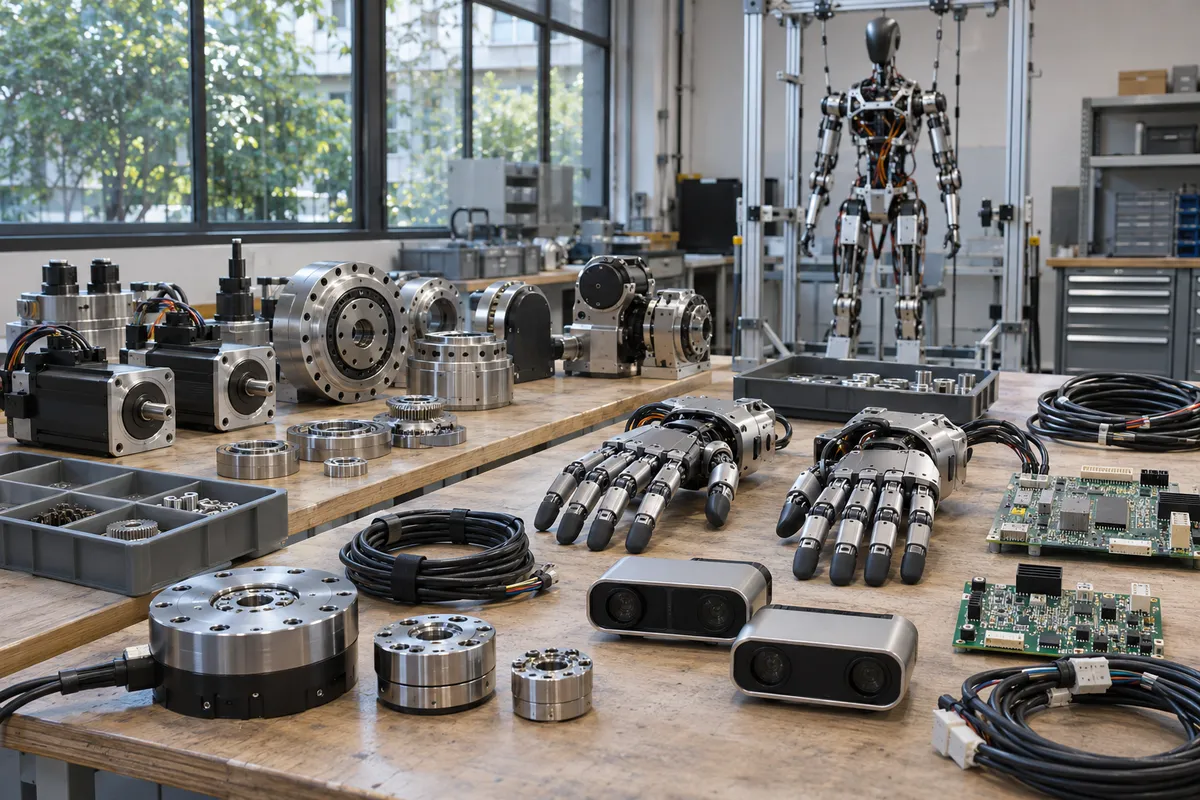
Seven in ten are not building a humanoid
Ask what a humanoid robotics company does and the obvious answer is that it builds humanoid robots. The tracker says otherwise. Of 1,112 organizations in more than 80 countries and territories, 310 have a complete humanoid as their primary focus. That is 28%.
The other 802 make the parts, write the software, deploy other people’s robots, or build a different kind of robot and watch this one closely. The largest group is not the builders. It is the 356 organizations that supply the body, from motors and reducers to sensors, hands and chips.
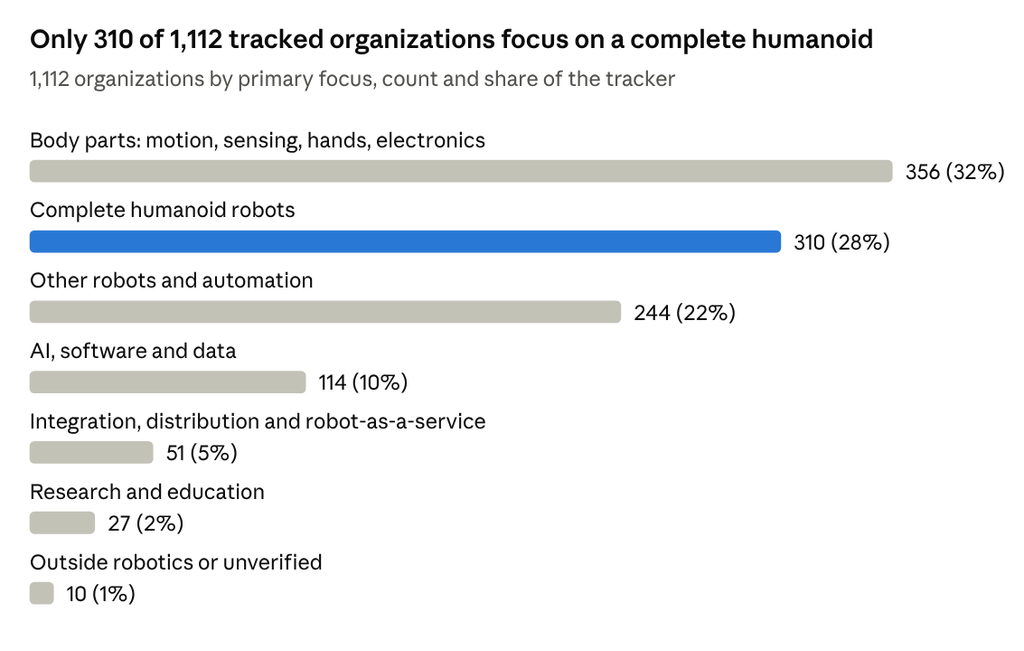
For every organization building a humanoid, there are 2.6 that are not. The label “humanoid company” now describes a supply chain, and most of its members do not ship a robot under their own name.
The body shop is bigger than the showroom
Motion hardware is the most crowded layer of the supply chain. Some 122 organizations focus on motors, drives, actuators, reducers, bearings and screws. That is more than the 114 working on AI, software and data. Counted by firms, the humanoid is still a mechanical engineering problem first.
| Body layer | Organizations | What the focus covers |
| Motion hardware | 122 | Motors, drives, actuators, reducers, bearings, screws |
| Sensing and touch | 83 | Vision, lidar, force and torque sensors, tactile skin |
| Hands and manipulation | 69 | Dexterous hands, grippers, bionic hands, arms |
| Electronics, power and materials | 57 | Chips, controllers, batteries, cables, structural parts |
| Components, not specified | 25 | Generic “robotics components” label |
The hand is the one body part with an industry of its own. Sixty-nine organizations list hands or manipulation as their primary focus. Add the tactile skin specialists and 94 organizations outside the builders work on the hand or its sense of touch.
No supplier in the tracker lists legs, walking or balance as its primary focus. One reading is that locomotion has become something builders do themselves with bought actuators, while the hand is where they still go shopping.
A robot for everything, and no job in particular
The tracker tags 297 organizations as core builders, covering humanoid makers and corporate humanoid programs. Their focus labels should answer a simple question. What is the robot for?
For 180 of them, 61%, the label does not say. Of those, 119 carry no application at all, typically just “humanoid robot platforms”. Another 61 say “general-purpose” and stop there.
Only 100 builders, 34%, name specific work without a general-purpose hedge. A further 17 name a sector and claim general purpose in the same breath. Tesla’s label is the cleanest example in the tracker. It reads “Manufacturing / future general-purpose”, which is the industry’s whole plan in one line.
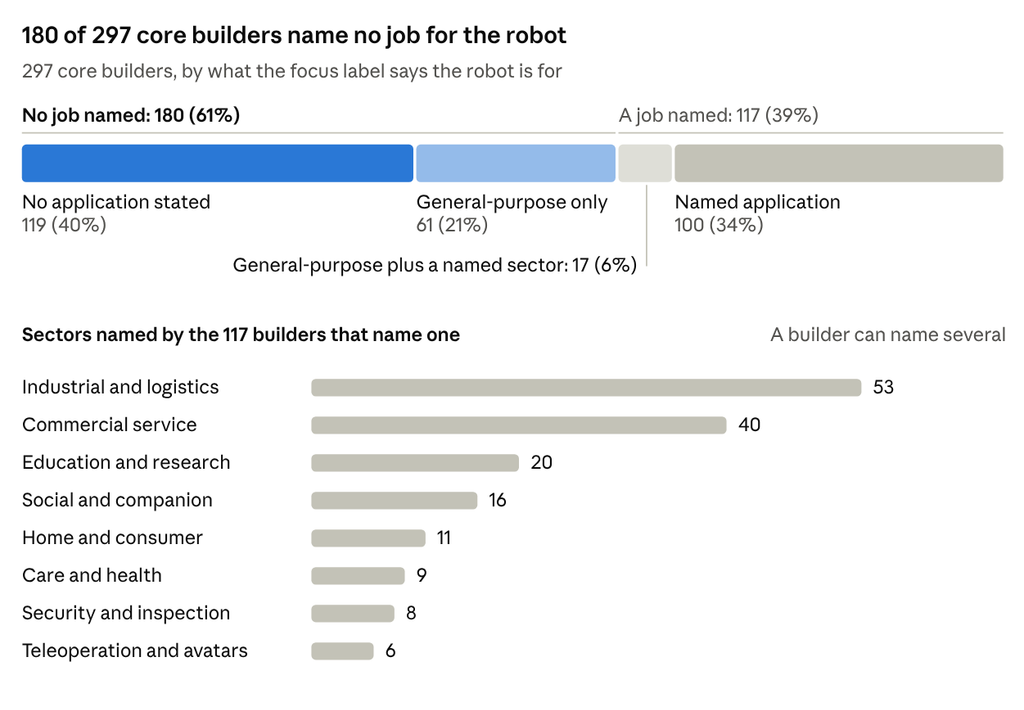
The home is the surprise. Only 11 builders name it, fewer than 4% of the core, and five of those are appliance or consumer electronics groups running corporate programs. Factory and warehouse work is where builders point when they point anywhere.
Geography changes the picture. Outside China, 72 of 122 core builders name specific work. Inside China, 28 of 175 do, and 96 carry no application at all.
Some of that gap is the tracker itself. All 64 entries labelled simply “humanoid robot platforms” are Chinese, many of them firms with little public detail. The rest is a disclosure gap. For 96 Chinese builders, the public record the tracker could find does not yet say what the robot is for.
China makes the body. The brain and the hand are still open.
China accounts for 637 of the 1,112 organizations, or 57%. That average hides the real pattern. China’s share runs above 80% in every hardware layer except the hand, and falls to half in the layers that decide what the robot can do.
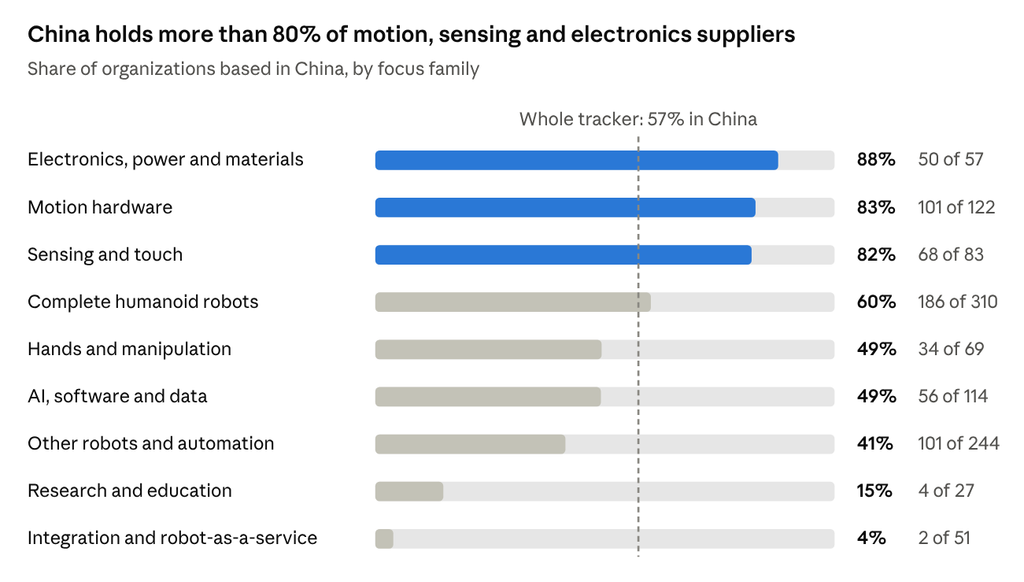
In AI, software and data, China has 56 organizations and the rest of the world has 58. In hands, the split is 34 to 35. These are the two layers of the robot where a company outside China is not starting from behind on numbers.
Country profiles are just as lopsided. The United States has 85 organizations in the tracker, including 31 builders and 20 AI and software firms, and none whose primary focus is motors, reducers, bearings, chips or batteries. Japan is the mirror image, with 13 motion hardware firms and 28 industrial and other robot makers against 12 builders. South America has 37 organizations and no core builder.
The tracker covers Chinese suppliers in more depth than Western ones, so read the United States gap as a direction and not a census.
Even the vocabulary splits. “Embodied” appears in 61 focus descriptions, 50 of them Chinese. “Physical AI” appears in 30, and 25 of those are outside China.
The deployment layer is forming outside China
The layer that puts robots to work for customers is the one where China is almost absent. The tracker counts 51 integrators, distributors and robot-as-a-service operators. Two are Chinese. The other 49 are spread across more than 30 countries, with 23 in Europe and 10 in South America.
Twelve of their labels name the robot brand they deploy, and ten of those name a Chinese one. Unitree appears in five, AgiBot in three and UBTECH in two, in markets from Finland to Panama. Fifteen describe rental, subscription or robotics as a service.
These firms rarely design a robot. They import one, add software and local support, then rent or deploy it. If humanoids reach customers in volume, this layer may end up holding the customer relationship. Today it is small and almost entirely non-Chinese.
Sources:
- Humanoid Analytics Company Tracker, 1,113 rows as of 10 November 2026. One shareholding vehicle is excluded, leaving 1,112 organizations.