
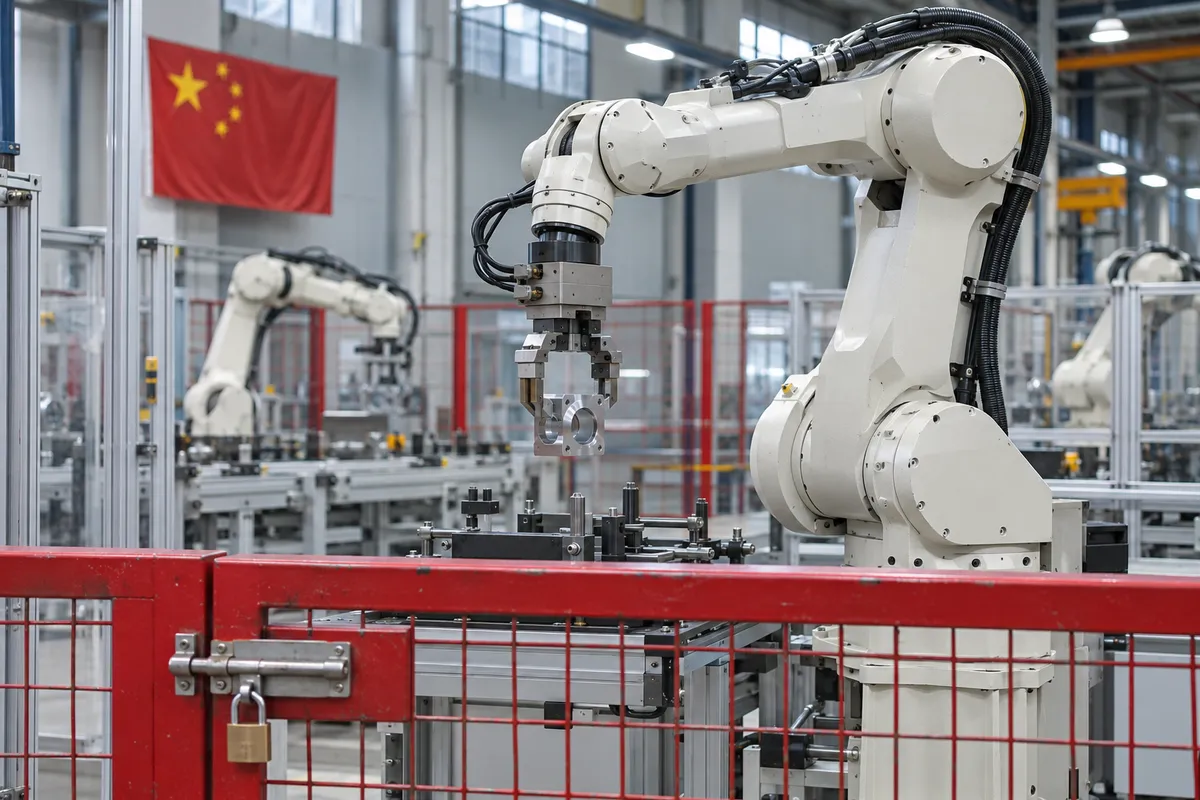
SoftBank’s $5.4 billion plan to buy ABB Robotics has reached a question that matters across physical AI: how much of a global robotics business can a buyer actually control?
Reuters reported on November 5 that China had blocked the acquisition. SoftBank’s November 6 disclosure clarified the scope: Chinese authorities prohibited the purchase of ABB’s robotics business in China, with notification received on November 4. SoftBank said both companies were still working on the transaction. The immediate investor question is what assets and rights an acceptable deal would contain. A revised agreement and regulatory clearance remain missing.
By November 7, Reuters, citing Bloomberg reporting, described discussions about separating the Chinese operations into an entity with different ownership. ABB declined to comment, and SoftBank did not respond to Reuters’ request. That is a reported route forward, not an agreed solution.
What SoftBank wanted to buy
The agreement signed on October 8, 2025 set a purchase price of $5.375 billion, subject to adjustments, with closing originally expected in mid-to-late 2026. SoftBank presented the acquisition as part of its physical AI strategy, combining ABB’s industrial robotics expertise and customer relationships with its AI investments.
There was an established business behind that ambition. SoftBank published ABB-supplied, pro forma unaudited figures showing robotics revenue of $2.279 billion and operational EBITA of $277 million for 2024. Those historical figures describe the business before any potential China separation.
Humanoid Analytics’ interpretation is that ABB offered SoftBank a route into industrial customers and working production environments. Those relationships could help bring more capable AI into real workflows. The relevance to humanoids lies in that commercial infrastructure. This transaction itself provides no new evidence of humanoid reliability, autonomy or deployment economics.
China accounts for about 30% of ABB’s robotics business, according to Reuters. A carve-out could therefore change the acquisition’s commercial value substantially. Its effect would depend on the revenue retained, manufacturing arrangements, intellectual-property rights and ability of the separated businesses to cooperate.
The original price cannot simply be treated as the price of whatever remains.
The next test is the deal’s shape
Reuters reported concerns about sensitive data reaching the United States and SoftBank’s ties to Western companies, including OpenAI, citing a person familiar with the transaction. SoftBank’s public update did not explain the regulator’s reasoning. The data concern remains an attributed explanation, not a published regulatory finding.
For investors and robotics companies considering cross-border acquisitions, the case illustrates why ownership, data access and regulatory permission belong in the same commercial assessment. A technically useful combination may still require a structure that limits how its businesses can share technology or operate together.
Separation could preserve much of SoftBank’s strategic rationale if it retains valuable customers, technology and manufacturing capabilities. It could also introduce costs and restrictions that weaken the expected benefits. The disclosed information does not yet establish either outcome.
The evidence to watch is concrete: a signed revised agreement, the assets and rights included, updated consideration, required approvals and a credible closing timetable.
SoftBank may still secure an important industrial platform for physical AI. Its value will depend on the business it can actually acquire, and the freedoms that come with it.
Sources:
- Reuters, “China blocks SoftBank’s $5.4 billion takeover of ABB’s robotics division”
Source type: Tier 2, strong independent evidence. Named ABB confirmation supports the prohibition; explanations of officials’ concerns rely on anonymous sources.
https://www.reuters.com/business/media-telecom/china-blocks-softbanks-54-billion-takeover-abbs-robotics-division-ft-reports-2026-11-05/ - SoftBank Group Corp., “Update on Acquisition of ABB Ltd’s Robotics Business”
Source type: Tier 3, detailed first-party disclosure. Company-controlled source, November 6, 2026.
https://group.softbank/en/news/press/20261106 - Reuters, “SoftBank, ABB explore China carve-out to salvage robotics deal, Bloomberg News reports”
Source type: Tier 2, strong independent evidence. The carve-out account relays Bloomberg’s anonymous sourcing and is not independent corroboration of that account.
https://www.reuters.com/business/media-telecom/softbank-abb-explore-china-carve-out-salvage-robotics-deal-bloomberg-news-2026-11-07/ - SoftBank Group Corp., “Acquisition of ABB Ltd’s Robotics Business”
Source type: Tier 3, detailed first-party disclosure. Company-controlled source, October 8, 2025.
https://group.softbank/en/news/press/20251008