
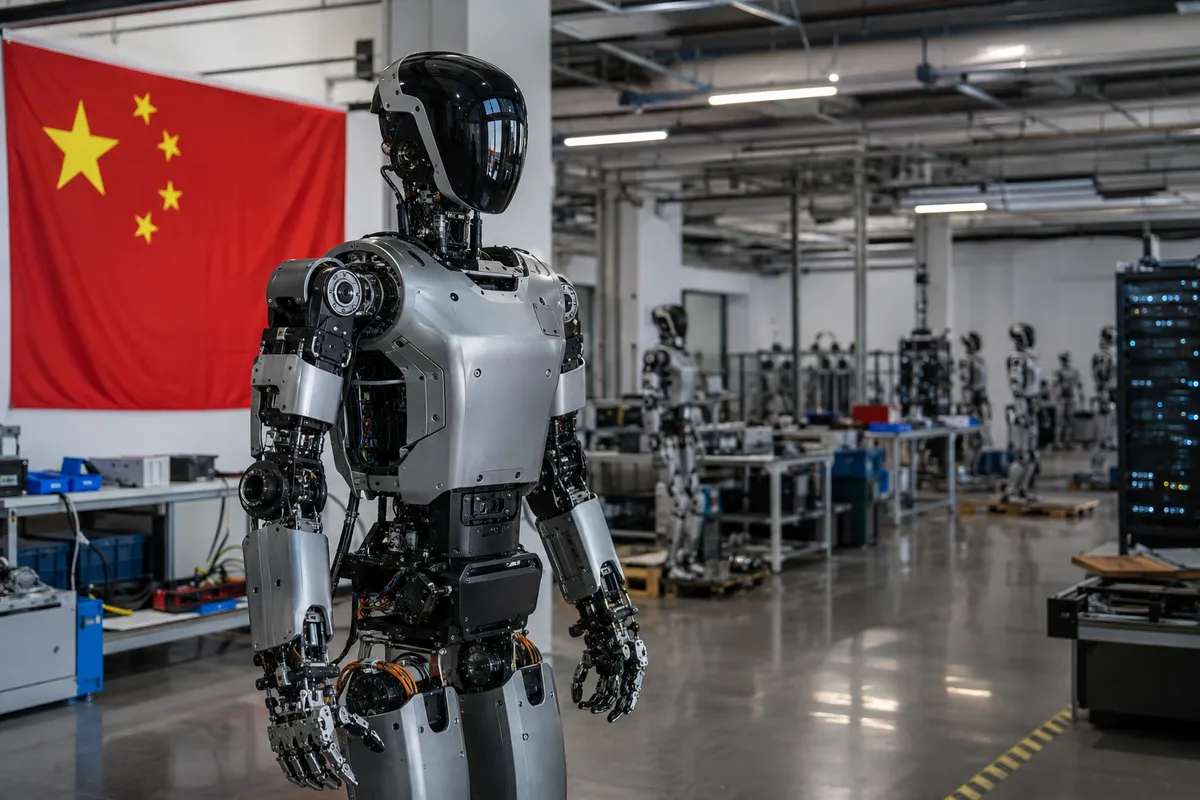
China is more likely than any other country to create the first mass-market hardware inflection in humanoid robotics. It is not yet clearly more likely to produce the first convincing commercial-intelligence breakthrough.
That distinction matters. A robot that is inexpensive, widely shipped, and capable of impressive demonstrations can change public expectations. It does not necessarily change industrial economics. A true ChatGPT moment would require a product that non-specialists can use quickly, that performs useful tasks across more than one narrowly engineered workflow, and that improves through software and deployment data rather than repeated hardware customization.
The most probable outcome is therefore not one global breakthrough. It is a sequence of partially separate moments: China reaches scale, affordability, and public visibility first, while a U.S. company may establish stronger operating proof in selected Western industrial environments. Geopolitics could divide the market before either side achieves genuinely general-purpose humanoid intelligence.
China Has the Hardware and Attention Advantage
China is treating embodied artificial intelligence and robotics as national industrial priorities. The country’s 2026 government work report identified embodied AI as an industry of the future, while the draft 15th Five-Year Plan called for accelerated robotics development through 2030. This establishes policy support, not commercial success, but it gives companies access to a coordinated environment involving manufacturing, research institutions, local governments, capital, and potential public-sector demand.
China has also created a public-awareness moment. Humanoid robots appeared prominently in the 2026 Spring Festival Gala, China’s largest annual television event, with products from Unitree, Galbot, Noetix, and MagicLab performing martial-arts, dance, and comedy sequences. The event connected industrial policy with mass-market visibility in a way no U.S. humanoid company has yet matched.
The early volume estimates point in the same direction, although the numbers are not directly comparable. Omdia estimated that China accounted for 90% of roughly 13,000 humanoid shipments in 2025. A separate Counterpoint estimate reported by Reuters put China above 80% of 16,000 global installations. The difference between shipments and installations, and between the underlying estimates, shows that market measurement remains unstable. Both estimates nevertheless indicate a substantial Chinese hardware-volume advantage.
Volume alone does not establish commercial readiness. Reuters Breakingviews reported that most of the approximately 12,000 humanoids sold in China during 2025 went to scientific research, education, and testing rather than industrial or commercial applications. Unitree’s own disclosed market mix similarly indicated that its humanoids were used mainly by research institutions, performance operators, and service establishments.
UBTECH provides evidence that humanoid revenue is becoming material for at least one listed Chinese company. Its official 2025 results disclosed RMB820.6 million in revenue from full-size embodied intelligent humanoid products and services, representing 41.1% of group revenue, with reported sales volume of 1,079 units. The same filing describes industrial trials, production capacity, and commercial applications, but many operating claims remain company-controlled. The filing does not by itself establish customer-confirmed uptime, intervention rates, labor savings, or deployment economics.
China has therefore achieved important parts of the formula: supply-chain availability, falling hardware barriers, public attention, policy support, and a growing installed base. The missing part is the one that made ChatGPT commercially disruptive: an interface between advanced technology and immediate, repeatable user value.
The United States Has Stronger Public Proof in at Least One Industrial Case
The U.S. market presents the opposite pattern. Publicly visible unit volumes appear lower, but at least one deployment has stronger customer-side operating evidence.
BMW reported that Figure 02 supported production of more than 30,000 BMW X3 vehicles at its Spartanburg plant over ten months. According to the customer, the robot worked ten-hour weekday shifts, moved more than 90,000 components, completed approximately 1.2 million steps, and accumulated around 1,250 operating hours. BMW later confirmed that the successor Figure 03 would begin a new logistics-sequencing application at the same plant.
This is materially stronger evidence than a shipment total or demonstration because the customer identified the site, task, duration, activity, and follow-on use case. It still does not establish payment status, fleet-level scale, uptime, intervention frequency, all-in operating cost, or return on investment.
The example nevertheless shows a potential U.S. path to leadership. Rather than winning initially through the largest number of robots, U.S. companies could establish premium positions through high-value industrial workflows, close integration with customer systems, frontier AI models, and trusted access to Western production environments.
That advantage is not secure. A small number of well-documented pilots cannot match the learning potential of thousands of robots if Chinese companies begin collecting high-quality field data at scale. Conversely, thousands of robots in laboratories, schools, exhibitions, or highly scripted demonstrations will not automatically generate the failure data, task variation, and customer feedback needed to build reliable industrial intelligence.
The strategic competition is therefore shifting from robot production to data quality. The winner will be the ecosystem that converts real operating failures, interventions, task outcomes, and customer requirements into software improvements that transfer across robots and sites.
Geopolitics Is Dividing the Addressable Market
The assumption that the best humanoid robot will compete freely in one global market is becoming less credible.
On July 28, 2026, the Federal Communications Commission added foreign-produced advanced robotic devices, including humanoids and quadrupeds, to its Covered List. The restrictions apply to new models seeking equipment authorization, although previously authorized models can continue to be sold and used. Conditional approval remains possible.
The measure is formally country-neutral because it covers foreign-produced devices regardless of national origin. Its most immediate commercial implications, however, include Chinese manufacturers seeking access to the U.S. market. Unitree subsequently warned that future products could face U.S. barriers. The company disclosed that overseas revenue exceeded 40% during each reported period, with the United States accounting for between 13.30% and 19.54%.
The wider technology relationship was already segmented. The U.S. outbound-investment program covers certain investments involving Chinese semiconductor, quantum, and artificial-intelligence activities. Humanoid robotics is not automatically prohibited as a category, but embodied-AI companies may be affected when particular transactions or technologies fall within the program’s definitions.
The U.S. is also developing domestic performance infrastructure. NIST began work in 2026 on a common humanoid benchmark covering mobility, manipulation, whole-body control, and basic reasoning. A widely accepted benchmark will not prove commercial economics, but it could improve comparability and reduce reliance on edited company demonstrations.
The likely result is a divided market. Chinese companies will have stronger incentives to prioritize domestic customers and countries where cost, availability, and financing outweigh U.S. security concerns. U.S. companies may gain a more protected domestic market, but protection could also reduce price competition and limit access to Chinese manufacturing scale.
Third-country buyers will face a broader decision than robot performance. Procurement may depend on data location, remote access, software updates, component origin, cybersecurity, service capability, political alignment, and the risk that future restrictions make an installed fleet difficult to support.
Forecast Through 2030: Two Moments, Not One
The following scenario weights are analytical estimates, not measured probabilities.
| Scenario through 2030 | Estimated probability | Expected outcome |
|---|---|---|
| Bifurcated leadership | 50% | China leads hardware volume, cost reduction, and domestic adoption. U.S. companies lead in selected high-value Western deployments and frontier software. No single global platform dominates. |
| Chinese platform breakaway | 30% | A Chinese ecosystem combines affordable hardware, large domestic fleets, strong task-learning software, and export growth outside the United States. It becomes the principal platform across much of the non-U.S. market. |
| Commercial reset | 20% | Reliability, dexterity, integration costs, and weak economics delay both ecosystems. Conventional industrial robots and specialized automation capture most near-term demand. |
The most likely Chinese breakthrough between 2026 and 2028 is an affordability and availability moment. More universities, developers, integrators, and smaller industrial companies will be able to obtain humanoid hardware. That expands experimentation and creates a larger developer ecosystem, even when many units do not yet perform economically useful work.
The same expansion will probably produce consolidation. Reuters reported that Chinese officials had warned about possible bubble conditions amid approximately 150 humanoid manufacturers. By 2028, a significant share of current vendors is likely to merge, fail, become component suppliers, or retreat into research and entertainment markets. The survivors will be those that can combine production quality with software, service, and customer access.
Between 2027 and 2029, the competitive question will move from whether robots can walk, run, or manipulate an object once to whether one task-learning system can be deployed repeatedly. The most consequential product announcement may not be a new robot. It may be a software release that allows an existing fleet to learn a new workflow from demonstration and transfer it to multiple sites with limited additional engineering.
By 2030, Humanoid Analytics’ base case is that China leads global unit volume and hardware cost, while U.S. companies retain a stronger position in high-value American deployments, advanced AI software, and regulated enterprise environments. Europe and other major markets are likely to become contested territory rather than automatically joining either ecosystem.
A genuine Chinese ChatGPT moment would require independent customers to confirm repeat or expanded deployments across multiple sites, with disclosed operating hours, uptime, intervention rates, task success, productivity, safety results, service costs, and commercial renewal. It would also require evidence that capabilities generalize beyond one carefully engineered task.
The equivalent U.S. proof would require more than a small number of prestigious pilots. U.S. vendors would need serial production, repeat deliveries, multiple customer-confirmed deployments, lower hardware and service costs, and evidence that their software advantage can compensate for China’s supply-chain scale.
China will probably create humanoid robotics’ first mass public and hardware moment. It may not create the first decisive commercial-intelligence moment.
The more important forecast is that there may never be one global equivalent of ChatGPT. Geopolitics is separating the market before the technology has matured. China could dominate one hardware and software ecosystem while the United States leads another. The ultimate commercial winner will not be determined by the most robots shipped or the most impressive demonstration. It will be determined by which ecosystem turns field experience into reliable, low-intervention, economically useful work.
Sources:
- State Council of the People’s Republic of China, “China to nurture emerging, future industries”
Source type: Tier 1, direct or official evidence
https://english.www.gov.cn/2026special/2026npcandcpcc/202603/05/content_WS69a8eea9c6d00ca5f9a09891.html - Reuters, “China’s humanoid robots take centre stage for Lunar New Year showtime”
Source type: Tier 2, strong independent evidence
https://www.reuters.com/business/media-telecom/chinas-humanoid-robots-ready-lunar-new-year-showtime-2026-02-16/ - Reuters, “China humanoid robot half-marathon to showcase technical leaps”
Source type: Tier 2, strong independent evidence
https://www.reuters.com/world/asia-pacific/china-humanoid-robot-half-marathon-showcase-technical-leaps-2026-04-18/ - Reuters Breakingviews, “China’s robot quest triggers system overload”
Source type: Tier 2, independent reporting and analysis
https://www.reuters.com/commentary/breakingviews/chinas-robot-quest-triggers-system-overload-2026-06-29/ - UBTECH Robotics Corp Ltd, “Annual Results Announcement for the Year Ended December 31, 2025”
Source type: Tier 1, direct or official evidence; HKEX filing containing company-controlled operating claims
https://www.hkexnews.hk/listedco/listconews/sehk/2026/0331/2026033102607.pdf - BMW Group, “BMW Group to deploy humanoid robots in production in Germany for the first time”
Source type: Tier 1, direct customer confirmation
https://www.press.bmwgroup.com/global/article/detail/T0455864EN/bmw-group-to-deploy-humanoid-robots-in-production-in-germany-for-the-first-time?language=en - BMW Group, “BMW Group advances the use of Physical AI in production with Figure 03 project in Spartanburg”
Source type: Tier 1, direct customer confirmation
https://www.press.bmwgroup.com/global/article/detail/T0458778EN/bmw-group-advances-the-use-of-physical-ai-in-production-with-figure-03-project-in-spartanburg?language=en - Federal Communications Commission, “Fact Sheet: FCC Updates Covered List to Include Foreign-Produced Advanced Robotic Devices and Power Inverters”
Source type: Tier 1, direct or official evidence
https://docs.fcc.gov/public/attachments/DOC-423682A1.pdf - Reuters, “China’s Unitree flags US sales risk ahead of Shanghai IPO”
Source type: Tier 2, strong independent evidence based on the company’s regulatory filing
https://www.reuters.com/world/asia-pacific/chinas-unitree-sets-august-10-subscription-shanghai-ipo-2026-07-30/ - U.S. Department of the Treasury, “Outbound Investment Security Program”
Source type: Tier 1, direct or official evidence
https://home.treasury.gov/policy-issues/international/outbound-investment-program - National Institute of Standards and Technology, “Humanoid Robot Baseline Performance Benchmark”
Source type: Tier 1, direct or official evidence
https://www.nist.gov/el/intelligent-systems-division-73500/humanoid-robot-baseline-performance-benchmark