
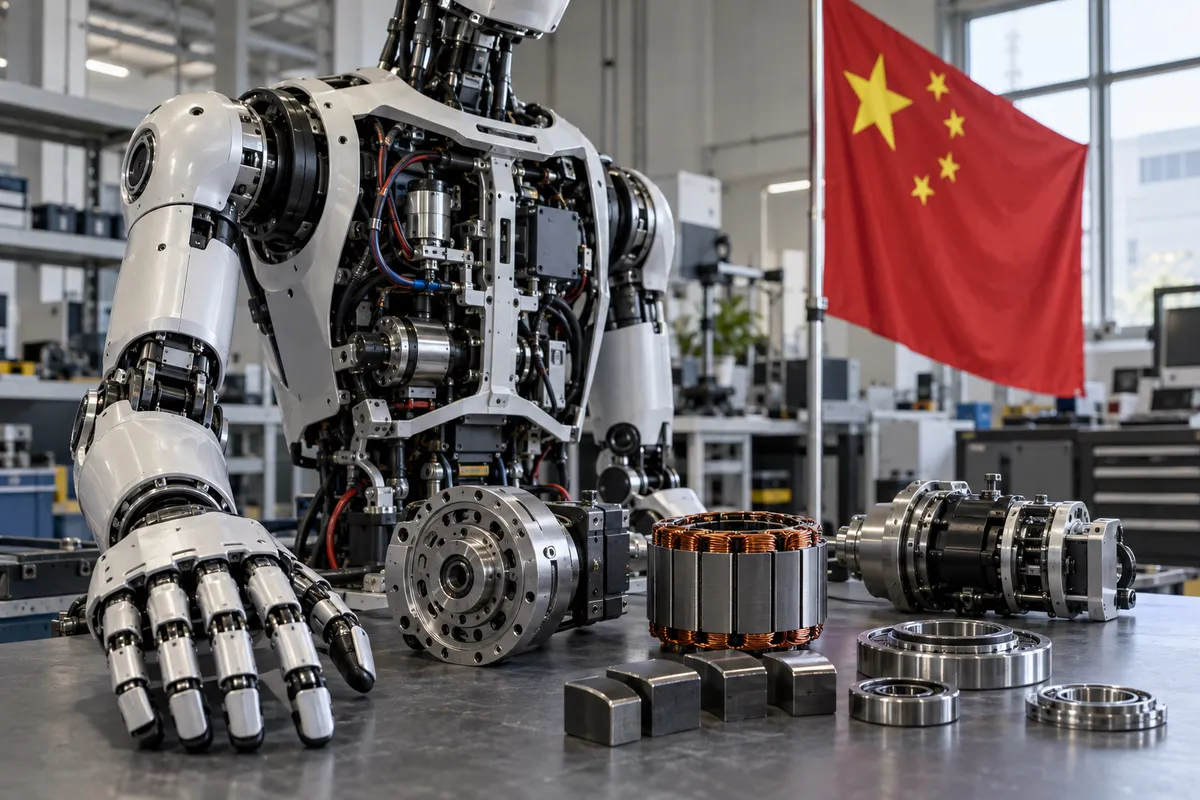
China does not control 90% of the entire humanoid robotics supply chain.
It does control more than 90% of several critical upstream layers that sit inside the robot.
That is the more important conclusion.
Humanoid Analytics’ current Company Tracker contains 360 organizations across humanoid OEMs, component companies, manipulation specialists, sensing companies, corporate programs and other parts of the ecosystem. China accounts for 221 of those entries, or 61.4%.
The concentration rises when the analysis is restricted to the 225 companies and programs classified by Humanoid Analytics (HA) as Core. China accounts for 144, exactly 64.0%.
Among 204 tracked Humanoid OEMs, 132 are Chinese, equal to 64.7%.
China therefore represents roughly two-thirds of the mapped core humanoid ecosystem.
But China’s position becomes much more concentrated when the robot is broken into specific physical inputs. In rare-earth processing, permanent magnets and parts of the lithium-ion battery supply chain, the country already holds 90% or more of global production.
These are not marginal components. They influence motors, actuation, energy storage, weight, torque density and operating time.
The 90%+ Layers Inside the Humanoid Supply Chain
The clearest concentration sits inside the electric motors used throughout humanoid joints.
Humanoids require large numbers of motors and actuators to move their shoulders, elbows, wrists, hips, knees, ankles and fingers. High-performance motors commonly use rare-earth permanent magnets because they can provide high torque density without making each joint excessively large or heavy.
China dominates the processing chain behind those magnets.
The International Energy Agency estimates that China accounted for about 60% of global mining of magnet rare earths in 2024.
Mining, however, is not the most concentrated stage.
China accounted for 91% of global refined magnet rare-earth output and 94% of global sintered permanent-magnet production in 2024.
McKinsey reaches a similar conclusion from the humanoid-component perspective. Its 2026 supply-chain analysis assigns China about 90% of permanent-magnet capacity used within the motor supply chain.
Table 1. Critical humanoid-related layers where China exceeds or approaches 90%
| Supply-chain layer | China share | Why it matters to humanoids |
|---|---|---|
| Sintered permanent-magnet production | 94% | High-strength magnets are used in compact, high-torque electric motors |
| Magnet rare-earth refining | 91% | Converts mined material into inputs usable by magnet manufacturers |
| Permanent magnets within motor supply chain | ~90% | Direct input into many humanoid joint motors |
| Battery anode active material production | >90% | Core material inside lithium-ion battery cells |
| Installed anode-material manufacturing capacity | ~97% in earlier IEA capacity data | Shows the depth of China’s battery-material manufacturing base |
| Lithium-ion battery cells | >80% | Main energy-storage technology used across mobile robotics |
| Cathode active material | ~85% | Major input into lithium-ion battery cells |
The permanent-magnet figures provide the strongest evidence for saying China controls more than 90% of a critical component chain inside humanoid robotics.
The key distinction is that China does not need to control every motor manufacturer to hold substantial leverage over motor production.
Control of upstream refining and magnet manufacturing can create exposure even for a humanoid designed and integrated outside China.
Permanent Magnets Are a Particularly Important Chokepoint
McKinsey estimates actuators account for approximately 40% to 60% of a humanoid robot’s hardware bill of materials.
Within an actuator, the motor is only one element. Reducers, bearings, encoders, screws and other components are also required. China does not dominate all of them.
Permanent magnets stand apart because the concentration occurs several stages upstream.
A humanoid manufacturer can potentially qualify a different motor supplier. That alternative motor, however, may still rely on the same geographically concentrated magnet-processing chain.
This makes the distinction between mining and processing particularly important.
China’s approximately 60% share of magnet rare-earth mining is already substantial, but the country’s position rises to 91% at the refining stage and 94% in sintered permanent magnets.
That means diversification requires more than discovering alternative mineral deposits.
Alternative supply chains need separation and refining facilities, metallurgical expertise, alloy production, magnet manufacturing, quality control and sufficient industrial scale to compete economically.
The concentration has also acquired geopolitical relevance.
China introduced export restrictions covering several rare-earth elements and related products in 2025. The IEA has highlighted those restrictions as evidence that concentrated critical-mineral supply chains can create practical disruption for manufacturers outside China.
For humanoid robotics, this makes permanent magnets one of the clearest physical dependencies to monitor.
A robot may be American, European, Japanese or Korean by brand and design while still containing motors dependent on a Chinese-dominated upstream magnet chain.
Batteries Create a Second Concentrated Supply Layer
The battery system provides another example of China’s industrial advantage.
McKinsey estimates battery modules represent approximately 5% to 10% of a humanoid robot’s hardware bill of materials.
That percentage is smaller than actuation, but batteries influence operating time, weight, peak power delivery, charging strategy and thermal management.
Most humanoid developers do not manufacture battery chemistry from scratch. They source cells and materials from an industry originally scaled for consumer electronics, electric vehicles and stationary energy storage.
China is the center of that manufacturing ecosystem.
According to the International Energy Agency, China produced more than 80% of global battery cells in 2025, approximately 85% of cathode active material and more than 90% of anode active material.
Earlier IEA capacity data also put China’s installed anode active-material manufacturing capacity at approximately 97%.
Table 2. China’s position in battery-related layers
| Battery supply-chain layer | China share | Relevance |
|---|---|---|
| Anode active material production | >90% | Core battery material |
| Installed anode-material capacity | ~97% | Indicates exceptionally concentrated manufacturing infrastructure |
| Cathode active material production | ~85% | Major battery-cell input |
| Lithium-ion battery cells | >80% | Provides the existing cell-manufacturing base available to robotics |
These percentages describe the broader lithium-ion ecosystem rather than humanoid-specific demand.
That qualification matters because humanoid robots currently represent only a small part of global battery consumption.
But the industrial implication is still significant.
Chinese humanoid manufacturers sit next to a battery ecosystem built at vastly greater scale than the current humanoid market. That gives them access to cell manufacturers, material suppliers, pack engineering, thermal-management expertise and established production infrastructure.
South Korea and Japan remain important battery competitors, so batteries should not be described as a Chinese monopoly.
But an 80%-plus cell-production position and more than 90% concentration in anode materials represent clear supply-chain dominance.
HA Finds China at 64% Across the Broader Core Ecosystem
The 90%+ component figures should not be confused with China’s share of the complete humanoid ecosystem.
Humanoid Analytics’ data provides a broader denominator.
Table 3. China in the Humanoid Analytics ecosystem
| HA tracker measure | Chinese entries | Total entries | China share |
|---|---|---|---|
| All tracked organizations | 221 | 360 | 61.4% |
| Core ecosystem | 144 | 225 | 64.0% |
| Humanoid OEMs | 132 | 204 | 64.7% |
The 64% Core figure is the most defensible HA-supported headline for China’s representation across the mapped core humanoid ecosystem.
It is not evidence that China manufactures 64% of every component.
It is a company-level concentration measure.
That distinction becomes clear when other component categories are examined.
McKinsey estimates China holds approximately 40% of precision-bearing capacity, 40% of encoder and position-sensor capacity, around 35% of motors and 30% of driver boards and power electronics.
Those are significant positions, but they are not 90% dominance.
Table 4. Critical components where China is strong but not dominant at 90%+
| Component | Estimated China share | Other important positions |
|---|---|---|
| Precision bearings | 40% | Japan 25%, Germany 20% |
| Encoders / position sensors | 40% | Japan 30%, Germany 15% |
| Motors | ~35% | Manufacturing remains geographically distributed |
| Driver boards / power electronics | 30% | Japan 20%, South Korea 15%, rest of world 35% |
| High-end precision ball screws | China not dominant | Japanese and European suppliers remain important |
This table is as important as the 90% table because it establishes the boundary of the claim.
China dominates certain upstream physical layers.
It does not dominate every important subsystem inside a humanoid.
MERICS also provides an independent cross-check on the broader ecosystem. Its April 2026 analysis estimates that China controls 63% of key companies in the global supply chain for humanoid robot components.
That is closely aligned with Humanoid Analytics’ independently derived 64% share of Core tracked entities.
At the same time, MERICS identifies continued Chinese weaknesses in areas including software and some high-end mechanical components. Japanese and European suppliers retain important positions in precision ball screws and other motion components.
The emerging humanoid supply chain is therefore not a single-country stack.
It is geographically uneven.
Why China’s 90%+ Component Positions Matter
For investors and strategy teams, a single percentage for the entire humanoid supply chain is less useful than identifying individual chokepoints.
China’s roughly 64% representation in the HA Core ecosystem shows breadth.
Its 90%+ positions in several upstream component layers show concentration.
Those are different forms of advantage.
The HA figure suggests China has substantially more companies attempting to build robots and enabling hardware than any other country.
The magnet and battery figures show that some of those companies also operate inside industrial supply chains where domestic Chinese capacity is already extraordinarily deep.
The combination can matter economically.
A large local customer base gives component suppliers incentives to expand robotics-specific capacity. Existing automotive and electronics factories can provide manufacturing equipment, engineers and suppliers. Competition between local OEMs can drive rapid design iteration and cost reduction.
But the strongest strategic implication comes from the components that are difficult to substitute.
Permanent magnets are the clearest example.
A humanoid OEM can redesign a joint or change a supplier. Replacing an entire rare-earth refining and high-performance magnet ecosystem is considerably harder.
Battery-material concentration presents a similar, although less absolute, challenge.
This is why the most useful supply-chain diligence should move below the country-of-origin label attached to the finished robot.
Investors and corporate strategy teams should ask where the magnets were manufactured, which battery cells are being used, who supplies the actuator components, whether alternative suppliers have been qualified and whether the supplier base can support substantially higher volumes.
Those questions reveal dependencies that a simple “Made in China” or “Made in America” label cannot.
China Does Not Control 90% of the Humanoid Supply Chain. It Controls 90%+ of Some of Its Most Important Inputs.
The evidence supports a narrower and stronger conclusion than the common claim that China controls almost the entire humanoid robotics supply chain.
Humanoid Analytics finds China accounts for 64.0% of the mapped Core humanoid ecosystem and 64.7% of tracked Humanoid OEMs.
That already represents extraordinary company-level concentration.
But China’s position rises above 90% in specific upstream layers.
The IEA estimates China controls 91% of magnet rare-earth refining and 94% of sintered permanent-magnet production. China also produces more than 90% of battery anode active material, while its share of lithium-ion battery cells exceeds 80%.
Those components matter directly to humanoid motors and power systems.
Other layers remain more competitive. Japan and Germany retain important positions in precision motion components. South Korea remains significant in batteries and electronics. The United States and Taiwan are critical to advanced semiconductors and compute.
The humanoid robotics supply chain is therefore not completely controlled by China.
But several of its physical foundations are extraordinarily concentrated there.
That is the distinction that matters.
As humanoid robotics moves toward higher production volumes, the next important evidence will be whether manufacturers outside China can qualify alternative sources for magnets, battery materials and other critical components without materially increasing cost or reducing performance.
Until then, China’s broad 64% ecosystem concentration and its 90%+ control of selected upstream layers should be treated as separate but reinforcing advantages.
Sources:
- Humanoid Analytics, “Humanoid Company Tracker”
Source type: Humanoid Analytics structured tracker
https://humanoidanalytics.com/humanoid-company-tracker/ - International Energy Agency, “Rare Earth Elements: Executive Summary”
Source type: Tier 1, direct or official evidence
https://www.iea.org/reports/rare-earth-elements/executive-summary - McKinsey & Company, “Turning humanoid supply chain constraints into billion-dollar wins”
Source type: Tier 2, strong independent evidence
https://www.mckinsey.com/industries/industrials/our-insights/turning-humanoid-supply-chain-constraints-into-billion-dollar-wins - McKinsey & Company, “China’s humanoid robot edge”
Source type: Tier 2, strong independent evidence
https://www.mckinsey.com/featured-insights/charts/chinas-humanoid-robot-edge - International Energy Agency, “Manufacturing and trade: Global EV Outlook 2026”
Source type: Tier 1, direct or official evidence
https://www.iea.org/reports/global-ev-outlook-2026/manufacturing-and-trade - International Energy Agency, “Trends in electric vehicle batteries”
Source type: Tier 1, direct or official evidence
https://www.iea.org/reports/global-ev-outlook-2024/trends-in-electric-vehicle-batteries - MERICS, “Embodied AI: China’s ambitious path to transform its robotics industry”
Source type: Tier 2, strong independent evidence
https://merics.org/en/report/embodied-ai-chinas-ambitious-path-transform-its-robotics-industry