
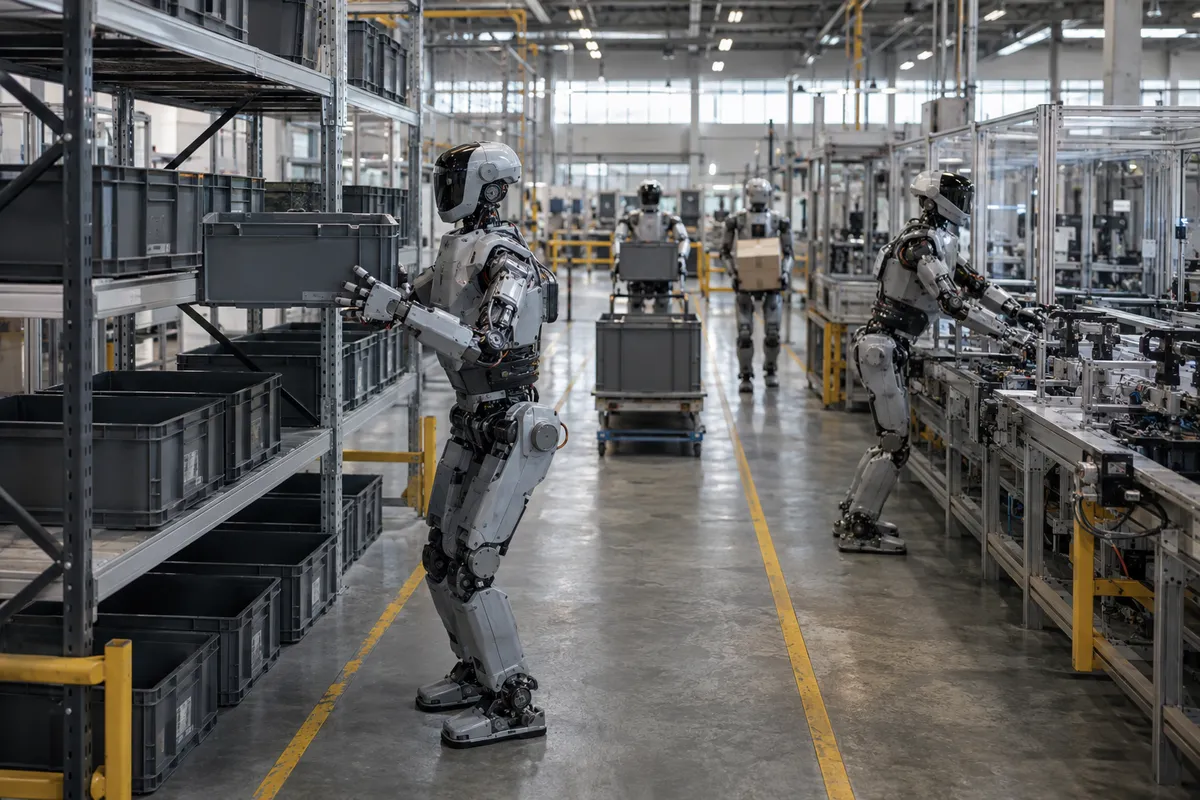
Smart Analytics Global (SAG) estimates that 19,100 humanoid robots shipped worldwide in the first half of 2026, up 272% from 5,100 a year earlier. AGIBOT accounted for approximately 8,400 units, Unitree 5,900, Galbot 900, UBTECH 700 and Leju 600. AGIBOT and Unitree alone represented about 75% of reported shipments.
Those numbers are significant. They show an industry moving from prototypes toward manufacturing volume.
But they do not answer the more commercially important question:
Where are those robots actually working?
That question matters because a robot can be produced, sold, shipped, delivered, accepted and operated at different points in its commercial life. Those stages are routinely compressed into a single story about adoption. They should not be.
Shipment proves shipment.
It does not establish that the robot reached an identifiable end customer, entered a productive workflow, operated with limited human assistance, remained in service or produced enough economic value to justify continued use.
New disclosures from Unitree, the world’s second-largest humanoid vendor by SAG’s first-half estimate, show why the distinction matters.
Unitree gives the market a rare look inside the shipment number
Unitree shipped more than 5,500 humanoid robots in 2025, according to its IPO disclosures, giving it a reported 32.4% share of that year’s global market. Reuters reported that real-world factory deployment remained limited and that Unitree’s industrial-application revenue included enterprise reception and tour-guide use alongside intelligent manufacturing and inspection. Enterprise tour-guide uses represented roughly 50% to 70% of that category.
Reporting based on Unitree’s exchange disclosures goes further.
During the first nine months of 2025, research and education represented 73.6% of Unitree’s humanoid revenue. Commercial consumption accounted for 17.39%, while industrial applications represented about 9%. Revenue from more clearly defined work scenarios including intelligent manufacturing, intelligent inspection and logistics distribution totaled RMB15.702 million.
That last number represented only a small share of Unitree’s humanoid business during the period.
It is important not to misuse it.
The disclosure is a revenue breakdown for the first nine months of 2025. SAG’s 5,900 figure is a shipment estimate for the first half of 2026. A revenue share from one period cannot be converted into an operating-unit ratio for another.
But the disclosure establishes something shipment totals cannot.
A large humanoid business can sell thousands of robots without those robots primarily being used as industrial labor.
Research institutions buying robots for development are real customers. Companies buying robots for reception or exhibitions are real customers. Those sales can generate legitimate revenue.
They are simply different evidence from robots performing repetitive production work inside factories and warehouses.
For investors trying to determine how quickly humanoids are moving toward labor substitution and industrial automation, that difference is material.
Commercial does not necessarily mean industrial deployment
The same problem appears in another fast-growing channel: robot rentals.
CNN reported that AGIBOT’s SHAREBOT platform offered humanoid rentals from RMB3,500 per day, including shipping and a human operator who helps control and program the machine. The platform recorded more than 5,500 orders in its first three months, according to the report. CNN also cited Chinese state media estimating more than 153,000 robot rental businesses in the country, although that broad figure depends heavily on how a robot rental business is defined.
This is genuine commercialization.
A rental operator can buy a robot. The manufacturer can recognize a sale. The machine can be shipped, accepted and repeatedly hired by customers.
Yet a humanoid appearing at an event with a human operator is not equivalent to a humanoid autonomously performing a production task for an industrial customer.
The distinction becomes especially important when market researchers describe shipments as “industrial and commercial.”
SAG estimates that more than 70% of global humanoid shipments in the first half of 2026 went to industrial and commercial applications. Applied mechanically to the 19,100 total, that means more than 13,370 units fall somewhere inside that broad classification. SAG identifies manufacturing, logistics, warehousing and other structured environments as important commercialization paths, but its public article does not provide a customer-level breakdown of those units.
That does not make the estimate wrong.
It means “industrial and commercial” should not automatically be read as “robots replacing productive labor.”
The category may contain substantially different forms of use, and those differences matter commercially.
Some robots are clearly doing real factory work
The evidence is not uniformly weak.
AGIBOT has published unusually detailed operating data from its work with Longcheer Technology.
In April 2026, AGIBOT said multiple G2 robots were operating in consumer-electronics production, with throughput of up to 310 units per hour, cycle times of approximately 19 to 20 seconds, a success rate above 99%, production of approximately 3,000 units per shift and more than 140 cumulative hours of continuous operation. The company reported downtime loss below 4% and said production-line integration had been completed within 36 hours.
Those metrics are materially stronger evidence than a shipment announcement or demonstration video.
AGIBOT also said it planned to expand the deployment to 100 robots by the third quarter of 2026. That is an important prospective signal, but it remains a plan until the expansion occurs and is verified. [5]
There is another limitation. The performance figures are published by AGIBOT. They are detailed and attributable, but they are not equivalent to independently audited fleet data.
That distinction is not an argument against the deployment. It is a statement about evidence quality.
A stronger benchmark can be seen at BMW.
BMW says Figure 02 worked at its Spartanburg plant for ten months in 2025, operating ten-hour shifts five days per week. The customer reports that the robot moved more than 90,000 components, accumulated about 1,250 operating hours and assisted in the production of more than 30,000 BMW X3 vehicles.
That is the type of evidence the humanoid market needs more frequently: a named customer, a defined task, a duration, operating hours and measurable production context.
It does not prove that Figure’s economics work at scale. It does show what customer-confirmed operating evidence can look like.
The same standard should apply to every vendor.
Even industrial-focused vendors acknowledge the productivity gap
UBTECH provides another useful reality check.
In January 2026, UBTECH chief brand officer Michael Tam told the Financial Times that Walker S2 robots were about 30% to 50% as productive as human workers, and only on selected tasks such as stacking boxes and quality control. The company said at the time that it hoped to increase performance toward 80% of human productivity by 2027.
That admission matters because UBTECH is not positioning Walker S2 primarily as a research platform.
Its focus is industrial use.
A robot can therefore be operating in a real factory and still be far from proving an attractive labor-replacement case. Productive operation, autonomy, reliability and economics remain separate questions.
This is why shipment volume is valuable but insufficient.
The 60,000-unit forecast raises the stakes
SAG expects global humanoid shipments to approach 60,000 units in 2026, with industry revenue of approximately $1.6 billion.
Starting from 19,100 units in the first half, reaching 60,000 would require approximately 40,900 additional shipments in the second half.
That is about 114% more than first-half volume.
If the industry achieves it, the manufacturing accomplishment will be substantial.
But a shipment surge of that magnitude would make the deployment question more urgent, not less.
For investors, the next useful dataset is not simply another forecast of how many humanoids will leave factories.
It is what happens to them afterward.
How many reached named customers?
How many were accepted?
How many were purchased rather than placed for evaluation?
What tasks were they assigned?
Were they autonomous, supervised or teleoperated?
How many hours did they operate?
Were deployments continued or expanded?
What throughput, intervention, reliability or productivity metrics were achieved?
Those questions turn a shipment number into commercial evidence.
The industry needs a shipment-to-work bridge
Humanoid robotics has made measurable progress.
Thousands of robots are being manufactured and sold. Unitree has demonstrated that a humanoid hardware company can generate substantial revenue from research, education and other buyers. AGIBOT has published detailed factory operating metrics. Rental fleets are creating another monetization channel. BMW has publicly documented sustained operation of a humanoid inside automotive production.
The evidence does not support the claim that humanoids are merely demonstrations.
It also does not support treating 19,100 reported shipments as 19,100 productive workers.
Both conclusions would go too far.
A publicly untraceable shipment should not be classified as fake, unused or unsuccessful. It simply cannot be assigned stronger customer-operation evidence until more information becomes available.
That is the distinction the market now needs.
The humanoid industry is beginning to prove that it can build and ship robots at scale.
The next commercial milestone is harder.
Show where they went. Show what they did. Show how long they worked. Show whether the customer came back for more.
The shipment leaderboard is becoming interesting.
The deployment evidence behind it will matter more.
Sources
- Smart Analytics Global, “SAG: Global Humanoid Robot Shipments Surged 272% YoY to 19.1K Units in 1H 2026; AGIBOT Overtook Unitree for No. 1 Position”
Source type: Tier 2, independent market research and shipment estimates
https://smartanalyticsglobal.com/global-humanoid-robot-shipments-2026-agibot-unitree/ - Reuters, “Unitree plans Shanghai IPO, testing interest in humanoid robots”
Source type: Tier 2, strong independent evidence based on regulatory disclosure
https://www.reuters.com/world/asia-pacific/unitree-plans-shanghai-ipo-testing-interest-humanoid-robots-2026-03-20/ - 36Kr Europe, “Unitree has made money, but humanoid robots haven’t.”
Source type: Tier 2, independent secondary analysis based on Unitree listing disclosures
https://eu.36kr.com/en/p/3735276262601477 - CNN, “China’s humanoid robots have captivated the world. A rental market is exposing their limits”
Source type: Tier 2, strong independent reporting; reviewed through CNN Newsource republication
https://ktvz.com/money/cnn-business-consumer/2026/06/29/chinas-humanoid-robots-have-captivated-the-world-a-rental-market-is-exposing-their-limits/ - AGIBOT, “AGIBOT and Longcheer Technology Achieve World’s First Embodied AI Deployment in Consumer Electronics Precision Manufacturing Mass”
Source type: Tier 3, detailed first-party disclosure; company-controlled source
https://www.agibot.com/article/231/detail/60.html - BMW Group, “First humanoid robot introduced in Plant Leipzig”
Source type: Tier 1, direct customer confirmation and customer-attributed operating data
https://www.bmwgroup.com/en/news/general/2026/humanoid-robot-in-leipzig.html - Financial Times, “Robots only half as efficient as humans, says leading Chinese producer”
Source type: Tier 2, strong independent reporting with named company executive
https://www.ft.com/content/0f831781-b450-4644-9f83-b3f76968a4af