
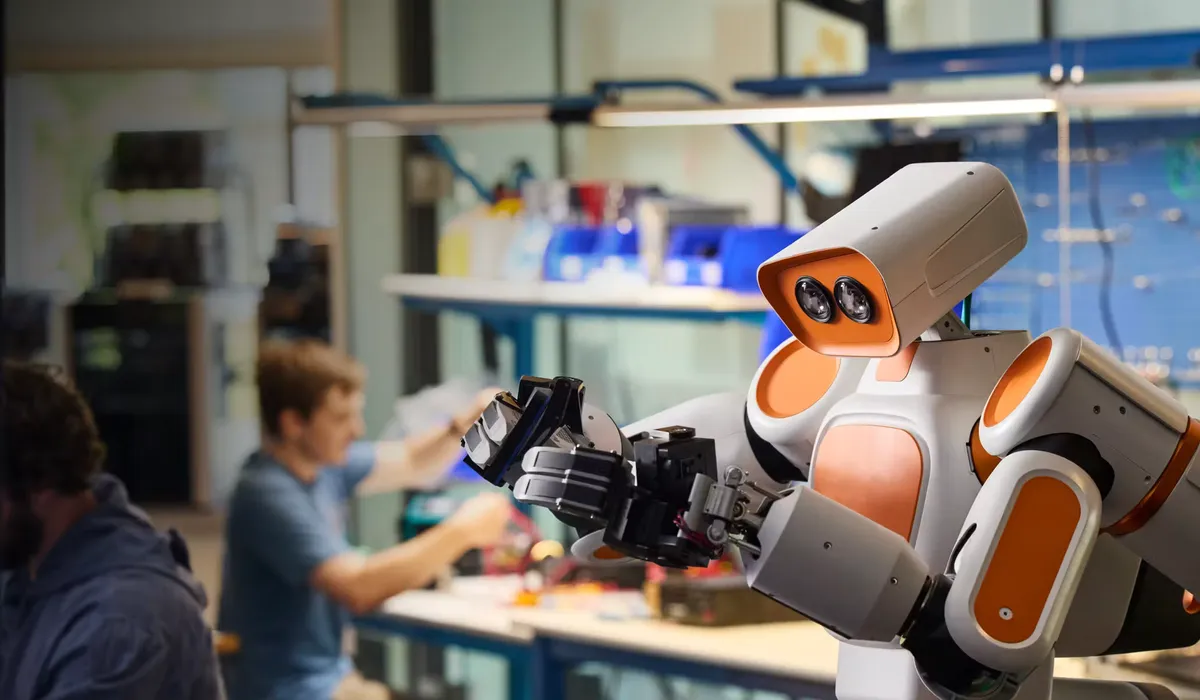
Walden Robotics enters the humanoid robotics market with more commercial evidence than a typical stealth launch, but less operating proof than its production-focused positioning might initially suggest.
The Cambridge company emerged publicly on July 15 with $300 million in seed financing at a stated $1.1 billion valuation. More importantly for commercial diligence, Walden says its general-purpose robots have been doing production work at a Toyota plant in North America since February 2026, progressing from an initial pilot to what the company calls real work in less than two months. Toyota Ventures separately confirms that Walden was spun out of Toyota Research Institute in January 2026 and that it participated in the financing round.
That is a materially stronger starting point than a laboratory video, preorder or future pilot announcement. It is not, however, the same as independently verified commercial deployment. The public sources reviewed do not provide a Toyota-controlled operating record identifying the plant, robot count, exact task, payment status, operating hours, uptime, productivity or intervention rate.
What the public record establishes
Walden grew out of work at Toyota Research Institute, with a founding team that includes CEO Russ Tedrake and other former TRI robotics leaders. Toyota Ventures describes the company as a January 2026 spinout focused initially on humanoid robots with wheeled bases for factory applications. The investor says the hardware approach is intended to support high duty cycles while avoiding some of the complexity and cost associated with bipedal locomotion.
Walden itself goes further. It says its robots have worked in production at a Toyota plant since February and currently promotes machine tending, tool setting, parts kitting and assembly as manufacturing applications.
IEEE Spectrum’s reporting provides useful independent context around that strategy. Tedrake described a deliberate choice to use wheels instead of legs and argued that manufacturing economics require applications with high robot utilization. The reporting also discusses the Toyota factory deployment, but its operating evidence is based on Walden executives rather than customer-side metrics or independent site observation.
The distinction matters. Independent reporting can strengthen confidence that Walden has a serious deployment program and that its design decisions are commercially motivated. It does not independently establish how many robots are working, how well they perform or whether Toyota is paying for the activity.
Meaningful operating signal, capped commercial proof
Under the Humanoid Analytics Evidence Standards, the Toyota event supports an Operational Deployment classification with a proposed Evidence Score of 6/10.
The raw component score is 7. The named Toyota environment and the claimed continuation of production work support strong real-world-operation points. The strategic relationship provides some evidence of commitment. But payment remains unclear, and no sufficiently contextualized operating metric is publicly available.
More importantly, the final score is capped at 6 because the central operating claim remains dependent on Walden-controlled disclosure rather than customer-controlled operating evidence or strong independent observation from the factory.
This is an important distinction for investors. A 6 does not mean the deployment is unsuccessful or that Walden’s claim is false. It means the current public evidence cannot support a stronger commercial classification.
The financing should also remain separate. Walden disclosed $300 million in funding and a $1.1 billion valuation, with Toyota and Deviation Capital co-leading the round and a long list of strategic and financial investors participating. Toyota Ventures independently confirms its participation.
That capital may materially increase Walden’s ability to hire, manufacture, deploy and develop its models. It does not increase the deployment Evidence Score.
Remote assistance is the metric to watch
One of Walden’s most commercially important disclosures came after the launch.
On August 6, CTO Ben Burchfiel wrote that every Walden robot operates with a remote assistant available. Walden says robots operate autonomously most of the time, while a remote person can intervene when the system encounters unfamiliar or uncertain situations. The company describes autonomy not as a binary state but as a ratio between robots and remote assistants that should improve as its models learn.
That is a commercially plausible operating architecture. Human assistance can keep production moving, prevent failures from disrupting a workflow and generate valuable training data. Humanoid Analytics does not treat teleoperation or human assistance as evidence of failure.
But it changes the diligence question.
For a system designed to perform sustained industrial work, the intervention rate, duration of interventions and number of robots supported by each remote operator directly affect scalability and operating economics. Walden has not publicly disclosed those figures.
This makes the robot-to-assistant ratio potentially more decision-relevant than another dexterity demonstration. If ten robots require nearly continuous support from several remote workers, the commercial model looks very different from a fleet in which one person provides occasional assistance to dozens of machines.
Walden’s practical hardware strategy points in the same direction. Wheels, adjustable upper-body height and comparatively simple grippers may sacrifice some human-like versatility, but they can reduce unnecessary mechanical complexity for factory environments. IEEE Spectrum’s reporting suggests that this is deliberate: Walden is optimizing for useful, high-utilization industrial work rather than maximum anthropomorphic capability.
That could prove commercially important, but operating metrics are required to determine whether the tradeoff is working.
Toyota is strong evidence, but also an unusually aligned proving ground
There is another reasonable interpretation investors should keep in view.
Toyota is not simply an unidentified external customer. Walden originated inside Toyota Research Institute, Toyota entities invested in the company, and Walden describes Toyota as a deep strategic partner. This relationship could provide Walden with unusually strong access to manufacturing expertise, workflows and deployment opportunities.
That is strategically valuable. It also means success inside Toyota should not automatically be extrapolated into evidence of broad independent customer demand.
Samsung provides an early test of that question. Samsung SDS disclosed in July that it had made a strategic investment in Walden through Samsung Venture Investment and said it intends to expand robotics partnerships and pursue robot-orchestration services linked with manufacturing execution systems. Walden separately says it is working with Samsung SDS on a proof of concept aimed at manufacturing use cases.
A proof of concept is not yet an operational deployment. If that work progresses into customer-confirmed production use, however, it would materially strengthen the case that Walden’s model can travel beyond its Toyota origins.
What would change the assessment
Walden does not need another high-profile investor to materially improve its commercial evidence.
The strongest next proof would be customer-controlled operating disclosure. Toyota confirming the robot count, production task, duration and current status would strengthen the deployment classification. Payment or procurement evidence would clarify whether the activity represents commercial commitment rather than strategically supported evaluation.
Operating metrics would matter even more: hours worked, task completions, uptime, intervention frequency, failure or recovery rates, productivity versus the previous process and evidence of continued or expanded use.
A second independently confirmed production customer would address another major uncertainty. It would show that the system can move from a highly aligned Toyota environment into a different organization, workflow and integration stack.
Walden has already crossed an important threshold. The public record supports taking its factory strategy more seriously than a demo-only humanoid program. The evidence does not yet support treating the company’s Toyota deployment as fully verified, paid, repeatable operating proof.
For investors, that gap is now the central story. The next meaningful Walden milestone is unlikely to be another funding announcement or partner logo. It is customer-side evidence showing how many robots are working, how independently they operate, what they accomplish, what the deployment costs and whether customers choose to expand it.
Sources:
- Walden Robotics, “Walden Robotics Launches with $300 Million to Put General-Purpose Robots to Work Today”
Source type: Tier 3, detailed first-party disclosure, company-controlled.
https://www.waldenrobotics.com/news/walden-robotics-launches-from-stealth/ - Toyota Ventures, “Accelerating Factory Automation Through Physical Intelligence: Our Investment in Walden Robotics”
Source type: Tier 3, detailed first-party investor disclosure.
https://medium.com/toyota-ventures/accelerating-factory-automation-through-physical-intelligence-our-investment-in-walden-robotics-799f3420bc54 - Walden Robotics, “Walden Robotics | Build the Future of Physical AI with Us”
Source type: Tier 3, detailed first-party product and deployment disclosure, company-controlled.
https://www.waldenrobotics.com/ - IEEE Spectrum, “Walden Robotics Partners With Toyota on Practical Humanoids”
Source type: Tier 2, strong independent reporting with named sources; not direct customer-side operating confirmation.
https://spectrum.ieee.org/humanoid-robots-walden-robotics-toyota - Walden Robotics, “Autonomy is a ratio”
Source type: Tier 3, detailed first-party technical and operating disclosure, company-controlled.
https://www.waldenrobotics.com/news/autonomy-is-a-ratio - Samsung SDS, “삼성SDS, 2분기 매출 3조 7,178억 원, 영업이익 2,318억 원 잠정 실적 발표”
Source type: Tier 3, detailed first-party corporate disclosure confirming Samsung SDS’s strategic investment and robotics-partnership strategy.
https://www.samsungsds.com/kr/news/ss-260730.html - Walden Robotics, “Samsung Backs Walden’s Mission to Put Robots to Work Today”
Source type: Tier 3, detailed first-party partnership disclosure, company-controlled.
https://www.waldenrobotics.com/news/walden-samsung-sds-partnership