
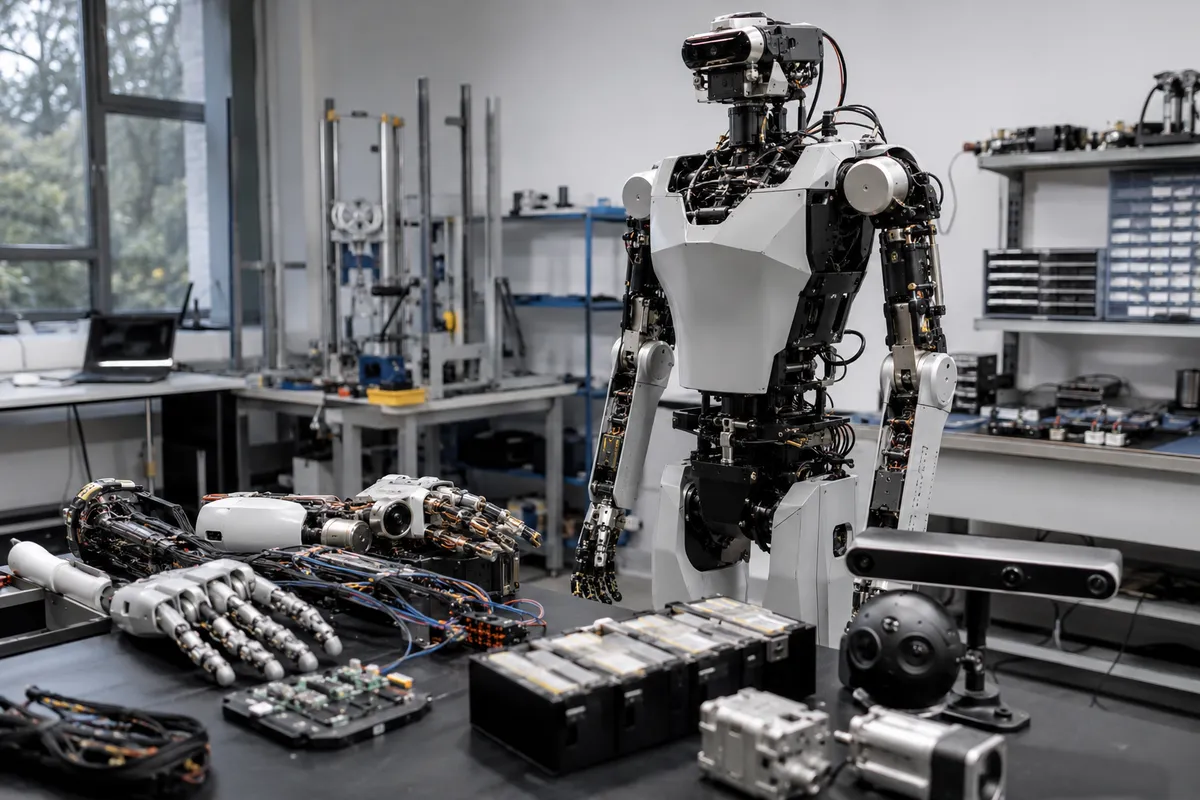
Humanoid robotics has an unusually important characteristic for startups: many of the industry’s biggest problems are not confined to the companies building complete robots.
They sit underneath them.
Actuators remain expensive and difficult to scale. Dexterous hands still struggle with the combination of strength, compactness, sensing, and reliability. Robot learning requires large amounts of physical-world data. Safety requirements become harder when robots leave cages and work around people. Factories still need robots connected to existing equipment, software, networks, and production processes. Once deployed, somebody also has to measure reliability, diagnose failures, recover from exceptions, and keep fleets productive.
That creates a potentially important second investment landscape alongside the humanoid OEM race: companies selling the picks and shovels required by many robot manufacturers.
McKinsey’s April 2026 analysis of the humanoid supply chain identifies actuators, precision transmission components, force and tactile sensing, and integrated compute and control as areas where supply constraints or immature supplier ecosystems could restrict scale. Its estimates put actuation at roughly 40 to 60 percent of a humanoid robot’s bill of materials, making it both a performance constraint and the largest cost category in its analysis.
The opportunity is not that every robotics component needs a startup. Motors, batteries, cameras, power electronics, and other components already benefit from large automotive, electronics, and industrial supply chains. The more interesting white space appears where humanoid-specific performance requirements meet weak standardization, limited qualified supply, difficult integration, or missing operational infrastructure.
Ten bottlenecks worth watching
| Bottleneck | Startup opportunity | Why it matters |
|---|---|---|
| Precision actuation | Integrated actuators, strain-wave alternatives, roller screws, compact motor-drive modules | Actuation is a major cost and performance constraint, while several precision components have shallow supplier bases. |
| Force and tactile sensing | Durable tactile skins, compact force sensors, calibration systems, sensor-fusion software | Manipulation needs contact information that vision alone cannot provide, while tactile architectures remain fragmented. |
| Dexterous hands | Modular hands, finger actuation, tendon systems, hand controllers and manipulation software | Human-like manipulation remains a central robotics challenge, especially for varied objects and contact-rich tasks. |
| Physical-AI data | Teleoperation, demonstration capture, labeling, data QA, synthetic-data pipelines | Collecting diverse real-robot data is expensive and difficult to scale. |
| Safety infrastructure | Functional-safety software, verification, risk tools, testing and certification workflows | Robots working around people require system-level safety engineering, not only capable AI. |
| Robot compute and control | Real-time robot ECUs, deterministic control, safety middleware, fault management | Humanoids combine AI compute, distributed motor control and safety logic without a broadly standardized control platform. |
| Brownfield integration | Hardware abstraction, connectors, workflow adapters, factory middleware | Existing factories contain heterogeneous equipment and software that robots must communicate with. |
| Fleet reliability | Observability, predictive maintenance, fault diagnosis and remote recovery | Commercial economics depend on sustained useful operation, not occasional task completion. |
| Performance verification | Independent benchmarks, acceptance testing and procurement metrics | Buyers still need comparable evidence of what humanoids can reliably do. NIST is developing a new humanoid baseline benchmark for this reason. |
| Uptime infrastructure | Autonomous charging, battery swapping, energy scheduling and duty-cycle optimization | The cell supply chain may be relatively mature, but achieving productive shift-level uptime remains a system problem. |
This is a qualitative opportunity map, not a Humanoid Analytics Evidence Score or an investment ranking.
Hardware still has some of the hardest choke points
The actuator stack is one of the clearest supplier opportunities.
Humanoid joints need high torque from small, lightweight packages while controlling backlash, heat, efficiency, shock loads and lifetime. McKinsey identifies strain-wave drives, planetary roller screws and some robotics-grade linear-motion components as areas where precision requirements, capacity and qualification could create supply pressure. Force and torque sensing presents similar problems because manufacturing and calibration are specialized.
Hands compound the difficulty.
A useful general-purpose hand needs actuation, transmission, tactile sensing, force control, compliance and software in a very small volume. A 2026 IEEE Robotics & Automation Magazine survey describes human-like dexterous manipulation as a continuing central challenge and highlights both data collection and learning as unresolved parts of the problem.
For startups, the opportunity may therefore be larger at the subsystem level than at the component level. An OEM may prefer a validated hand, actuator module or sensing package with known interfaces and performance over separately qualifying dozens of components.
The risk is that large industrial suppliers capture this market first. Precision motion, bearings, motors, power electronics and manufacturing are established industries. A startup needs more than a technically impressive part. It needs a reason for robot OEMs to qualify it instead of an incumbent.
Robotics has a data infrastructure problem
The second major opportunity is less visible because it does not appear directly in the robot’s bill of materials.
Robots need data.
Unlike language models, which can learn from enormous existing digital corpora, useful physical interaction data often has to be generated by robots, humans demonstrating tasks, simulation systems or teleoperators. NVIDIA explicitly describes collecting, curating and annotating physical-AI data as time-consuming and a bottleneck for developers. Its 2025 physical-AI dataset release was designed in part to reduce that barrier.
That creates multiple businesses rather than one.
Startups can build teleoperation hardware. Others can capture synchronized vision, tactile, force and proprioceptive data. Others can clean and standardize datasets across robot embodiments. Synthetic-data companies can generate additional training trajectories. Data infrastructure can track provenance, task success, intervention and failure cases.
The valuable asset may not simply be “more robot data.” It may be high-quality data tied to difficult industrial tasks, rare failures and measurable outcomes.
That distinction matters. Generic datasets can become commoditized. Proprietary data from real workflows, collected with permission and structured for training and evaluation, could be harder to replicate.
The deployment layer may be as valuable as the robot
A robot that works in a laboratory is only part of an automation system once it enters a factory.
BMW’s customer-side account of its Figure 02 deployment in Spartanburg illustrates the point. BMW reported around 1,250 operating hours and more than 90,000 components moved during the program. It also said the project required involvement from production IT, occupational safety, process management and shop-floor logistics, along with safety modifications, improved 5G coverage and standardized integration with BMW’s robotics environment.
Those details expose another startup layer.
Humanoids need integration with manufacturing execution systems, warehouse systems, machines, sensors, fleet managers and safety infrastructure. NIST has separately identified robot integration as difficult and expensive, noting that custom hardware and software and poor interoperability can impede adoption.
This creates room for something resembling an enterprise software stack for physical automation: hardware abstraction, deployment tooling, workflow orchestration, observability, permission systems, digital twins, incident records, maintenance systems and remote intervention.
Once several robot brands operate inside the same organization, customers are unlikely to want a completely separate operational stack for every OEM.
That could make the control plane above individual robots strategically valuable.
Safety and proof are products too
Safety should not be treated only as a compliance cost.
ISO published revised industrial robot safety standards, ISO 10218-1 and ISO 10218-2, in 2025. ISO is also working on additional common safety requirements covering parts of service and industrial robotics outside existing standards. The evolving standards landscape suggests that safety engineering will remain an active infrastructure requirement as robots move into more varied environments.
There is therefore a plausible market for safety validation software, simulation, logging, redundant controls, incident analysis and certification support.
A closely related opportunity is independent performance verification.
NIST launched work on a Humanoid Robot Baseline Performance Benchmark in 2026, explicitly arguing that a new benchmark is needed to compare current humanoid capabilities. Its proposed tests cover mobility, manipulation, coordinated loco-manipulation and basic reasoning.
That is a commercial signal in a broader sense. As buyers move from evaluating demonstrations to procurement, they need repeatable answers to questions such as: How often does the task succeed? Under what conditions? How many interventions are required? What happens after a fall? How quickly can the robot recover? What is its useful uptime?
The market needs not only better robots, but better ways to prove that robots are good enough.
Where the startup opportunity is strongest
The most attractive bottlenecks are likely to share four characteristics.
First, multiple robot OEMs have the same problem. That expands the addressable customer base and reduces dependence on one platform.
Second, qualification creates switching costs. A component or software system embedded deeply in a safety, control or manufacturing architecture can become difficult to replace.
Third, performance improves through accumulated data or operating experience. Reliability platforms, tactile systems, data infrastructure and integration software can become more valuable as deployments grow.
Fourth, the solution removes a bottleneck customers will pay to remove now, rather than solving a problem dependent on millions of humanoids being sold in the future.
That last test is important.
Some component opportunities will eventually be large but may be difficult startup markets today because robot volumes are still uncertain. Conversely, integration, testing, teleoperation, data tooling and specialized sensing can potentially earn revenue during the pilot phase.
The least optimistic interpretation is also important: many supposed startup opportunities may ultimately be captured by automotive suppliers, semiconductor vendors, industrial automation companies and robot OEMs themselves. Vertical integration remains rational while designs change quickly and supplier specifications remain unstable. McKinsey’s research explicitly notes that robot makers often build critical subsystems internally because suitable supplier platforms do not yet exist.
That means the opportunity is real, but it is not automatically a startup opportunity.
The strongest companies will need to prove that they solve a bottleneck better than both vertical integration and established industrial suppliers.
For investors, that may be the more useful way to approach the humanoid market. Instead of asking only which complete robot will win, ask which constraints almost every credible robot program must eventually pay someone to solve.
The winners may include humanoid OEMs.
They may also include the companies making humanoids cheaper to build, easier to train, safer to deploy, simpler to integrate, and more reliable to operate.
Sources:
- McKinsey & Company, “Turning humanoid supply chain constraints into billion-dollar wins”
Source type: Tier 2, strong independent evidence
https://www.mckinsey.com/industries/industrials/our-insights/turning-humanoid-supply-chain-constraints-into-billion-dollar-wins - IEEE Robotics & Automation Magazine, “The Developments and Challenges Toward Dexterous and Embodied Robotic Manipulation: A Survey”
Source type: Tier 2, strong independent evidence
https://ramagazine.ieee.org/2026/04/17/the-developments-and-challenges-toward-dexterous-and-embodied-robotic-manipulation-a-survey/ - NVIDIA, “NVIDIA Unveils Open Physical AI Dataset to Advance Robotics and Autonomous Vehicle Development”
Source type: Tier 3, detailed first-party disclosure, company-controlled
https://blogs.nvidia.com/blog/open-physical-ai-dataset/ - International Organization for Standardization, “ISO 10218-1:2025 – Robotics – Safety requirements – Part 1: Industrial robots”
Source type: Tier 1, direct or official evidence
https://www.iso.org/standard/73933.html - International Organization for Standardization, “ISO 10218-2:2025 – Robotics – Safety requirements – Part 2: Industrial robot applications and robot cells”
Source type: Tier 1, direct or official evidence
https://www.iso.org/standard/73934.html - International Organization for Standardization, “ISO/WD 25874.2 – Robotics – Safety requirements”
Source type: Tier 1, direct or official evidence
https://www.iso.org/standard/91815.html - National Institute of Standards and Technology, “Robotic Systems Interoperability and Integration”
Source type: Tier 1, direct or official evidence
https://www.nist.gov/programs-projects/robotic-systems-interoperability-and-integration - BMW Group, “BMW Group: First humanoid robot introduced in Plant Leipzig”
Source type: Tier 1, direct customer confirmation
https://www.bmwgroup.com/en/news/general/2026/humanoid-robot-in-leipzig.html - National Institute of Standards and Technology, “Humanoid Robot Baseline Performance Benchmark”
Source type: Tier 1, direct or official evidence
https://www.nist.gov/el/intelligent-systems-division-73500/humanoid-robot-baseline-performance-benchmark - McKinsey & Company, “Humanoid robots: Crossing the chasm from concept to commercial reality”
Source type: Tier 2, strong independent evidence
https://www.mckinsey.com/industries/industrials/our-insights/humanoid-robots-crossing-the-chasm-from-concept-to-commercial-reality