
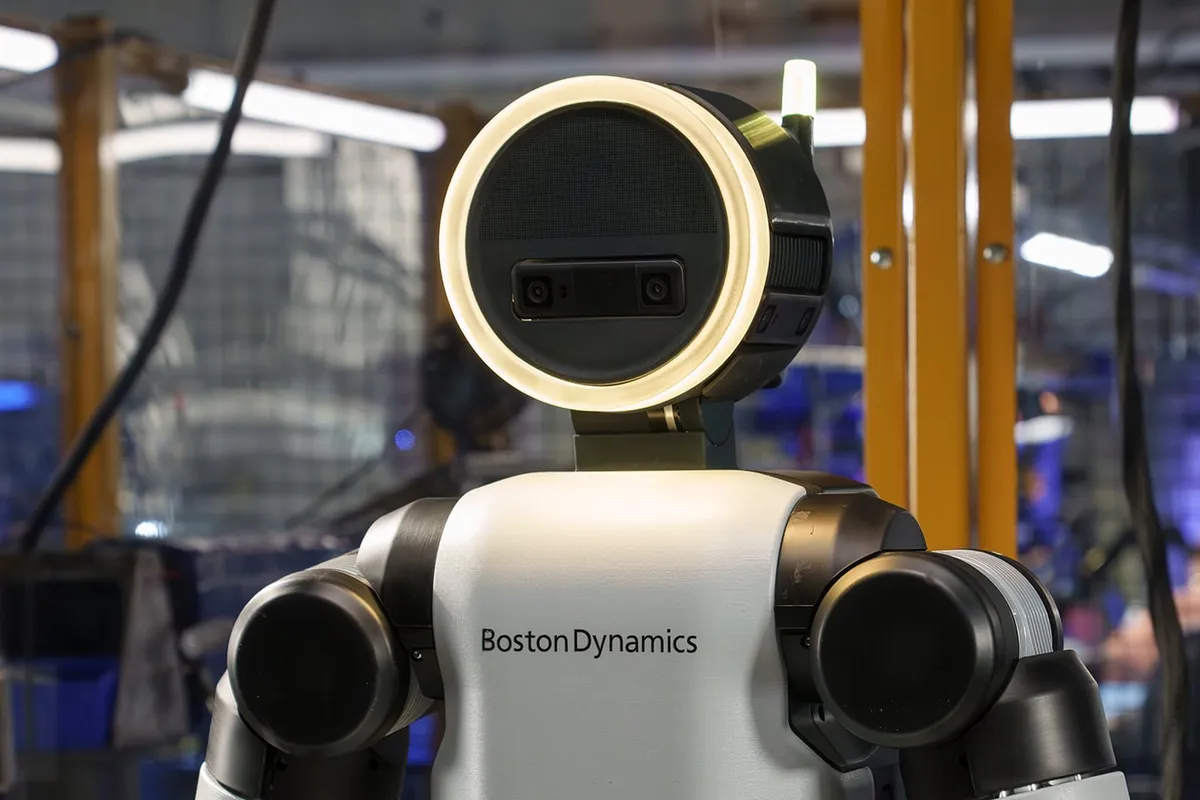
Boston Dynamics says its Robotics Metaplant Application Center at Hyundai Motor Group’s Georgia campus has opened and is training Atlas robots. Announced on September 21, 2026, the facility gives the humanoid program a place to work through manufacturing tasks. For investors, this is a concrete integration milestone. The evidence remains primarily company-sourced, with sustained production performance and paid external deployment still unestablished.
The company describes logistics and parts-sequencing training. Its release also labels a photograph as teleoperation during training. That disclosure does not establish how much assistance eventual production work will require. Axios reports that Boston Dynamics declined to disclose RMAC’s robot count.
The chronology matters. Hyundai’s January 5 roadmap already scheduled RMAC’s opening for 2026, sequencing deployments for 2028 and component assembly for 2030. The September announcement therefore supports progress against a previously disclosed infrastructure plan. It provides no basis to conclude that the production-deployment timetable has accelerated.
Hyundai owns Boston Dynamics. Under Humanoid Analytics’ methodology, activity at an affiliated organization belongs in Internal testing unless an arm’s-length customer relationship is established. A factory address alone cannot settle commercial status. The relevant questions are what work the robots perform, under which operating constraints, and who bears the cost of assistance and recovery.
The investor implication is a better-defined diligence opportunity. Training alongside a manufacturer’s workflows may expose integration problems earlier and make task requirements more concrete. That is an inference from the setting, rather than a measured improvement in reliability or economics. The same access could support a lengthy development program before yielding productive work. Both interpretations remain compatible with the disclosed evidence.
The useful comparison is between the robot’s eventual cost per successfully completed task and the customer’s existing process. That assessment would need to include supervision, resets, maintenance, charging and downtime. It should also test whether a fixed arm or another established automation approach can perform the selected workflow more economically. The reviewed announcements do not provide the operating data needed to make that comparison.
The next evidence milestone is a sustained, defined workflow with disclosed robot numbers, task volumes, operating hours, intervention rates and recovery times. A documented transition from training to production, followed by repeat use and attributable cost or productivity results, would strengthen the commercial assessment. An independently confirmed, paid deployment outside the affiliated network would separately test whether the capability transfers to a customer relationship.
Sources:
- Boston Dynamics, “Boston Dynamics Opens Robotics Metaplant Application Center to Train Humanoid Robots for Manufacturing Tasks”
Source type: Tier 3, detailed first-party disclosure. Company-controlled source, September 21, 2026.
https://bostondynamics.com/news/boston-dynamics-opens-robotics-metaplant-application-center-to-train-humanoid-robots-for-manufacturing-tasks/ - Axios, “Boston Dynamics opens testing ground for humanoid robots”
Source type: Tier 2, strong independent evidence. Reporting includes a direct spokesperson response, September 21, 2026.
https://www.axios.com/local/boston/2026/09/21/boston-dynamics-humanoid-robots-hyundai-metaplant - Hyundai Motor Group, “Hyundai Motor Group Announces AI Robotics Strategy to Lead Human-Centered Robotics Era at CES 2026”
Source type: Tier 3, detailed first-party disclosure. Company-controlled source. January 5, 2026 announcement, used as historical context.
https://www.hyundai.com/worldwide/en/newsroom/detail/0000001100