
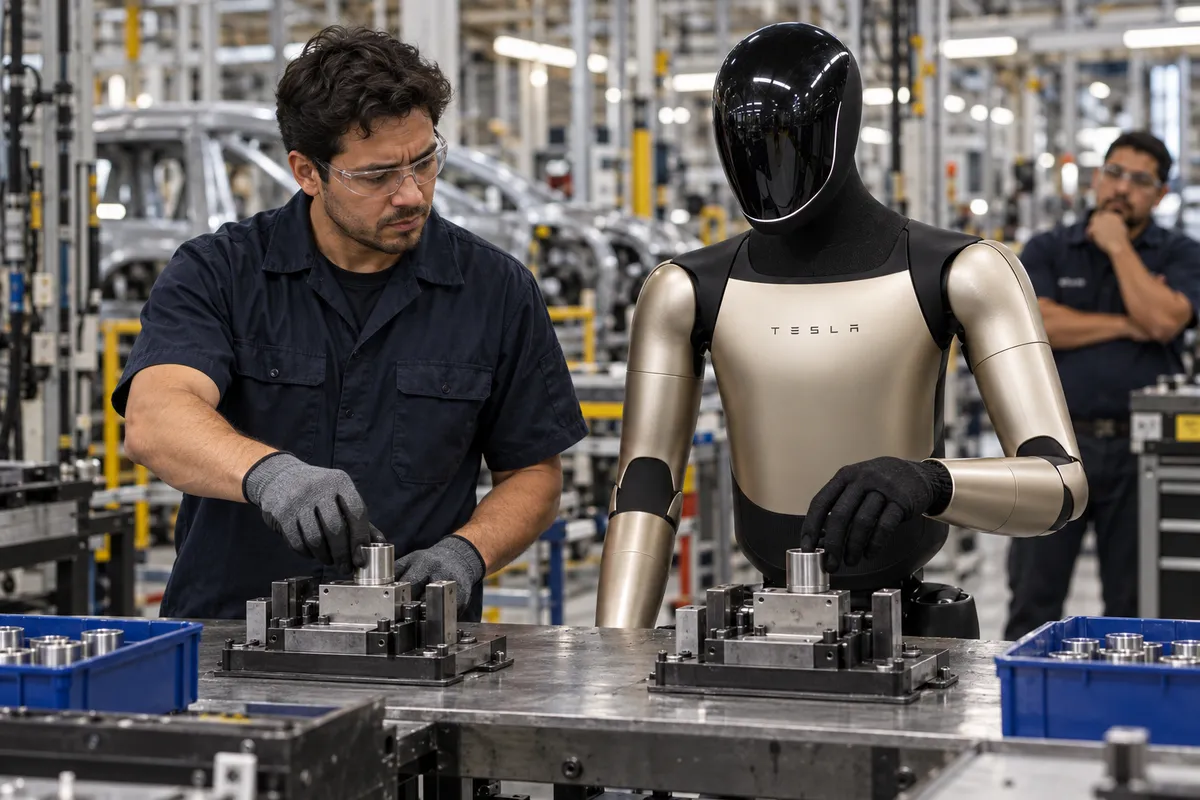
Teaching a robot your job becomes a harder proposition when you suspect it is learning to replace you. Some Tesla factory workers reportedly raised that concern when asked to record their movements for Optimus training. Their complaints point to a potential obstacle for humanoid developers: securing cooperation from the people whose work they hope to automate. The scale of the objections and their effect on training remain unknown.
According to The Next Web’s account of The Information’s September 25 report, Tesla used movement-recording suits on factory workers in Texas and California. Some complained because they understood the robots were intended eventually to replace them. Tesla subsequently shifted collection work to dedicated teams and established training hubs.
That is a narrower claim than the refusal described in ForkLog’s headline. ForkLog’s own article refers to complaints. The available coverage does not establish an organized boycott, widespread refusal, or a work stoppage. It also leaves unanswered whether participation was mandatory or whether anyone faced consequences for declining.
The distinction matters because the employee account comes from one underlying report, examined here through secondary coverage. Repetition across outlets does not provide independent corroboration.
Human labor behind robot training
Earlier reporting shows what supplying that data can involve. In November 2025, Business Insider interviewed five current and former Optimus workers who described repetitive, physically demanding tasks. Workers were expected to produce at least four hours of usable footage per shift. One former employee reported a back injury, while three people described severe motion sickness during teleoperation. Those accounts provide background on collection work; they do not establish the experiences of the factory employees in the newer report.
For employees, the potential bargain is uncomfortable: contribute physical effort and practical knowledge now, without knowing what happens to your role if the robot improves.
For Tesla, dedicated collectors may offer a way to continue gathering demonstrations without relying on reluctant production workers. But changing who collects the data does not establish that concerns about job security have been resolved. Any effect on collection costs, data quality, or development speed remains unmeasured in the available reporting.
The fear of replacement also runs ahead of demonstrated capability. Electrek’s summary of The Information’s reporting describes difficulties handling unfamiliar situations and says most Optimus units remain in internal testing, training, and data collection. Employee concern is evidence of perceived employment risk, not proof that the robot can already take over their jobs.
What would change the assessment
The next evidence should come from the workplace: how many employees objected, whether they could opt out, what Tesla told them about future roles, and whether dedicated collection teams changed training costs or schedules.
For companies planning humanoid programs, this creates a practical question before deployment: what reason do employees have to help? Clear participation terms, credible reassignment plans, and an explanation of how workers benefit could matter alongside the recording equipment.
The reporting identifies a possible conflict between robot development and employee interests. Whether that conflict becomes a material constraint depends on evidence Tesla and its workers have yet to make public.
Sources:
- The Next Web, “Tesla’s Optimus production hits snags with hands, The Information reports”
Source type: Tier 4, promotional or incomplete evidence. Secondary account of reporting not independently verified here.
https://thenextweb.com/news/tesla-optimus-production-hands-suppliers - ForkLog, “СМИ: часть сотрудников Tesla отказалась обучать Optimus себе на замену”
Source type: Tier 4, promotional or incomplete evidence. Secondary reporting.
https://forklog.com/news/ai/smi-chast-sotrudnikov-tesla-otkazalas-obuchat-optimus-sebe-na-zamenu - Business Insider, republished by AOL, “Inside the glass-walled Tesla lab where workers train the Optimus robot to act like a human”
Source type: Tier 5, unverifiable information, applied to the anonymous workplace allegations rather than the publication as a whole.
https://www.aol.com/articles/inside-glass-walled-tesla-lab-101402347.html - Electrek, “Tesla ramps Optimus to hundreds a week, but the robots can’t generalize”
Source type: Tier 4, promotional or incomplete evidence. Secondary reporting.
https://electrek.co/2026/09/25/tesla-optimus-production-ramp-hands-ai-generalization-problems/