
The largest AI software companies no longer treat humanoid robots as someone else’s business. In 2026 alone, OpenAI said it will build its own humanoid, Google DeepMind shipped a model that drives a humanoid’s whole body, and Microsoft released its first robotics model. Anthropic published a hardware interface standard, and DeepSeek bought into Unitree’s IPO with a pact to co-develop robot models.
China’s platform giants moved earlier and wider. Tencent, Alibaba, ByteDance and Ant Group each now run embodied AI models, robot programs or large investment books in the sector.
Yet “entering the humanoid race” means three different things. A few companies are building bodies. More are building brains they hope to put inside anyone’s body. The rest are buying a position through capital, cloud and standards. Each playbook carries a different cost, a different data position, and a different threat to the humanoid makers that exist today.
Why now
The trigger is data. Language models were trained on the open internet, but a robot model needs records of physical contact, such as what the robot tried, how hard it gripped and what moved. Only robots working in the real world produce that.
OpenAI learned this the hard way. Forbes reported that a shortage of data contributed to OpenAI closing its first robotics project in 2021. The same logic runs through DeepSeek’s Unitree deal, which Reuters noted could give the model maker robots and physical-world data.
The second trigger is portability. Google DeepMind says Gemini Robotics 2 can adapt to a new robot body with fewer than 200 examples, per Northeast Times. If a model really moves between bodies that cheaply, the brain becomes a product that can be sold across many makers.
The third is where the bodies are built. Bloomberg and Smart Analytics Global counted 19,100 humanoid shipments in the first half of 2026, 97% from Chinese makers, as China Daily reported. IDC puts the same half nearer 25,000 units, per Humanoid Guide. Either way, US labs face a market where most bodies come from China, which ABI Research analyst George Chowdhury summed up as “China does the bodies and the U.S. does the brains” (AI Business).
In the US, one body-builder and many brain-sellers
Only OpenAI has said plainly that it will build a full humanoid of its own. Meta is building hardware but says the product is the software. Google, Microsoft and Anthropic sell layers that sit above someone else’s body, while Amazon has quietly become both buyer and builder.
OpenAI moves from investor to rival
Sam Altman told the Sources podcast in early September 2026, “We will definitely do a humanoid”. Forbes counted 19 open robotics roles in San Francisco, four of them on actuators, plus firmware, thermal and PCB work. That is deeper hardware work than putting a model on someone else’s chassis.
The move flips OpenAI’s earlier strategy. It led 1X’s $23.5 million round in 2023 and joined Figure’s $675 million round in 2024, but Figure ended the partnership in February 2025 and its CEO now calls OpenAI a competitor (36Kr). OpenAI has disclosed no design, first application, production target or manufacturing partner.
Meta builds a robot to license the brain
CTO Andrew Bosworth called humanoids Meta’s next “AR-size bet” and described an internal robot, Metabot. His stated goal is an Android-style software platform that any maker can license if its robot meets Meta’s specs (CO/AI).
On May 1, 2026, Meta closed the acquisition of Assured Robot Intelligence, whose founders Lerrel Pinto and Xiaolong Wang joined Meta Superintelligence Labs to work with Meta Robotics Studio (Bloomberg Law, Quartz). Terms were not disclosed.
Google DeepMind has the most complete brain on public record
Gemini Robotics 2, released July 30, 2026, is a three-model suite that DeepMind says controls a humanoid from feet to fingertips. On Apptronik’s Apollo 2 with Inspire hands, DeepMind reported pick-up success of 76.3% from a shelf, 68.4% from a table and 45.7% from the floor. These are company-reported figures without independent benchmarks.
The reasoning model, ER 2, is open to developers through Google AI Studio. The action and on-device models remain limited to early-access partners (The Robot Report). Google is the clearest example of the brain-seller playbook, with Apptronik as its lead body partner since December 2024.
Microsoft offers a model and a cloud, not a body
Microsoft Research released Rho-alpha in January 2026, its first robotics model, derived from the Phi family and adding tactile sensing. It is being evaluated on dual-arm setups and humanoids, through an early-access program before a later Microsoft Foundry release (Interesting Engineering).
At CES in January 2026, Microsoft also partnered with Hexagon Robotics to deploy the AEON humanoid on Azure for inspection and manipulation in automotive, aerospace and logistics (Hexagon). Microsoft earlier put $95 million into Figure’s 2024 round.
Anthropic builds the plumbing, not the robot
Anthropic opened a research preview of its Model Hardware Standard on August 27, 2026, a model-agnostic way for AI agents to discover and operate physical devices (Fortune). Early partners include AWS, Universal Robots, Doosan Robotics and Hugging Face, which is adding support to its LeRobot library (Techzine). It targets lab and factory hardware first, not humanoids.
Amazon, the buyer that started building
Amazon trialled Agility’s Digit in 2023 and put $50 million into Figure’s 2024 round through an affiliated fund. In 2025 it began building AI software for delivery humanoids, tested on others’ hardware including Unitree’s, at an indoor “humanoid park” (Allwork.Space).
In March 2026 it bought Fauna Robotics, maker of the 42-inch Sprout humanoid, folding its roughly 50 staff into Amazon’s Personal Robotics Group (eWeek).
Apple, xAI and NVIDIA
- Apple is still at proof of concept. Analyst Ming-Chi Kuo expects no mass production of any Apple robot before 2028, with a tabletop device likely first (MacRumors).
- xAI is the brain for a sister company’s body. Elon Musk has said Grok will be the voice and brain of Tesla’s Optimus, and Tesla invested $2 billion in xAI (TechCrunch).
- NVIDIA sells the shovels. Its open Isaac GR00T reference humanoid, built on Unitree’s H2 Plus and Jetson Thor, ships to research labs from late 2026 (NVIDIA).
China bets on platforms and stakes, plus two in-house robots
China’s software giants mostly sell brains and buy stakes in the makers that already lead world shipments. Only Xiaomi and Ant Group run humanoids of their own design. Tencent, Alibaba, Huawei and JD position themselves as model and cloud suppliers to everyone else.
Tencent, the neutral platform
Tencent’s Robotics X lab dates to 2018, and its Tairos open platform launched at WAIC 2025. Lab head Zhang Zhengyou said Tencent wants to partner with robot makers rather than compete with them (KrASIA).
At WAIC on July 18, 2026, Tencent upgraded this into a full stack with three Hy-Embodied models (a VLA, a VLM and a world model called RxBrain), the TairosAgent framework, and an Embodied-AI-as-a-Service cloud offer (10jqka). One live pilot is a robot tour guide built with Unitree for the Dunhuang Mogao Grottoes digital exhibition centre (Tairos).
Alibaba and Ant Group bring model, cloud and chequebook
Qwen lead Lin Junyang set up a robotics and embodied AI team inside Qwen in October 2025, weeks after Alibaba Cloud led a $140 million round in X Square Robot (TechNode). In February 2026, Alibaba’s DAMO Academy released RynnBrain, an embodied foundation model (Caixin).
Affiliate Ant Group goes further. Its unit Robbyant unveiled the wheeled, two-armed R1 humanoid in September 2025, already in production and sold as part of service packages (SCMP). In July 2026, Ant led a $73.58 million round in Zeroth, its 12th humanoid-sector investment since early 2025 (AI Business).
ByteDance has a research brain and a lab robot
ByteDance folded its robotics team into the Seed model division in April 2025 (36Kr). In July 2025 Seed released GR-3, a VLA model, alongside ByteMini, a two-armed mobile lab robot that hung shirts and cleared tables (Interesting Engineering). ByteDance also joined X Square Robot’s 1 billion yuan round (Caixin).
DeepSeek, a model lab that bought into a body maker
DeepSeek took 140.8 million yuan (about $20.8 million) of Unitree’s Shanghai IPO, per an exchange filing disclosed August 6, 2026. The two Hangzhou firms will co-develop humanoid AI models and give each other purchasing preference, with Unitree favouring DeepSeek’s training services and DeepSeek favouring Unitree’s robots (Reuters via StreetInsider). It is the clearest case of a pure model company paying for a data pipeline.
Huawei brings chips, cloud and partners
Huawei opened a Global Embodied Intelligence Innovation Center in Shenzhen in November 2024. In May 2025 it signed a broad deal with UBTECH, supplying Ascend and Kunpeng chips, cloud and large models for industrial and home humanoids (Silicon UK). An earlier tie-up put Huawei’s Pangu model in Leju’s Kuafu humanoid (Taibo).
For Xiaomi, the factory is the lab
Among China’s internet and software giants, Xiaomi stands out for training its own humanoid on its own production line. After four months in its EV plant, the new-generation robot raised nut-installation success from 90.2% to 98% and held the line’s 76-second cycle for three hours (ProPakistani). Xiaomi says the program is still prototype and internal validation, with no external revenue (36Kr).
JD, Baidu and Meituan
- JD.com launched its JoyAI brand and announced five embodied AI investments in three months around WAIC 2025, showcasing partners such as EngineAI and MagicLab (KrASIA).
- Baidu has stayed light. Its main public link is a 2024 deal connecting UBTECH’s Walker S to the ERNIE model through Baidu AI Cloud (Eye Shenzhen).
- Meituan is a financial backer, including in X Square Robot’s round led by Alibaba Cloud (Robotics & Automation News).
Scorecard of 18 companies and three playbooks
Five of the 18 companies plan or run humanoid bodies of their own. Only Ant Group and Xiaomi have their own humanoids doing real work today, and Xiaomi’s is still an internal factory trial.
| Company | Region | Playbook | Latest move | Evidence |
|---|---|---|---|---|
| Ant Group | China | Build the body | R1 wheeled humanoid in production, sold inside service packages (Sep 2025) | Robots in use |
| Xiaomi | China | Build the body | New humanoid shown after four months on its EV line (Aug 2026) | Robots in use |
| Amazon | US | Build the body | Bought Fauna Robotics, maker of the Sprout humanoid (Mar 2026) | Model or deal released |
| OpenAI | US | Build the body | CEO confirms its own humanoid, with actuator and firmware hiring (Sep 2026) | Stated intent |
| Apple | US | Build the body | Humanoid and non-humanoid concepts at proof-of-concept stage | Reported only |
| Google DeepMind | US | Sell the brain | Gemini Robotics 2, whole-body control on Apptronik Apollo 2 (Jul 2026) | Model or deal released |
| Microsoft | US | Sell the brain | Rho-alpha model and Hexagon AEON humanoid on Azure (Jan 2026) | Model or deal released |
| Meta | US | Sell the brain | Bought Assured Robot Intelligence, builds Metabot in-house (May 2026) | Model or deal released |
| Tencent | China | Sell the brain | Tairos full stack with three Hy-Embodied models (Jul 2026) | Model or deal released |
| Alibaba | China | Sell the brain | Qwen embodied team and DAMO RynnBrain model (Feb 2026) | Model or deal released |
| ByteDance | China | Sell the brain | Seed GR-3 model and ByteMini lab robot (Jul 2025) | Model or deal released |
| xAI | US | Sell the brain | Grok named as Optimus brain, and Tesla invests $2 billion in xAI | Stated intent |
| DeepSeek | China | Buy and enable | 140.8 million yuan in Unitree IPO plus joint models (Aug 2026) | Model or deal released |
| Anthropic | US | Buy and enable | Model Hardware Standard research preview (Aug 2026) | Model or deal released |
| NVIDIA | US | Buy and enable | Isaac GR00T reference humanoid on Unitree H2 Plus (Jun 2026) | Model or deal released |
| Huawei | China | Buy and enable | UBTECH alliance on chips, cloud and models (May 2025) | Model or deal released |
| JD.com | China | Buy and enable | JoyAI brand and five embodied AI investments in three months (2025) | Model or deal released |
| Baidu | China | Buy and enable | ERNIE connected to UBTECH Walker S (2024) | Model or deal released |
Evidence grades follow the publication’s rule that third-party deployment outranks vendor claims. No row yet shows published third-party deployment numbers.
Three bets and one shared body
The brain-sellers hold the cheapest bet and the best published results. The body-builders hold the data loop that every brain needs.
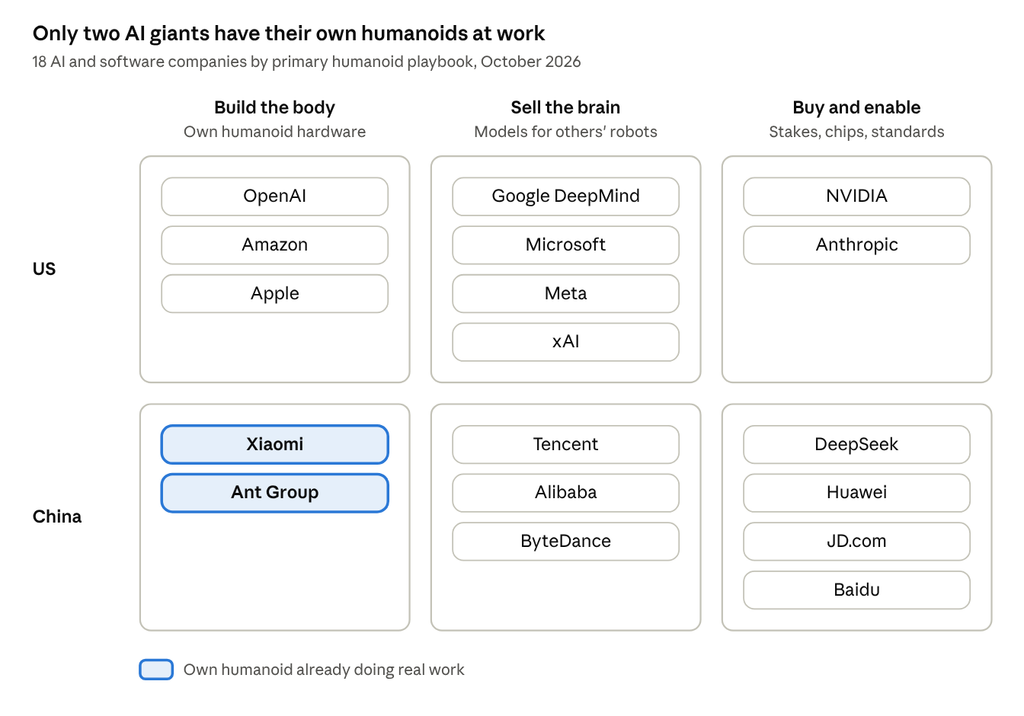
In the US, the middle column is the most crowded. In China, the weight sits on the right, in stakes, chips and cloud around makers that already lead world shipments.
Building the body buys the costliest data
Owning the robot means owning every grip, slip and failure it records. It also means owning the hardware bill. Forbes, citing McKinsey, puts actuators at 40% to 60% of a humanoid’s bill of materials (Humanoid Guide).
Xiaomi and Ant arrive with factories, supply chains and service channels. OpenAI arrives with none of them, which makes its timeline the least predictable in the scorecard. Amazon has the strongest captive demand, in its own warehouses and delivery routes.
Selling the brain is cheap to scale but hard to defend
A licensed model scales across many makers without a factory. The risk is that the best makers want their own brains, as Figure showed when it left OpenAI in February 2025 to build its own models.
Google has the strongest public evidence in this group. Even so, its whole-body numbers are self-reported and its action model is still partner-only.
Buying and enabling carries the least risk and the least control
NVIDIA, Anthropic and Huawei win if the market splinters into many makers that all need chips, interfaces and cloud. DeepSeek’s Unitree stake shows a cheaper route, in which a model lab buys a data pipeline without building a factory.
The shared body is Chinese
One maker keeps turning up across all three columns. NVIDIA’s reference humanoid is built on Unitree’s H2 Plus, and Amazon planned delivery tests on Unitree hardware. DeepSeek bought into Unitree’s IPO, Tencent’s tour-guide pilot runs with Unitree, and Alibaba and Ant are both investors.
For US labs selling brains, the most convenient body is Chinese, and that risk is already live. On July 28, 2026, the FCC added new foreign-made humanoid and quadruped robots to its Covered List, which blocks the authorisation they need for US sale without a security clearance (Interesting Engineering).
AP coverage of the ban cited NVIDIA’s Unitree-based reference design as an example of how tangled the two industries have become, and noted the Pentagon had recently listed Unitree among firms it says aid China’s military (AP via KSL). The brain-sellers’ cheapest body is now their biggest policy exposure.
What it means for humanoid startups
Independent makers face a squeeze from both sides. Former model partners become competitors, as OpenAI now is to Figure. Platform licensors such as Meta and Tencent would turn hardware into Android-style commodity devices.
The startups most likely to keep their margin are those that own a data loop. Figure’s in-house models and Apptronik’s data operations with Google DeepMind and its customers are two versions of that defence (RuntimeWire).
What would change this view
Five signals over the next 12 months would move companies between evidence grades.
- OpenAI names a manufacturing partner or shows a prototype. That would turn stated intent into a hardware program with a supply chain, and make it a direct rival to Figure and 1X.
- A brain-seller lands a paying customer on a robot it does not own. Gemini Robotics 2 leaving early access, a first Metabot licensee, or Rho-alpha on Foundry with named users would test the licensing model.
- Xiaomi or Ant Group publish fleet numbers. Unit counts, hours worked and task success outside pilot stations would lift either one to the top evidence grade.
- DeepSeek ships an embodied model trained on Unitree data. That would show whether a model lab can buy its way into physical data.
- NVIDIA’s Unitree-built reference humanoid reaches US labs, or does not. It is due in late 2026, and its path past the FCC rules will show how far the ban reaches into the brain-sellers’ supply chain.
Sources
- Humanoid Guide, OpenAI confirms it will build its own humanoid robot
- 36Kr, Altman confirms OpenAI will develop humanoid robots
- CO/AI, Meta bets big on humanoid robots with a software-first strategy
- Bloomberg Law, Meta acquires robotics AI company to help build humanoid tech
- Quartz, Meta acquires Assured Robot Intelligence
- Humanoid Guide, Google DeepMind demonstrates Gemini Robotics 2 humanoid control
- The Robot Report, Gemini Robotics 2 enables full body control
- Northeast Times, Google unveils Gemini Robotics 2
- RuntimeWire, Apptronik and Gemini Robotics 2
- Interesting Engineering, Microsoft Rho-alpha robotics model
- Hexagon, Hexagon Robotics collaborates with Microsoft
- Reuters via 21st Century Chronicle, Figure AI funding round investors (2024)
- Fortune, Anthropic makes first move into physical AI
- Techzine, Anthropic MHS connects AI to machines
- Allwork.Space, Amazon humanoid park report
- eWeek, Amazon acquires Fauna Robotics
- MacRumors, Kuo on Apple robot timing
- TechCrunch, Tesla invests $2B in xAI
- NVIDIA, Isaac GR00T Reference Humanoid Robot announcement
- KrASIA, JD and Tencent want to power robots, not build them
- 10jqka, Tencent embodied AI full-stack launch at WAIC 2026 (Chinese)
- Tencent, Tairos open platform
- TechNode, Alibaba Qwen forms robotics team
- Caixin, Alibaba unveils RynnBrain robot model
- SCMP, Ant Group unit unveils R1 humanoid
- AI Business, Chinese tech vendors converge on humanoid robotics
- 36Kr, ByteDance Seed robotics team (German)
- Interesting Engineering, ByteDance GR-3 and ByteMini
- Reuters via StreetInsider, DeepSeek invests in Unitree IPO
- Silicon UK, Huawei and UBTech team up on humanoids
- Taibo, Huawei and UBTECH cooperation agreement
- ProPakistani, Xiaomi humanoid after factory training
- 36Kr, Xiaomi humanoid after four months in its car plant
- Eye Shenzhen, UBTECH and Baidu ERNIE cooperation
- Robotics & Automation News, X Square Robot funding round
- China Daily HK, H1 2026 humanoid shipments
- Humanoid Guide, IDC H1 2026 shipments
- Interesting Engineering, US bans new foreign-made humanoid imports
- AP via KSL, FCC ban targets China