
Figure AI now has more robots than people on its Bay Area campus. Founder Brett Adcock puts it at about 1,500 robots against 700 to 800 staff. It was the most modest claim in his two-hour interview on Peter Diamandis’s Moonshots podcast.
The rest were bigger. Adcock called this the “flip phone era” for humanoids and said Figure 4 is probably the industry’s “iPhone one moment”. He described Helix 3, Figure’s unreleased AI model, as a “baby AGI moment”. And he hopes, though he would not promise, to have robots working for hours in unseen homes within six months.
Several of those claims now carry dates. That makes them testable, which is more than most humanoid announcements offer.
The room was friendly. One host disclosed on air that he is an early Figure investor. Helix 3 was shown to the hosts in a private lab, and across more than two hours Adcock gave no customer shipment numbers.
So we did what we do with every vendor claim. We logged each one, graded the evidence and set the checkpoint that would settle it.
Our read is short. Figure’s boldest claims are unverified. Its most believable statements are the problems it admitted. And on disclosure, the Chinese rivals Adcock criticized are ahead of Figure.
The ledger
We logged ten of Adcock’s biggest claims. One has partial public support. None is verified.
| Claim | Adcock’s timing | Public evidence today | What would settle it | Status |
|---|---|---|---|---|
| Robots doing hours-long tasks end to end in any unseen home | Within six months, so about May 2027 | Helix 2.5 succeeded on 56% of trials across three chores in 30 unseen homes, Figure-reported | Third-party or customer trials with published success and intervention rates on multi-hour tasks | Unverified |
| A robot working about 10 hours in any home | By the end of 2027 | Testing in 20 to 100 new California homes at a time, per Adcock | Paid home deployments with no teleoperation | Unverified |
| A home robot lease | $300 to $500 a month, no launch date | No product, price or terms published | A published price and lease terms | Unverified |
| Helix 3 as a “baby AGI moment” | Unreleased | A private demo for the hosts. Teased as “baby AGI” at an October all-hands, with no evaluations | A public release with evaluations comparable to Helix 2.5 | Unverified |
| Billion-dollar Helix training runs | Summer 2027 | The Nscale deal commits $3.5 billion of compute, with GPUs from the second half of 2027 | The Barstow cluster online and a disclosed run size | Partly corroborated |
| Figure 4 as the “iPhone one moment”, with a near-human hand | No date | Design lock, per Adcock at an October all-hands. Not shown publicly | Launch, plus hand tests against human dexterity benchmarks | Unverified |
| BotQ capacity above 40,000 robots a year across four lines | Now, at full rate | Figure reported more than 350 robots delivered by April 29. Adcock marked the 1,000th on July 23, under eight a day in between | Disclosed annual output and customer deliveries | Unverified |
| A million robots a year from one facility | “Fairly quickly” once chapter three is solved | None | The same disclosures at scale | Unverified |
| Lights-out manufacturing, robots building robots | Within five years | Adcock says Figure 4 was designed for it | A line run end to end without human labor | Unverified |
| Hark, his other company, bigger than Figure | Within 90 days to six months | Sacra estimated Hark had no revenue as of September 2026 | Revenue disclosure or a priced round for either company | Unverified |
Status reflects public evidence on November 19, 2026. We will update this table as each checkpoint passes.
The most believable part is what he admitted
Adcock’s most credible statements were the ones that cut against his own story.
Compute ran out. Adcock said the world “ran out of compute” in September 2026. Figure’s last request for more capacity drew no bids, then a single bid at a bad price. Its Nscale cluster only starts arriving in the second half of 2027.
That timing matters. The six-month home deadline falls around May 2027, before the Nscale GPUs land. Figure has to hit it without them.
Memory is next. Executives at one of the largest memory makers told Figure they had no capacity for humanoids. Another large supplier said humanoids were not in its projections at all. Figure has signed memory partnerships to cover the next few years.
Capacity is not output. BotQ’s 40,000-unit figure is capacity at full rate. Figure’s own milestones imply fewer than eight robots a day between April and July. A host noted that production had slowed, and Adcock said it would scale back up in December and January.
Figure’s revenue is small. Adcock said Hark, his personal AI company, already brings in more revenue than Figure. Sacra estimated Hark had no revenue as of September 2026, and Hark Pro launched only about a month before the interview. If both statements hold, Figure’s commercial revenue is modest.
The support market does not exist yet. Adcock said he has seen no robot insurance products. Financing demand is mostly for commercial contracts, through banks and funds. Figure will maintain home robots itself “for now”.
Tariffs forced a rebuild. Tariffs on Chinese parts hit 270% for one week, he said. Figure has since moved its supply chain out of China.
None of this is a reason to doubt Figure’s engineering. It is a reason to doubt its calendar.
The China gap runs the other way
Adcock named China as Figure’s closest competitor and criticized its robots. On disclosure, China is ahead.
He said Chinese hardware and models “don’t look that great”, though they are improving fast. He described Unitree’s robots as tiny, handless and short on compute. Unitree does sell G1 configurations with three-finger dexterous hands.
Unitree’s IPO prospectus reports 5,632 humanoids sold from 2023 to 2025, with more than 5,500 shipped in 2025 alone. Its 2025 revenue was 1.70 billion yuan.
The same filing estimated Figure’s 2025 shipments at roughly 150 units. Figure has not publicly confirmed that number. It publishes production milestones, not customer deliveries or revenue.
Policy now shapes the race as well. On July 28, 2026, the FCC closed the US market to new foreign humanoid models, a move aimed at Chinese makers. Adcock called it “a little bit of a shock” and said he wants a level playing field.
For investors, the irony is plain. The rival Adcock criticizes is the one whose numbers can be checked.
What it means for buyers, investors and suppliers
Treat Figure’s home timeline as research, its logistics work as the real test, and its admitted gaps as market openings.
Buyers. There is no home robot to buy and no launch date. In logistics, Figure has shown endurance on its own line. A 200-hour livestream in May processed 249,560 packages with zero hardware failures.
At BMW Spartanburg, an 11-month Figure 02 deployment logged over 1,250 hours and loaded over 90,000 parts, by Figure’s account. BMW now plans to use Figure 03 for parts sequencing, with no robot count or schedule disclosed. Ask Figure for intervention rates, uptime and cycle times at your own site, not demo videos.
Investors. Figure’s $39 billion valuation dates from September 2025. It rests on two bets. Helix must keep improving with more data and compute, and BotQ capacity must turn into paid deliveries. Watch for a public Helix 3 evaluation, the Barstow cluster going live and the first disclosed delivery numbers.
Founder bandwidth is a fair question too. Adcock said he is running three companies at once, and predicted Hark may soon be bigger than Figure.
Suppliers and adjacent companies. Adcock named four openings.
- Insurance. He has seen no humanoid insurance products, commercial or consumer.
- Leasing and finance. A $300 to $500 monthly lease needs lessors, and banks and funds already want to finance Figure’s commercial contracts.
- Memory and chips. Suppliers are not planning for humanoid demand, so early capacity deals carry weight.
- Service. Figure maintains its robots itself for now, but Adcock said the end state is “for sure” not Figure doing everything.
If you are sizing one of these openings, our research and advisory work covers it.
Checkpoints we will track
The first real test lands in about six months. Adcock’s home deadline falls around mid-May 2027, six months after the interview aired and before the Nscale GPUs begin arriving.
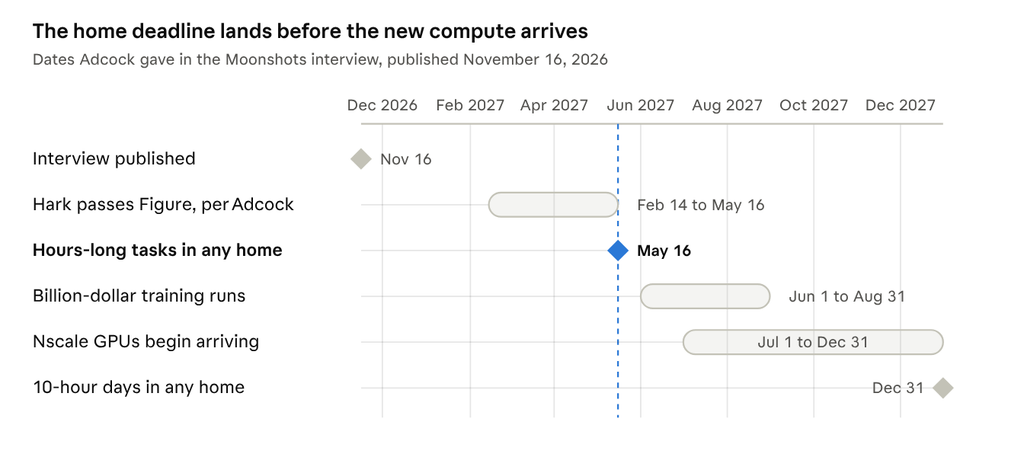
Lights-out manufacturing, his longest claim, runs to about November 2031. We will revisit each checkpoint as its date passes and log the result in the Global Humanoid Company Tracker.