
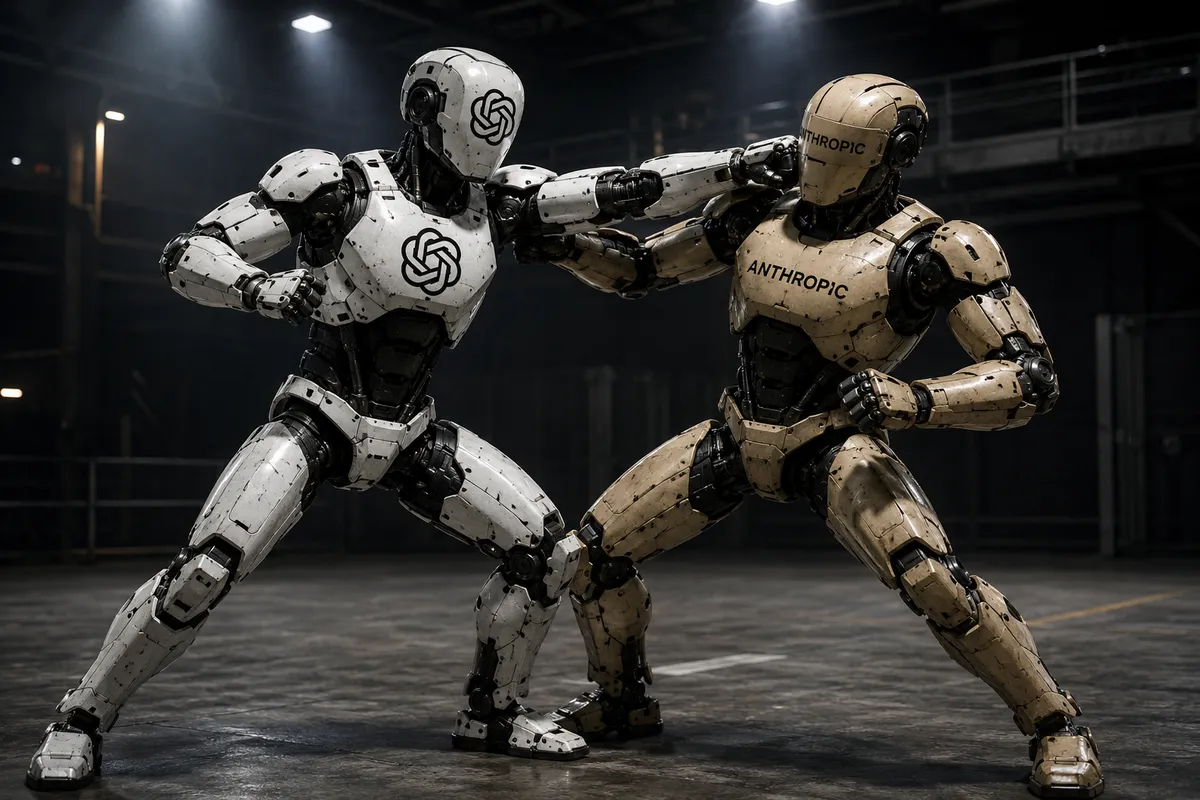
The humanoid robotics race has a new class of competitor.
For the past several years, the industry has largely been framed as a contest between companies building robot bodies, actuators, hands, control systems and manufacturing capacity. Now two of the most powerful frontier AI laboratories are moving directly into the physical layer, but they are approaching it from very different directions.
OpenAI CEO Sam Altman made the clearest declaration yet in a September 1 interview with Alex Heath. Asked whether OpenAI was building a humanoid robot, Altman replied: “We will definitely do a humanoid.” He added that OpenAI expects to explore other robot form factors as well, but argued that the human form has an obvious advantage because much of the physical world has already been designed around people.
That statement turns OpenAI’s growing robotics program into something more concrete. The company is not merely interested in supplying intelligence to someone else’s robot. It intends to build toward a humanoid of its own.
Anthropic is making a different bet. It has not announced a humanoid robot. Instead, its Model Hardware Standard, or MHS, attempts to create a common layer through which AI agents can discover, understand and operate physical equipment. The early examples include robotic arms, laboratory automation systems and industrial cobots.
Taken together, the two moves suggest that the frontier AI competition is beginning to escape the screen.
OpenAI Wants the Brain, and Increasingly the Body
Altman’s humanoid comment did not appear in isolation.
OpenAI now has a dedicated Robotics organization focused on what it calls “general-purpose robotics” in dynamic real-world environments. Its current recruitment spans robotics software, electrical systems, firmware, simulation, safety, field engineering and actuator development.
That last category is particularly important.
OpenAI is recruiting around custom robotic actuators, including motors, transmissions, sensing, thermal systems and structural components. Another actuator-focused role covers development through “production readiness” across mechanical, electrical, firmware, controls, testing, reliability, manufacturing and supply chain.
This looks broader than a laboratory trying to connect an existing language model to an off-the-shelf robot.
OpenAI is assembling capabilities across intelligence, robot data, controls, electromechanical hardware, safety and physical-system operations. One current Field Engineer description refers to a large internal operational environment containing multiple robotic workcells used for ongoing data acquisition. The same posting emphasizes keeping robotic fleets operational and feeding failure information back into engineering.
None of that establishes that an OpenAI humanoid product is close to market. There is still no disclosed humanoid design, prototype specification, launch date, production target or customer deployment.
But the strategic direction has become considerably harder to miss.
Altman also made clear where he believes the real source of differentiation sits. In the interview, he described robot form factor as less important than developing the “brain” that makes the robot work.
That could become OpenAI’s central robotics thesis: build intelligence capable of learning across physical tasks, then develop enough hardware around it to close the training, data and deployment loop.
Anthropic Is Attacking a Different Bottleneck
Anthropic appears to be entering Physical AI from almost the opposite direction.
Its Model Hardware Standard does not begin by asking what robot Anthropic should manufacture. It begins with a more infrastructural question: how should an AI agent communicate with machines at all?
MHS introduces standardized drivers that expose physical devices through common operations such as reading state and writing commands. Devices can describe their capabilities, characteristics and enforced safety limits in a machine-readable form, allowing an agent to discover and operate hardware without requiring a completely new integration for every device. Anthropic says MHS is model-agnostic and can work with any programmable device.
That may sound like infrastructure plumbing, but robotics has an enormous plumbing problem.
Different cameras, arms, sensors, controllers, laboratory instruments and industrial systems expose information differently. Integrating them can require significant custom engineering before an AI system gets anywhere near the actual physical task.
MHS is an attempt to standardize part of that translation layer.
Universal Robots provided an early robotics example. The company said it connected Claude through MHS to four of its cobots. The agent discovered the robots and coordinated them as a single cell, including handing payloads between machines. Universal Robots stressed that its existing robot safety architecture remained underneath the AI layer and retained control of safety functions. The company also explicitly described the experiment as a proof of concept and said MHS is not yet generally available.
Reuters separately reported the August 27 launch of the MHS research preview and Anthropic’s push to let AI agents operate physical scientific and manufacturing devices.
This is not evidence that Anthropic is building a humanoid.
It is evidence that Anthropic wants Claude, and potentially other models using the standard, to have a standardized route into the physical world.
That distinction matters.
The Humanoid Race Is Becoming a Stack War
The most interesting interpretation is therefore not “OpenAI robot versus Anthropic robot.”
There is no Anthropic robot to compare.
The emerging competition is over which layers of Physical AI will become strategically valuable.
OpenAI appears increasingly willing to move vertically. It can develop foundation models, collect robot data, train physical policies, develop control systems and now build hardware subsystems on the path toward a humanoid.
Anthropic is pursuing something closer to an interoperability layer. If MHS or a similar architecture gains adoption, models could interact with many different machines through a more consistent interface rather than requiring bespoke integration for every robot.
That could have important consequences for humanoid companies.
A robot manufacturer today can attempt to own almost everything: the body, actuators, controls, data infrastructure, autonomy stack and application software. But standardized model-to-hardware interfaces could make some parts of that stack more modular.
As Humanoid Analytics argued in its August analysis of Physical AI standardization, the opportunity is not to eliminate the unpredictability of the physical world. It is to make the interface to that unpredictability more consistent.
If that happens, competition could shift.
Robot companies might compete more intensely on mechanical performance, reliability, cost, safety and manufacturing while increasingly consuming intelligence from large model providers. Alternatively, the largest AI laboratories may decide they need deeper control of the body, data and hardware stack to achieve the physical generalization they want.
OpenAI’s current direction suggests it is at least exploring the second path.
Anthropic’s direction suggests the first could remain viable.
What Would Prove These Strategies Matter?
The next important OpenAI milestone is not another statement about humanoids.
It is hardware.
A disclosed platform, prototype, actuator architecture or repeatable autonomous task would make the program more tangible. A manufacturing partner, production plan or external operating deployment would move it into another category entirely.
For Anthropic, the next milestone is adoption.
MHS needs to move beyond selected research partners and proof-of-concept systems. Interoperability across robot manufacturers, different model providers and multiple classes of physical equipment would show whether the standard can become infrastructure rather than simply an Anthropic research project.
Humanoid robots would be an especially important test. A humanoid combines sensing, manipulation, locomotion, safety and rapidly changing state in ways that are substantially more complicated than exposing a single laboratory instrument through a common interface.
The deeper question is whether the leading AI laboratories ultimately need to own robots at all.
OpenAI appears increasingly willing to find out by building one.
Anthropic appears to be asking whether a sufficiently capable model should instead be able to walk into a heterogeneous hardware environment and understand how to operate whatever machines are already there.
Those are very different bets.
But both point in the same direction.
The competition for frontier AI is moving from tokens, browsers and computer screens into motors, sensors, actuators and physical work. The humanoid robotics race is no longer only about who can build the best robot body. It may increasingly be about who controls the intelligence, the hardware interface, the training data and the feedback loop between them.
OpenAI and Anthropic are entering that contest from opposite ends of the stack.
The next question is where they meet.
Sources:
- Sources with Alex Heath, “Sam Altman on OpenAI’s next model and the AI backlash”
Source type: Tier 3, detailed first-party disclosure; direct interview with OpenAI CEO Sam Altman published by an independent host.
https://youtu.be/VeizK1M7V7E?t=3499 - OpenAI, “Careers at OpenAI”
Source type: Tier 3, detailed first-party disclosure; company-controlled source.
https://openai.com/careers/search/?c=c16efb3c-493d-401c-a76f-a493cfccbeb8 - OpenAI, “Technical Program Manager, Actuators”
Source type: Tier 3, detailed first-party disclosure; company-controlled source.
https://openai.com/careers/technical-program-manager-actuators-san-francisco/ - Anthropic, “Previewing the Model Hardware Standard”
Source type: Tier 3, detailed first-party disclosure; company-controlled source with named partner contributions.
https://www.anthropic.com/news/model-hardware-standard-research-preview - Universal Robots, “Testing Agentic Physical AI on UR Cobots”
Source type: Tier 3, detailed first-party disclosure; robot-manufacturer partner describing its own MHS proof of concept.
https://www.universal-robots.com/blog/testing-agentic-physical-ai-univeral-robots-cobots/ - Reuters, “Anthropic unveils new framework allowing AI agents to operate physical devices”
Source type: Tier 2, strong independent evidence.
https://www.reuters.com/technology/anthropic-unveils-new-framework-allowing-ai-agents-operate-physical-devices-2026-08-27/ - Humanoid Analytics, “Standardizing Physical AI: Why Common Hardware Interfaces Could Accelerate Generalization”
Source type: Tier 2, strong independent analytical evidence; used for technical and strategic context rather than independent confirmation of Anthropic’s claims.
https://humanoidanalytics.com/2026/08/31/standardizing-physical-ai-why-common-hardware-interfaces-could-accelerate-generalization/