
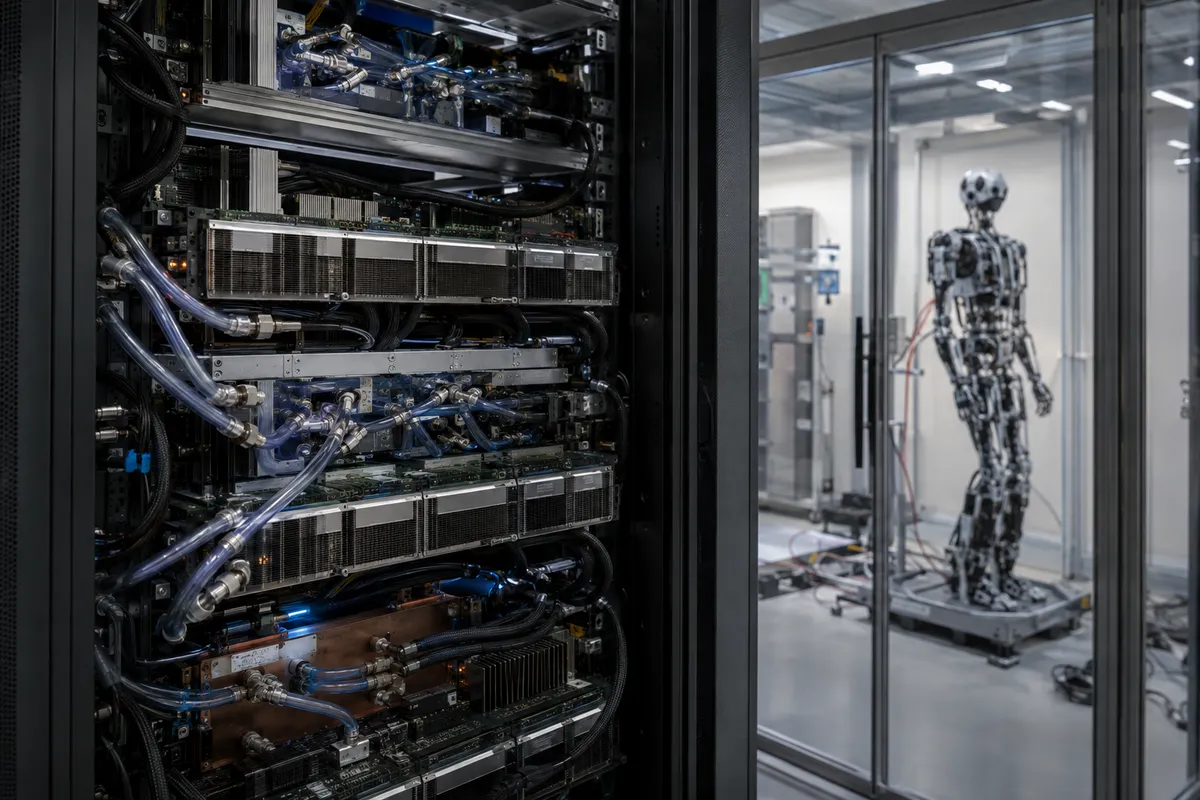
The technological story through 2035 is unlikely to be one sudden moment when artificial intelligence overturns the economy and humanoid robots immediately replace large categories of physical labor. The more credible forecast is both slower and more consequential: technological capability will continue advancing rapidly, while companies, institutions and physical infrastructure absorb those capabilities at a much slower rate.
ChatGPT was released publicly on November 30, 2022, not 2023, although 2023 was the year generative AI became a mainstream business and investment question. The distinction matters because more than three years later, the gap between what AI systems can technically do and what organizations have actually integrated remains substantial.
That gap is probably the defining technology investment problem of the next decade.
AI can improve at software speed. Businesses cannot reorganize at software speed. Humanoid robots face the same adoption problem, then add manufacturing, safety, maintenance, integration and physical reliability. The result is a likely sequence through 2035: AI transforms digital workflows first, organizational redesign follows, and physical AI expands later through narrower industrial applications before reaching anything resembling broad consumer adoption.
AI Capability Is Moving Faster Than Economic Adoption
Technical progress is difficult to dismiss. Stanford’s 2026 AI Index reports rapid improvement across coding, reasoning and agent benchmarks, while also documenting broad growth in AI use. It describes AI capability as continuing to accelerate rather than plateau.
But usage statistics become much less dramatic when the question changes from whether someone has access to AI to whether a business has integrated it deeply into actual operations.
The U.S. Census Bureau reported that from December 2025 through May 2026, only around 17% to 20% of U.S. employer businesses said they were using AI in a business function. Adoption was much higher among larger companies. Around 37% of businesses with at least 250 employees reported AI use, while smaller firms remained well below that level.
Other surveys produce much higher numbers because they define AI use differently. A 2026 international survey summarized by the National Bureau of Economic Research found that 69% of businesses across the United States, United Kingdom, Germany and Australia reported some current AI use. Yet executives averaged only about 1.5 hours of AI use per week, and 89% reported no productivity impact from AI over the previous three years.
These figures are not necessarily contradictory. They reveal the problem.
Experimentation is not integration. Having employees use a chatbot is not the same as redesigning a procurement process, underwriting workflow, engineering organization, supply chain or customer-service operation around AI.
This pattern has historical precedent. Research on the “productivity J-curve” argues that general-purpose technologies require complementary investment in processes, organizational structures, skills and business models before their full productivity effects become visible.
AI may therefore become dramatically more capable while the economy appears to change relatively slowly. The constraint moves from obtaining intelligence to reorganizing work around intelligence.
That is why the world can remain surprisingly stable even during extremely rapid technological progress.
Humanoid Robotics Has an Even Harder Adoption Problem
Humanoid robotics inherits the AI integration challenge and adds physical reality.
Humanoid Analytics currently argues that the industry’s central problem is commercial execution rather than simply getting a robot to walk, manipulate an object or complete an impressive demonstration. Reliability, safety, integration, human support, maintenance and unit economics begin to dominate once a machine leaves the laboratory.
There is now real evidence that humanoids can perform useful customer work.
BMW says Figure 02 operated during a ten-month program at its Spartanburg plant, accumulated approximately 1,250 operating hours, moved more than 90,000 components and supported production of more than 30,000 BMW X3 vehicles. That is materially stronger evidence than a staged demonstration because the metrics come from the customer and relate to an actual production environment.
GXO has separately confirmed a multi-year Robots-as-a-Service agreement involving Agility Robotics’ Digit and described the robots as operating in a live warehouse workflow alongside existing automation.
Yet Humanoid Analytics’ Deployment Tracker shows how exceptional stronger evidence remains. Its July 2026 review placed only Agility Robotics and Figure AI in the highest evidence tier for specific documented events, while much of the wider market remained at pilot, planned-deployment, shipment or demonstration stages.
This is an early market, not a failed one.
It also competes against an enormous installed ecosystem of conventional automation. The International Federation of Robotics reported 542,000 industrial robot installations globally in 2024 alone, more than double the annual level a decade earlier.
A humanoid therefore does not only have to prove that it works. It has to prove that its flexibility creates more economic value than a robot arm, autonomous mobile robot, conveyor, mobile manipulator or redesigned workflow.
That commercial test will take longer than improvements in robot intelligence.
The Most Likely Technology Path From 2026 to 2035
From 2026 through roughly 2028, the largest AI change is likely to occur inside existing jobs rather than through wholesale elimination of those jobs.
AI assistants, coding systems, search, document processing and bounded agents should become increasingly normal. The strongest returns are likely to appear where organizations redesign specific workflows around the technology instead of merely providing employees with another software tool.
This creates opportunity around the adoption layer: data infrastructure, security, evaluation, governance, enterprise integration and vertical applications. The model itself becomes increasingly powerful, but value shifts toward making that model trustworthy and useful inside a particular business process.
Humanoid robotics during this period is likely to remain concentrated in manufacturing, logistics, material handling and other relatively structured environments. The important signal will not be how many companies announce robots. It will be how many customers pay, renew, expand and disclose useful operating metrics.
Between roughly 2029 and 2031, the AI story could shift from assistance toward workflow orchestration. More processes may be handled by systems capable of performing several connected actions rather than answering individual prompts. Humans will remain important, particularly where decisions are regulated, expensive, ambiguous or difficult to verify, but the unit of automation increasingly becomes a workflow rather than a single task.
This period could also produce the first real enterprise inflection for humanoids.
Humanoid Analytics’ current analysis places a plausible enterprise “ChatGPT moment” for humanoid robotics around 2030, provided robots become significantly easier to teach, require less human intervention and demonstrate acceptable customer economics.
That date should not be interpreted as a prediction that millions of robots suddenly appear in 2030. It describes a possible change in deployment logic. Customers begin asking how quickly they can expand a proven system rather than whether the technology works at all.
Paid repeat deployment becomes the critical benchmark. A robot that performs useful work for one customer is evidence of feasibility. A customer that pays again, adds robots, introduces another workflow or expands to another site provides much stronger evidence of economic value.
From roughly 2032 through 2035, AI could become less visible precisely because it becomes more embedded.
Rather than every company describing itself as an “AI company,” intelligence increasingly becomes part of software, operations, engineering, finance, sales, logistics and industrial systems. Employment effects are likely to remain uneven. Some functions may require fewer people, others may expand, and much of the adjustment could occur through slower hiring, job redesign and changed skill requirements rather than immediate mass replacement.
Humanoid robotics could become a financially significant industrial category during the same period without becoming ubiquitous.
Goldman Sachs Research has forecast a $38 billion global humanoid market and around 1.4 million annual shipments by 2035. Morgan Stanley takes a more delayed view, arguing that adoption may remain relatively slow until the mid-2030s before accelerating later.
These forecasts should be treated as scenarios, not operating evidence. Their real usefulness is that very different financial institutions arrive at a similar structural point: meaningful economic scale does not require humanoid robots to become commonplace immediately.
A market can become strategically important long before there is a robot in every factory or home.
Where the Opportunity Actually Sits
The investment implication is broader than choosing which AI model company or humanoid manufacturer will win.
This is analytical inference rather than a recommendation, but the adoption bottleneck suggests that significant value may accumulate in the systems required to turn capability into production.
For digital AI, that includes compute, data infrastructure, enterprise software, security, model evaluation, governance, workflow integration and specialized applications.
For physical AI, the opportunity set expands into actuators, motors, sensors, batteries, dexterous manipulation, simulation, training data, manufacturing, safety systems, fleet orchestration, systems integration, field service, repair and maintenance.
The strongest robot manufacturers may eventually capture substantial value, but only if deployment experience produces a compounding advantage. Each new customer should ideally reduce installation time, intervention requirements, hardware failures and service costs for the next customer.
If those improvements do not appear, growing robot shipments could simply create a growing support burden.
The same principle applies to AI software. The winning system is not necessarily the one producing the most impressive demonstration. It is the one that organizations can reliably integrate into workflows where the value exceeds the cost, risk and organizational disruption required to use it.
What Could Make This Forecast Wrong
The main upside risk is that software and robotics become dramatically easier to integrate.
Agentic AI could move from supervised experimentation into reliable production workflows faster than expected. Better interfaces, standardized enterprise infrastructure and declining inference costs could reduce the organizational burden.
Humanoid robotics could also accelerate if foundation models transfer skills effectively between tasks, Chinese manufacturing drives hardware costs sharply lower, teleoperation requirements fall quickly and customers discover a small number of highly repeatable applications.
The downside risks are equally important. Reliability problems, safety incidents, regulation, power constraints, weak economics, expensive maintenance or continuing dependence on human operators could extend the adoption curve.
The evidence that would materially change the baseline forecast is therefore observable.
For AI, watch for broad increases in the number of business functions using AI, accompanied by independently measured productivity, revenue or cost improvements rather than adoption surveys alone.
For humanoids, watch for customer-confirmed active robot counts, productive hours, uptime, task success, intervention frequency, repair time, deployment cost, commercial terms, renewals and multi-site expansion.
The most revealing metric may eventually be human support time per productive robot-hour. If that number falls consistently as fleets grow, the economics of physical AI could change rapidly.
Until then, capability should not be confused with adoption.
The world in 2035 will probably look substantially more automated and intelligent than the world of 2026. But the path there is unlikely to resemble a single technological explosion.
AI moves first because software travels almost instantly. Businesses move second because organizations must change processes, incentives, data, skills and controls. Humanoid robots move third because physical machines must solve all of those problems while also surviving the real world.
That delay is not evidence that the technology is failing.
It is where much of the economic opportunity will be created.
Sources:
- OpenAI, “Introducing ChatGPT”
Source type: Tier 3, detailed first-party disclosure, company-controlled
https://openai.com/index/chatgpt/ - Stanford Institute for Human-Centered Artificial Intelligence, “The 2026 AI Index Report”
Source type: Tier 2, strong independent institutional research
https://hai.stanford.edu/ai-index/2026-ai-index-report - U.S. Census Bureau, “Large Firms With at Least 20 Employees Biggest AI Users”
Source type: Tier 1, official government evidence and survey data
https://www.census.gov/library/stories/2026/05/ai-use-businesses.html - National Bureau of Economic Research, “Firm Data on AI”
Source type: Tier 2, independent academic research
https://www.nber.org/papers/w34836 - National Bureau of Economic Research, “The Productivity J-Curve: How Intangibles Complement General Purpose Technologies”
Source type: Tier 2, independent academic research
https://www.nber.org/papers/w25148 - Humanoid Analytics, “The Real Pain of Humanoid Robotics Is Commercial Execution”
Source type: Tier 2, structured independent analysis, Humanoid Analytics-controlled
https://humanoidanalytics.com/2026/08/03/the-real-pain-of-humanoid-robotics-is-commercial-execution/ - BMW Group, “First Humanoid Robot Introduced in Plant Leipzig”
Source type: Tier 1, direct customer confirmation
https://www.bmwgroup.com/en/news/general/2026/humanoid-robot-in-leipzig.html - GXO Logistics, “GXO Signs Industry-First Multi-Year Agreement with Agility Robotics”
Source type: Tier 1, direct customer confirmation
https://investors.gxo.com/news-releases/news-release-details/gxo-signs-industry-first-multi-year-agreement-agility-robotics/ - Humanoid Analytics, “Humanoid Deployment Tracker”
Source type: Tier 2, structured analyst research and source-linked market tracker, Humanoid Analytics-controlled
https://humanoidanalytics.com/humanoid-deployment-tracker/ - International Federation of Robotics, “World Robotics 2025”
Source type: Tier 2, strong independent industry data
https://ifr.org/worldrobotics/report-2025 - Humanoid Analytics, “How Close Is Humanoid Robotics to Its ChatGPT Moment?”
Source type: Tier 2, structured independent market analysis, Humanoid Analytics-controlled
https://humanoidanalytics.com/2026/07/23/how-close-is-humanoid-robotics-to-its-chatgpt-moment/ - Goldman Sachs, “The Global Market for Humanoid Robots Could Reach $38 Billion by 2035”
Source type: Tier 2, institutional research forecast, not operating evidence
https://www.goldmansachs.com/insights/articles/the-global-market-for-robots-could-reach-38-billion-by-2035.html - Morgan Stanley, “Humanoids: A $5 Trillion Market”
Source type: Tier 2, institutional research forecast, not operating evidence
https://www.morganstanley.com/insights/articles/humanoid-robot-market-5-trillion-by-2050