
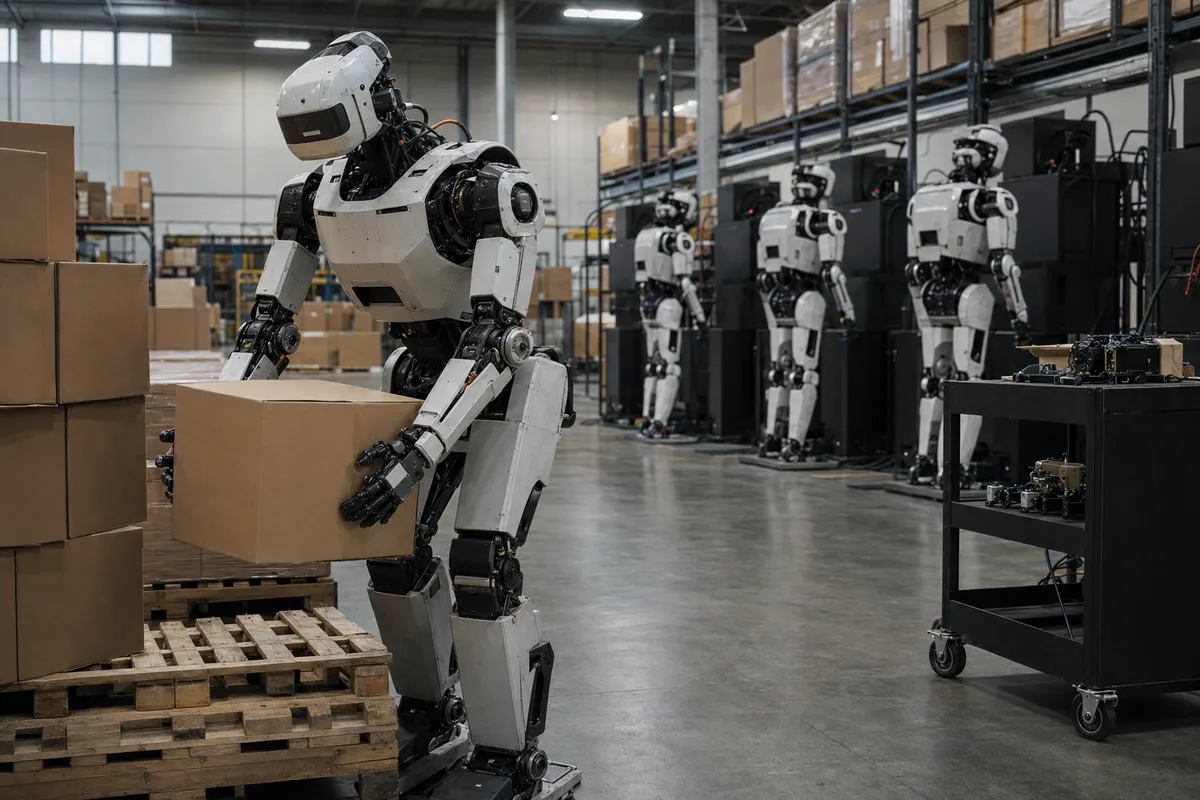
The hardest problem facing humanoid robotics companies is no longer simply making a robot walk, manipulate an object, or complete a carefully selected task. It is converting those capabilities into customer operations that work reliably, safely, repeatedly, and economically enough to survive procurement, integration, and renewal.
Public evidence now establishes that useful humanoid work is possible. BMW has confirmed substantial operating activity involving Figure 02, while GXO has confirmed a commercial deployment of Agility Robotics’ Digit. These are material advances beyond promotional demonstrations. They do not yet establish that humanoid robots can be deployed broadly, supported cheaply, or operated profitably across diverse customer sites.
Humanoid Analytics’ public Deployment Tracker, last updated on July 2, 2026, placed Agility Robotics and Figure at an Evidence Score of 10 for specific customer-backed events. UBTECH and Apptronik were listed at lower levels. The snapshot shows that strong commercial evidence exists, but remains concentrated in a limited number of deployments with narrowly defined workflows.
The central commercial challenge is therefore not producing one convincing demonstration. It is building an operating system around the robot that reduces failures, human assistance, integration work, maintenance, and cost every time the fleet expands.
The Pain Starts Where the Demo Ends
Figure’s deployment at BMW’s Spartanburg plant is one of the strongest publicly documented humanoid operating cases.
BMW confirmed that Figure 02 contributed to the production of more than 30,000 BMW X3 vehicles. The robot worked 10-hour shifts, moved more than 90,000 sheet-metal components, accumulated approximately 1,250 operating hours, and walked around 1.2 million steps. These are meaningful task and duration metrics from the customer, not merely from the robot developer.
The numbers also reveal what production readiness actually requires.
Figure said the deployment lasted 11 months and took roughly 10 months to reach full deployment on an active production line. Its stated operating targets included an 84-second cycle, placement within a five-millimetre tolerance, a placement success target above 99 percent, and a goal of zero safety interventions. Figure also identified the forearm as the largest source of hardware failures during the deployment and said that the experience informed the design of Figure 03.
This is not evidence that the deployment failed. It is evidence of what the real development process looks like. A controlled demonstration tests whether a task can be completed. A production shift exposes wear, thermal behavior, calibration drift, component weakness, recovery problems, and the consequences of small delays repeated hundreds of times.
BMW also said that the initial deployment involved production IT, occupational safety, process management, and shop-floor logistics. It is developing standardized interfaces through its Smart Robotics ecosystem to connect robots with production systems. The robot was therefore one component of a larger integration project.
For investors, this changes the meaning of technical progress. Improved manipulation or a more capable AI model may be necessary, but it is not sufficient. The commercial asset is the complete learning loop through which field failures produce hardware changes, software improvements, safer workflows, faster installation, and lower support requirements.
The Robot Is Only One Layer of the Product
Agility Robotics’ work with GXO shows the same principle in a warehouse environment.
GXO announced a multi-year robotics-as-a-service agreement after an earlier proof of concept. It described Digit as fully operational in a live warehouse, performing the specific task of moving totes from collaborative robots and autonomous mobile robots to conveyors. GXO also said the system used Agility Arc for facility mapping, workflow definition, operational management, and troubleshooting.
That is stronger evidence than a robot operating alone in an isolated test area. It shows that the humanoid must coordinate with other machines, software, conveyors, and warehouse processes.
Agility later said that Digit had moved more than 100,000 totes at GXO’s Flowery Branch facility. The milestone is commercially relevant, but the disclosed figure remains company-controlled. The reviewed public sources do not establish the number of robots responsible for the task volume, intervention frequency, uptime, repair burden, service cost, or economic return to either party.
The absence of those figures does not establish that performance or economics were poor. It means that external readers cannot yet distinguish between an efficient recurring service and a successful but support-intensive early deployment.
Human support is an especially important unresolved cost.
Mercedes-Benz said that its workers used teleoperation and augmented reality to transfer production knowledge to Apptronik’s Apollo robot. The company described autonomous operation as a subsequent development stage. The tested work included repetitive intralogistics, component transport, and initial quality checks.
Reuters separately reported that an AgiBot training facility operated for 17 hours per day, with dozens of robots maneuvered by human operators who repeatedly performed tasks to generate training data.
Teleoperation, demonstration collection, supervision, and remote recovery are not automatically evidence of weak technology. They can be rational tools for bringing an immature system into a useful workflow while collecting data. The commercial question is whether the required human effort declines as deployments accumulate.
A company could increase its installed fleet while also increasing the number of robot pilots, field technicians, safety engineers, and customer-integration staff at a similar rate. That would represent deployment growth, but not necessarily scalable software-like economics. The more revealing metric is human support time per productive robot-hour, together with the direction of change across successive installations.
Manufacturing and Unit Economics Are a Second Product
A robotics company must industrialize two systems at once.
The first is the customer-facing robot. The second is the manufacturing, quality, service, repair, and supply-chain system required to produce and support that robot.
A company-prepared Agility Robotics investor presentation filed with the US Securities and Exchange Commission illustrates the capital burden. The presentation reported a current Digit v4 bill of materials of approximately $125,000. It also reported preliminary 2025 cash uses of $102 million, including $74 million of research and development expense and $37 million of selling, general, and administrative expense, partly offset by other items in the company’s calculation. Agility stated that it had not achieved positive operating cash flow and had limited experience with high-volume manufacturing.
Those figures are company disclosures, not a sector-wide cost benchmark. The presentation also contains forward-looking projections and illustrative unit-economics assumptions that may not be achieved. It nevertheless makes the execution burden visible.
A developer has to reduce component cost while increasing durability. It needs production testing, supplier redundancy, spare parts, diagnostic tools, field-repair processes, software update controls, and enough service capacity to protect customer operations. Hardware revisions may improve reliability, but they can also create support obligations across multiple robot generations.
This is why production capacity, output, shipment, delivery, operation, and repeat deployment must remain separate. A factory capable of assembling robots does not establish that those robots have been accepted by customers. Delivery does not establish sustained operation. Sustained operation does not establish positive gross margin.
Safety adds another layer of cost and integration. ISO’s current industrial robot safety framework separates requirements for robot design from requirements covering system integration, commissioning, operation, and maintenance. That distinction matters because a technically safe robot can still require substantial application-specific risk reduction at the customer site.
Humanoid companies also compete with established forms of automation. The International Federation of Robotics reported that 542,000 industrial robots were installed in 2024, more than twice the annual number installed a decade earlier. Reuters, citing PitchBook, reported that more than 70 percent of the $2.26 billion invested in robotics during the first quarter of 2025 went to task-focused machines rather than general-purpose humanoids.
This does not establish that specialized robots will always outperform humanoids. It does raise the commercial threshold. A humanoid must compete with fixed arms, autonomous mobile robots, conveyors, conventional mobile manipulators, and changes to the workflow itself.
Its flexibility has value only when that value exceeds the additional cost of balance, mobility, dexterous manipulation, perception, safety, maintenance, and support.
What Would Count as Commercial Proof
The most useful next evidence is not another increasingly difficult demonstration. It is customer-confirmed operating and economic data from repeated deployments.
A stronger public case would identify active robot numbers, deployment duration, productive hours, task volume, cycle time, task success, intervention frequency, uptime, mean time between failures, repair time, energy use, installation labor, maintenance cost, and customer savings. It would also show whether the customer renewed, expanded to another workflow, or introduced the system at another site.
No single metric is sufficient. High task volume could be produced by a small reliable fleet or by a larger fleet with frequent intervention. High uptime could exclude planned maintenance or unproductive standby periods. A low robot price could be offset by expensive deployment and service work. Metrics need definitions, dates, operating context, and customer confirmation.
Commercial proof should therefore progress through an observable chain: useful customer work, sustained operation, paid commitment, declining support intensity, renewal, expansion, and credible economics.
There is a reasonable alternative explanation for the current lack of public detail. Customers may consider operating data, labor costs, production processes, and contract terms commercially sensitive. Robotics companies may also avoid publishing immature economics that could change rapidly as hardware is redesigned.
That confidentiality can be legitimate. It does not justify treating unavailable evidence as established. Public analysis must remain conservative until a customer, official record, or strong independent source verifies the relevant commercial claim.
The real pain of humanoid robotics is not making a machine appear intelligent. It is shrinking the distance between an impressive capability and a repeatable customer profit-and-loss result.
Funding can extend the time available to solve that problem. It cannot establish that the problem has been solved. The decisive evidence will be field reliability, falling human support per robot-hour, faster deployment, paid renewal, multi-site expansion, and improving service economics.
The sector has moved beyond the point where every customer pilot should be dismissed as publicity. It has not yet reached the point where one strong deployment can be generalized into broad commercial readiness. The companies that create durable value will be those that turn operating experience into lower cost and lower intervention faster than capital is consumed.
Sources:
- Humanoid Analytics, “Humanoid Deployment Tracker”
Source type: Tier 2, structured analyst research and source-linked market tracker, Humanoid Analytics-controlled
https://humanoidanalytics.com/humanoid-deployment-tracker/ - BMW Group, “BMW Group to deploy humanoid robots in production in Germany for the first time”
Source type: Tier 1, direct customer confirmation
https://www.press.bmwgroup.com/global/article/detail/T0455864EN/bmw-group-to-deploy-humanoid-robots-in-production-in-germany-for-the-first-time?language=en - GXO Logistics, “GXO Signs Industry-First Multi-Year Agreement with Agility Robotics”
Source type: Tier 1, direct customer confirmation
https://investors.gxo.com/news-releases/news-release-details/gxo-signs-industry-first-multi-year-agreement-agility-robotics/ - Figure AI, “F.02 Contributed to the Production of 30,000 Cars at BMW”
Source type: Tier 3, detailed first-party disclosure, company-controlled
https://www.figure.ai/news/production-at-bmw - Agility Robotics, “Digit Moves Over 100,000 Totes in Commercial Deployment”
Source type: Tier 3, detailed first-party disclosure, company-controlled
https://www.agilityrobotics.com/content/digit-moves-over-100k-totes - Mercedes-Benz Group, “KI und humanoide Roboter.”
Source type: Tier 1, direct customer confirmation
https://group.mercedes-benz.com/unternehmen/produktion/produktionsnetzwerk/mbdfc-humanoide-roboter.html - Reuters, “China’s AI-powered humanoid robots aim to transform manufacturing”
Source type: Tier 2, strong independent evidence
https://www.reuters.com/world/china/chinas-ai-powered-humanoid-robots-aim-transform-manufacturing-2025-05-13/ - US Securities and Exchange Commission, “Investor Presentation of Churchill, dated June 2026”
Source type: Tier 1, official record containing company-prepared first-party disclosures and projections
https://www.sec.gov/Archives/edgar/data/2074973/000121390026071287/ea029548401ex99-2.htm - International Organization for Standardization, “Industrial robot safety bundle”
Source type: Tier 1, direct or official evidence
https://www.iso.org/publication/PUB200102.html - International Federation of Robotics, “Global Robot Demand in Factories Doubles Over 10 Years”
Source type: Tier 2, strong independent industry data
https://ifr.org/ifr-press-releases/global-robot-demand-in-factories-doubles-over-10-years - Reuters, “Function over flash: Specialized robots attract billions with efficient task handling”
Source type: Tier 2, strong independent evidence
https://www.reuters.com/business/finance/function-over-flash-specialized-robots-attract-billions-with-efficient-task-2025-05-22/