
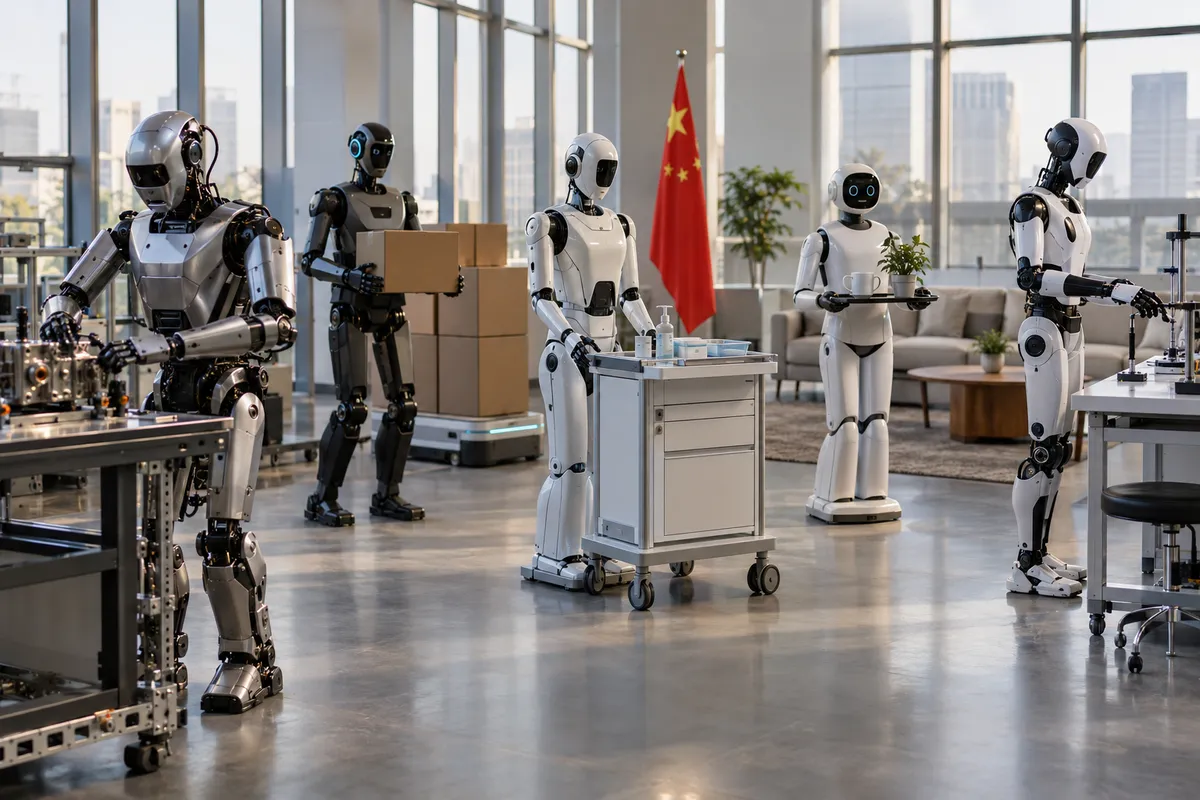
The humanoid robot market is broader than factory automation, but its major segments are developing at different speeds. Current evidence supports five distinct buyer markets: research, development and experience; data production and model training; industrial and commercial work; household and personal assistance; and military applications.
The important market signal in 2026 is the separation between shipment volume and operating proof. Chinese manufacturers dominate reported unit shipments, yet researchers disagree sharply about what those robots are being used for. Research, education, performances and AI data production account for a substantial share under some estimates. Meanwhile, several of the strongest customer-confirmed examples of productive humanoid work remain relatively small factory and warehouse deployments.
For investors and strategy teams, that means the market cannot be understood through a single shipment curve or total-addressable-market forecast. The more useful question is where human-form mobility and manipulation create enough value to justify a humanoid instead of specialized automation, another robot form or continued human labor.
Five Buyer Markets, Five Commercial Questions
| Segment | Representative opportunities | Why a humanoid could matter | Main commercial question |
|---|---|---|---|
| Research, Development and Experience | Academic research, robotics and AI development, education, training, entertainment, exhibitions, developer platforms and competitions | A general physical platform provides access to locomotion, manipulation and human-scale interaction | Can hardware, software and developer ecosystems support durable demand beyond experimentation and events? |
| Data Production and Model Training | State-backed training centers, AI laboratories, OEM data factories, teleoperation fleets and evaluation sites | Physical AI models require large quantities of interaction data, including demonstrations involving human-shaped tasks and environments | Does robot-generated training data become a durable market, or does demand decline as models generalize and simulation or human video improve? |
| Industrial and Commercial Work | Manufacturing, assembly, logistics, inspection, maintenance, construction, energy, mining, retail, hospitality, cleaning, healthcare and facilities | Humanoid mobility and manipulation can potentially automate workplaces built around human bodies, tools and workflows | Can the robot deliver sufficient reliability, utilization and economic value compared with labor and specialized automation? |
| Household and Personal Assistance | Cleaning, cooking, organization, fetching, elder support, disability assistance, monitoring, telepresence and companionship | Homes contain stairs, furniture, tools, doors and objects designed around human movement and manipulation | Can one platform safely perform enough useful tasks at sufficient reliability to justify its purchase and service cost? |
| Military | Logistics, reconnaissance, maintenance, hazardous handling, security, CBRNE work and operations in human-built environments | Human-compatible mobility and manipulation may allow machines to use infrastructure and equipment designed for soldiers | Which missions gain enough value from a humanoid body to justify its complexity compared with quadrupeds, wheeled systems, tracked vehicles and drones? |
This framework describes the range of potential demand. Commercial maturity varies substantially within every segment.
China Leads Shipments, While the Application Mix Remains Contested
Smart Analytics Global, as reported by Humanoids Daily, estimated approximately 19,100 humanoid shipments worldwide in the first half of 2026, up 272% year on year. It put AgiBot at about 8,400 units and Unitree at about 5,900, with Chinese vendors representing more than 97% of shipments and China more than 85% of demand.
Counterpoint Research produced a higher estimate. Forbes reported more than 22,000 global shipments in the same period, with AgiBot at roughly 9,700 and Unitree above 7,000. The Humanoid Robot Scene Application Alliance separately claimed that Chinese vendors alone shipped more than 30,000 units. Forbes suggested that differences in whether wheeled humanoids are included could explain part of the gap.
The disagreement over applications is even more important. Counterpoint allocated more than 60% of first-half shipments to entertainment, performance, data production and research. Service and guidance represented about 19%, intelligent manufacturing 13%, and warehousing and logistics 5%. SAG estimated that industrial and commercial applications accounted for more than 70%.
Unitree’s securities disclosures provide a useful example of how category definitions affect interpretation. Inside Deep Tech’s analysis of the filing reports that 73.6% of humanoid revenue in the first nine months of 2025 came from research and education, 17.4% from commercial and consumer applications, and 9.0% from industrial applications. Corporate guided tours represented an estimated 50% to 70% of that industrial portion.
The same filing analysis shows a rapid reduction in average selling price. Unitree’s average humanoid price fell from RMB593,400 across five units in 2023 to RMB167,600 across 3,551 units in the first nine months of 2025. Reported humanoid gross margins were 62.42% in the first half of 2025 and 63.91% in the third quarter. These figures describe Unitree rather than the broader market, but they show that higher volumes and lower hardware prices can develop before industrial production work becomes the dominant source of revenue.
Data production deserves particular attention because it creates a buyer for humanoid hardware before the robot itself becomes economical as a labor substitute.
Rest of World reported that more than 40 state-owned robot data-collection centers had been announced across China by December 2025, with roughly two dozen operating. Workers at these centers teleoperate robots through actions such as folding clothes, wiping surfaces and manipulating objects to generate physical interaction data for embodied-AI models.
People’s Daily reported that a training center in Beijing’s Shijingshan district covers more than 10,000 square meters and had 100 humanoids training from October 2025. The robots practice tasks including parcel sorting, barcode scanning, clothes folding and lock opening. Leju Robotics technical director Wang Song said a robot could generate about four hours of training data per day at the center.
The scale is also visible in purchasing. Rest of World reported that UBTECH sold RMB566 million of humanoid robots to three data-collection centers in Jiangxi, Guangxi and Sichuan. Separately, UBTECH said in November 2025 that its Walker series had accumulated more than RMB800 million in orders since early 2025, including a RMB159 million contract for a data-collection center in Zigong. The periods and order definitions are not directly equivalent, but together they indicate that data production has become a material source of booked demand for a major Chinese industrial-humanoid vendor.
That activity has commercial value to the hardware vendor even though the buyer’s objective is AI development rather than replacing labor on a production line. Separating those motives is necessary when shipment growth is used as a measure of humanoid adoption.
Industrial Work Has the Strongest Customer-Confirmed Operating Evidence
Manufacturing and logistics currently provide some of the clearest public evidence of humanoids performing useful work for identifiable customers.
BMW reported that Figure 02 accumulated about 1,250 operating hours during a ten-month project at its Spartanburg plant. The robot worked ten-hour shifts from Monday to Friday, moved more than 90,000 sheet-metal components and supported production of more than 30,000 BMW X3 vehicles. The customer also described the task and production environment, making this substantially stronger evidence than a vendor demonstration or shipment count.
BMW expanded its testing to Figure 03 in June 2026. The new Spartanburg use case involves logistics sequencing: delivered parts arrive unsorted, Figure 03 picks and sorts them into trolleys, and existing transport automation moves the sequenced parts toward assembly. BMW described the application as a further project following its completed Figure 02 deployment.
In Germany, BMW is evaluating a different platform. Its Leipzig program uses Hexagon Robotics’ AEON for material delivery and applications around high-voltage battery assembly and component production. BMW said AEON made its initial operational debut at Leipzig in December 2025, followed by further testing planned for April 2026 and full integration into the pilot phase planned for summer 2026. BMW’s September page repeats that rollout sequence but does not provide operating-hour, productivity or fleet metrics comparable with the Spartanburg Figure 02 project.
The use of different vendors is strategically relevant. BMW is building experience with the technology category while evaluating separate platforms and tasks, which gives the customer a basis for comparison before any broader commitment.
GXO provides another customer-side example. In June 2024, GXO and Agility Robotics signed a multi-year Robots-as-a-Service agreement after an earlier proof-of-concept pilot. GXO described Digit robots as fully operational in a live warehouse environment at its SPANX facility and said the agreement would integrate Digit with other automation.
Chinese industrial activity also belongs on the market map, although much of the available public evidence is vendor-controlled. UBTECH says its Walker series works with companies including BYD, Dongfeng Liuzhou Motor, Geely Auto, FAW-Volkswagen Qingdao, Audi FAW, BAIC New Energy, Foxconn and SF Express, and that Walker S robots have entered automotive production lines for multiple tasks. Those disclosures are commercially relevant, but the cited source is an UBTECH-issued announcement and does not contain customer-side operating hours, productivity data or comparable confirmation from each named organization.
This difference is evidence quality, not market importance. Chinese vendors dominate reported shipment volume and may ultimately establish some of the largest operating fleets. Stronger public customer-side data would allow those deployments to be evaluated on the same basis as BMW or GXO.
Humanoids also face mature alternatives. IFR’s 2025 service-robot report counted 102,900 transportation and logistics robots, more than 25,000 professional cleaning robots and around 16,700 medical robots in its 2024 supplier sample. IFR explicitly warns that the sample of 294 suppliers should not be projected to the whole industry. The figures still demonstrate that customers already buy large volumes of specialized robotics for many of the tasks humanoid developers are targeting.
An ETH Zurich-led review similarly notes that quadrupeds already serve inspection, delivery, security and difficult-terrain applications, while household manipulation and human interaction impose additional technical challenges on humanoids. The commercial case for the human form becomes stronger where one machine must combine mobility, reach, tool use and manipulation across multiple human-designed tasks.
Homes and Military Applications Widen the Market With Earlier Evidence
Household robotics offers a large potential unit market, but today’s public evidence is still concentrated in technical demonstrations, product development and planned consumer shipments.
Figure reported on September 17 that Helix 2.5 was evaluated across 30 previously unseen Bay Area homes on living-room tidying, towel folding and bed-making. Under Figure’s own evaluation methodology, an Index-pretrained policy achieved a 56% zero-shot task success rate, compared with 9% for the policy trained from scratch. Figure said no task-specific data was collected from the evaluation homes before deployment. This is detailed company-controlled technical evidence of generalization rather than evidence of paid household service.
1X has moved further toward productization. In April 2026 the company announced that its Hayward, California NEO factory had commenced production and said the first customer shipments were planned for 2026. The same company release said robots coming off the line were being shipped to 1X’s R&D laboratory and internal home testing, so customer operation had not yet been established by that source.
Morgan Stanley’s longer-term forecast illustrates the possible scale if the technical and economic barriers fall. Its research projects a humanoid economy above $5 trillion by 2050, including associated supply chains and service activity, with roughly 90% of humanoids used in industrial and commercial applications and about 80 million units in homes. Morgan Stanley expects adoption to remain relatively slow until the mid-2030s before accelerating later. These figures are sell-side forecasts rather than current operating evidence.
Military demand forms another buyer category because procurement, operating conditions, security requirements and mission economics differ from civilian automation.
The U.S. Army’s xTechHumanoid competition offered up to $490,000 in cash prizes and a pool of up to $1.25 million for potential follow-on contracts. The Army sought baseline humanoid systems and advanced subsystems and planned a live experimentation event with military experts. The program demonstrates funded procurement interest and a pathway toward further testing.
China’s defense establishment is also investigating humanoids. A September 2026 Reuters review of more than 100 Chinese procurement notices, academic studies, patents, official publications, government records and defense-industry materials found increasing research, testing and acquisition activity. Reuters found no evidence that China had deployed an armed humanoid with an operational PLA unit. It also noted that quadruped, tracked and wheeled robots can be cheaper and easier to scale for simpler reconnaissance and logistics missions.
Across these five segments, the evidence follows a progression. Research and education purchases establish demand for development platforms. Data centers establish demand for robot-generated training data. Customer pilots demonstrate whether a platform can enter real workflows. Operating hours, task metrics and repeated use show whether the robot can remain useful inside those workflows. Repeat orders, fleet expansion and disclosed economics would provide stronger evidence that the technology is becoming a durable automation market.
That progression is more informative than shipment growth alone.
The next phase of humanoid-market development should therefore be assessed through the share of units moving into sustained productive work, the quality of customer confirmation, operating duration, human intervention, reliability, renewal and expansion, and the economics relative to both labor and existing automation.
If those measures improve while hardware prices continue to fall, the five segments described here could support a much wider commercial market. For now, the opportunity is broad, while the evidence remains concentrated by task, customer and geography.
Sources:
- Humanoids Daily, “Global Humanoid Shipments Surge 272% in 1H 2026 as AGIBOT Overtakes Unitree”
Source type: Tier 2, independent reporting of Smart Analytics Global estimates
https://www.humanoidsdaily.com/news/global-humanoid-shipments-surge-272-in-1h-2026-as-agibot-overtakes-unitree - Forbes, “Humanoid Robot Shipments Up 300%: Up To 30,000 So Far In 2026”
Source type: Tier 2, independent analysis of third-party market estimates
https://www.forbes.com/sites/johnkoetsier/2026/08/20/humanoid-robot-shipments-up-300-up-to-30000-so-far-in-2026/ - Inside Deep Tech, “What Unitree’s filing actually says about humanoid robots”
Source type: Tier 2, independent analysis based on company securities disclosures
https://www.insidedeeptech.com/unitree-humanoid-robot-filing/ - Rest of World, “In Chinese data factories, workers teach humanoid robots boring tasks”
Source type: Tier 2, strong independent evidence
https://restofworld.org/2026/china-robots-training-centers-workers/ - People’s Daily Online, “China’s humanoid robot training centers multiply as sector gains momentum”
Source type: Tier 3, detailed attributable reporting
https://en.people.cn/n3/2026/0428/c90000-20451334.html - UBTECH, “UBTECH Humanoid Robot Walker S2 Begins Mass Production and Delivery, with Orders Exceeding 800 Million Yuan”
Source type: Tier 3, detailed first-party disclosure; company-controlled source distributed through PR Newswire
https://www.prnewswire.com/news-releases/ubtech-humanoid-robot-walker-s2-begins-mass-production-and-delivery-with-orders-exceeding-800-million-yuan-302616924.html - BMW Group, “BMW Group to deploy humanoid robots in production in Germany for the first time”
Source type: Tier 1, direct customer evidence
https://www.press.bmwgroup.com/global/article/detail/T0455864EN/bmw-group-to-deploy-humanoid-robots-in-production-in-germany-for-the-first-time?language=en - BMW Group, “BMW Group advances the use of Physical AI in production with Figure 03 project in Spartanburg”
Source type: Tier 1, direct customer evidence
https://www.press.bmwgroup.com/global/article/detail/T0458778EN/bmw-group-advances-the-use-of-physical-ai-in-production-with-figure-03-project-in-spartanburg?language=en - BMW Group, “Leipzig debut: BMW Group introduces humanoid robots – a first in Germany”
Source type: Tier 1, direct customer evidence
https://www.bmwgroup.com/en/news/general/2026/humanoid-robot-in-leipzig.html - GXO Logistics, “GXO Signs Industry-First Multi-Year Agreement with Agility Robotics”
Source type: Tier 1, direct customer evidence
https://investors.gxo.com/news-releases/news-release-details/gxo-signs-industry-first-multi-year-agreement-agility-robotics - International Federation of Robotics, “World Robotics 2025 report – SERVICE ROBOTS – released by IFR”
Source type: Tier 2, industry research with disclosed sample limitations
https://ifr.org/ifr-press-releases/news/service-robots-see-global-growth-boom - arXiv, “Advances, challenges, and opportunities for legged robots”
Source type: Tier 2, detailed academic review
https://arxiv.org/html/2607.28952v1 - Figure AI, “Helix 2.5: Zero-Shot 30-Home Generalization”
Source type: Tier 3, detailed first-party technical disclosure; company-controlled source
https://www.figure.ai/news/helix-2-5-zero-shot-30-home-generalization - 1X Technologies, “1X Opens NEO Factory in Hayward, CA – America’s First Vertically Integrated Humanoid Robot Factory, with Consumer Shipments Planned for 2026”
Source type: Tier 3, detailed first-party disclosure; company-controlled source distributed through GlobeNewswire
https://www.globenewswire.com/news-release/2026/04/30/3285118/0/en/1x-opens-neo-factory-in-hayward-ca-america-s-first-vertically-integrated-humanoid-robot-factory-with-consumer-shipments-planned-for-2026.html - Morgan Stanley, “Humanoids: A $5 Trillion Market”
Source type: Tier 2, sell-side research forecast; forecast rather than current operating evidence
https://www.morganstanley.com/insights/articles/humanoid-robot-market-5-trillion-by-2050 - U.S. Army xTechSearch, “xTechHumanoid”
Source type: Tier 1, direct or official evidence
https://xtech.army.mil/competition/xtechhumanoid/ - Reuters, “From dance floor to war: China readies humanoid robots for combat”
Source type: Tier 2, strong independent evidence
https://www.reuters.com/world/china/dance-floor-war-china-readies-humanoid-robots-combat-2026-09-07/