
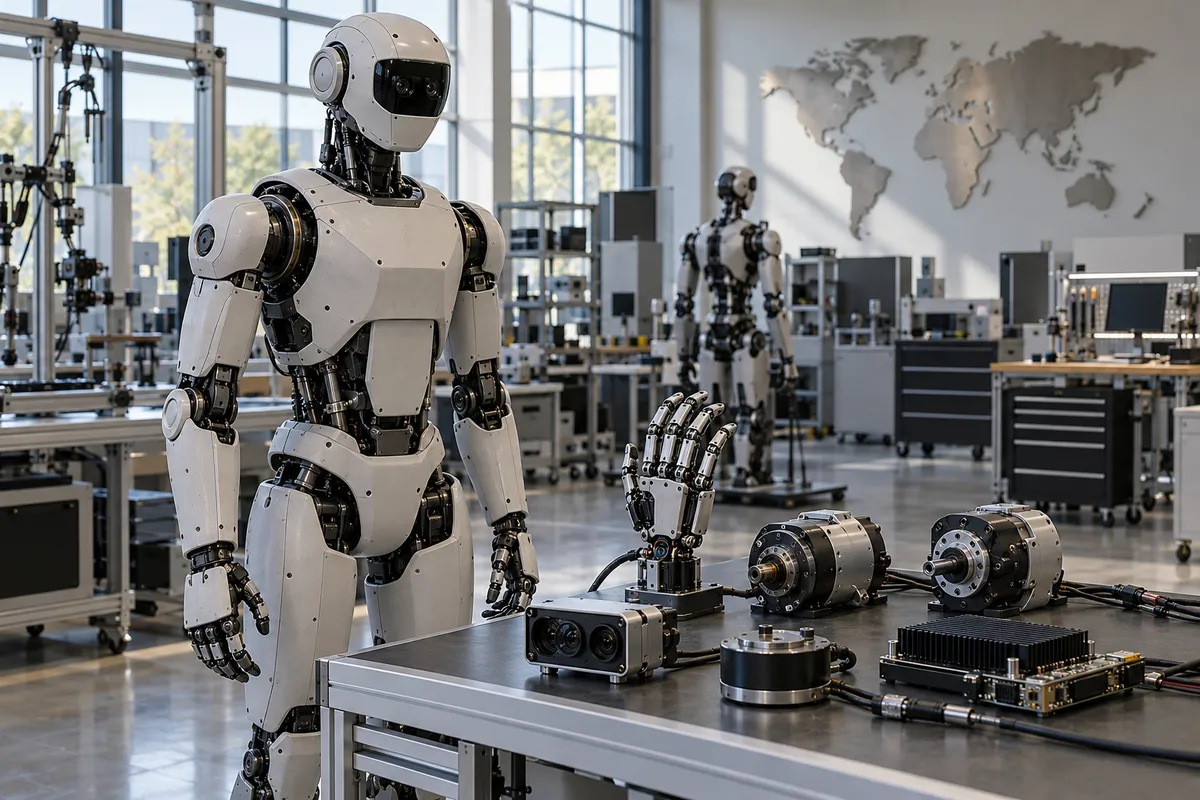
The humanoid robotics market extends well beyond the companies building complete robots. Hands, sensors, motion components, software and computing all have their own developers, customers and commercial challenges.
Humanoid Analytics’ Company Tracker makes that wider structure visible. About 73% of its in-scope records are classified as Adjacent or Ecosystem. Together, those categories contain substantially more entries than the Core group of robot developers and corporate humanoid programs.
For investors and strategy teams, this widens the research agenda. Understanding the industry means examining how its participants fit together, where customer demand appears and which relationships lead to repeat business.
Builders, suppliers and supporting infrastructure
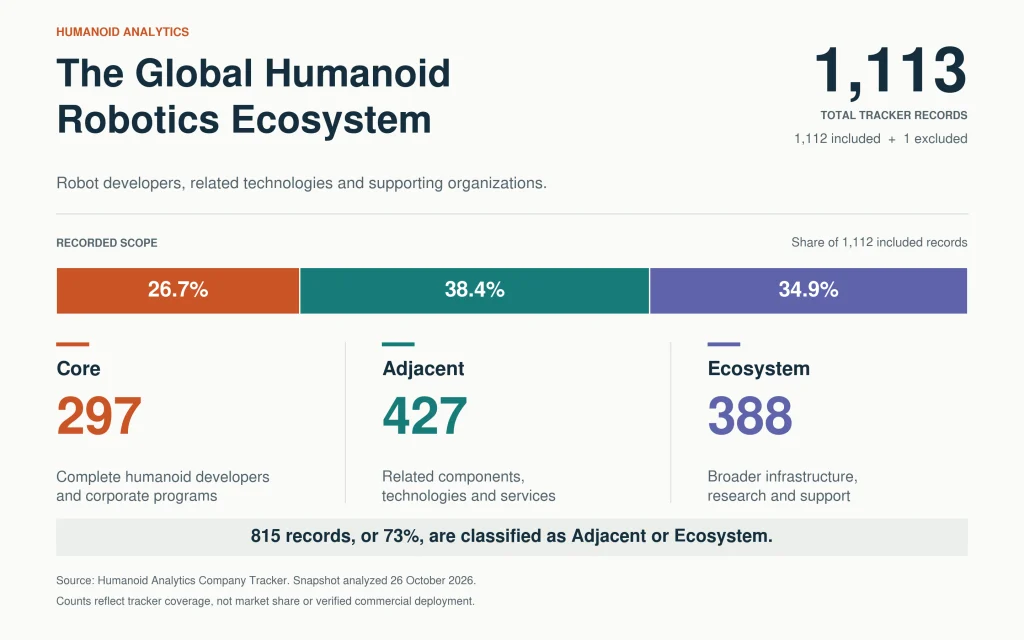
The snapshot reviewed on October 26, 2026 contains 1,113 records: 297 Core, 427 Adjacent and 388 Ecosystem entries, plus one record marked Exclude. The three included categories total 1,112 records.
Core covers complete humanoid developers and major corporate programs. The tracker places 1X Technologies, Agility Robotics and Unitree Robotics here, alongside Tesla’s Optimus program. These entries concern the integrated robot, although their intended applications and available commercial evidence differ.
Adjacent covers directly relevant technologies and services, including robotic hands, sensors, components, AI and system integration. These businesses can contribute to a humanoid without supplying the finished machine.
Bota Systems, classified as Adjacent under Tactile / Sensing, provides an example. Its technical documentation describes software for integrating its force-torque sensors across robotic platforms. That supports its sensing and integration role. Establishing a particular humanoid customer or recurring order would require further evidence.
Ecosystem covers broader supporting activity, including research, data, infrastructure and enabling technologies. NVIDIA appears in this category under AI / Simulation / Compute.
Scope describes the relationship recorded in the tracker. Commercial maturity requires a separate assessment. A supplier can win repeat orders while remaining Adjacent, and a Core developer can still be working toward its first customer application.
The counts preserve existing assignments, including profiles with unresolved identity or product questions. They should therefore be read as research records, with individual caveats, rather than a fully verified census of independent companies.
How the pieces connect
NVIDIA’s May 31, 2026 research announcement offers a concrete illustration. Its humanoid reference design combines Unitree robot hardware, Sharpa hands, NVIDIA Jetson Thor computing and Isaac GR00T software.
The tracker classifies Unitree as Core, Sharpa Robotics as Adjacent and NVIDIA as Ecosystem. Their contributions meet in one announced configuration.
This is a research platform, so the announcement does not establish paid customer operation. It does show a documented connection between a robot body, specialist manipulation hardware and computing infrastructure.
Our interpretation is that these connections deserve as much attention as the individual company profiles. A component supplier may address several robot platforms. A software provider may support different hardware designs. An integrator may help adapt a machine to a customer’s process.
Those possibilities become commercially meaningful when supported by named relationships, purchases and continued use. Inclusion in the same database does not establish a business relationship between two entries.
What the global map shows
The tracker covers Asia, North America, Europe and other regions, with a substantial concentration of records in China.
Among the 1,112 in-scope entries, the Country field lists 637 under China, 85 under the United States, 66 under Japan, 38 under South Korea and 32 under Canada.
These figures describe the database’s coverage. They cannot establish national shares of revenue, production or customer deployments.
The geographic picture becomes more useful when combined with Scope and Segment. A cluster of motor suppliers raises different research questions from a cluster of complete-robot developers. The useful comparison depends on the product, business model and customer being investigated.
Headquarters also capture only one part of an organization’s footprint. Manufacturing, engineering and customer activity can take place elsewhere.
Coverage choices matter too. Adding more suppliers or researching another region can enlarge the tracker without demonstrating equivalent industry growth. Comparisons across dates need consistent inclusion rules and resolved entity identities.
Different roles, different commercial tests
For a complete-robot developer, evidence should connect a named product to a customer, task and operating environment. Reliability, human assistance, duration of use and support requirements help explain what the system can deliver.
For a supplier, the investigation follows the component into the customer’s product. Evaluation, selection for a production design and repeat orders represent different commitments. Customer concentration, order volumes and the cost of serving those customers then become relevant business questions.
For software and infrastructure providers, adoption and continued use matter. The evidence should identify who uses the platform and how that use relates to humanoid development. A company’s broader computing or automation revenue cannot automatically be assigned to humanoids.
Funding belongs alongside this analysis, with its own context. The tracker’s amounts may represent individual rounds, cumulative funding or disclosed minimums. Funding Status explains the basis. Under Humanoid Analytics’ Evidence Standards, financing alone does not establish commercial operation.
The tracker provides a starting point for these investigations. Scope and Segment help identify comparable participants. Robot / Product and Primary Focus narrow the subject. Evidence / Caveat, review dates and source links show what supports each entry.
The next step is to follow the connections: which product, which customer, which task and what happened over time. That is where a global industry map becomes useful for decisions about competitors, suppliers and potential partners.
Sources
- Humanoid Analytics, “Humanoid Company Tracker”
Source type: Tier 1, direct or official evidence, limited to dataset contents and reproducible counts. Calculations use the supplied CSV reviewed on October 26, 2026.
https://humanoidanalytics.com/humanoid-company-tracker/ - Bota Systems, “Home”, Bota FT Stack: Documentation 1.0.0
Source type: Tier 3, detailed first-party disclosure. Company-controlled technical documentation.
https://code.botasys.com/en/gen_a/ - NVIDIA, “NVIDIA Announces NVIDIA Isaac GR00T Reference Humanoid Robot for Academic Research”
Source type: Tier 3, detailed first-party disclosure. Company-controlled announcement dated May 31, 2026.
https://nvidianews.nvidia.com/news/nvidia-open-humanoid-robot-reference-design - Humanoid Analytics, “Evidence Standards”
Source type: Tier 1, direct or official evidence, limited to the publisher’s methodology. Version 3.0, dated July 18, 2026.
https://humanoidanalytics.com/evidence-standards/