
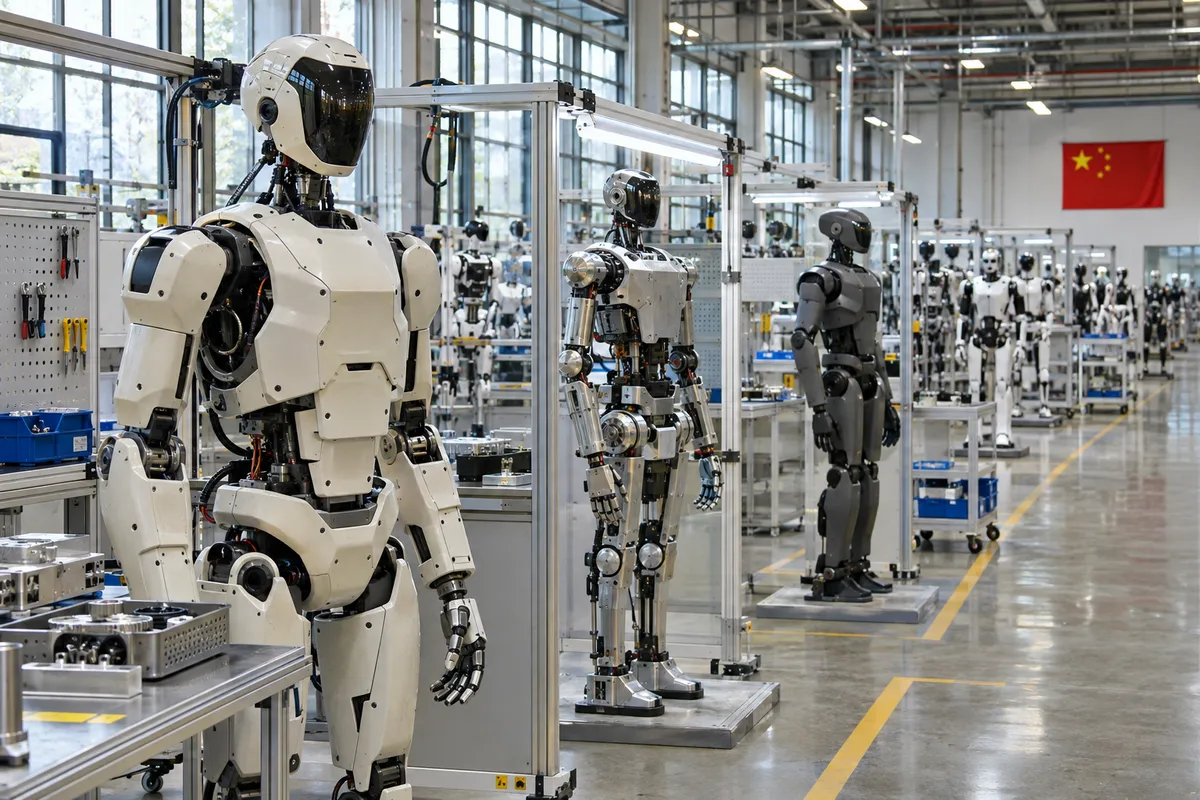
China is home to 175 of the 297 core humanoid companies in our Global Humanoid Company Tracker. That is more than the other 38 countries and territories combined, which hold 122. The United States is a distant second with 31, and Europe’s 13 countries hold 28 between them.
The count shows where humanoid companies are forming. It does not show who is shipping, selling or deploying robots, which is a much shorter list.
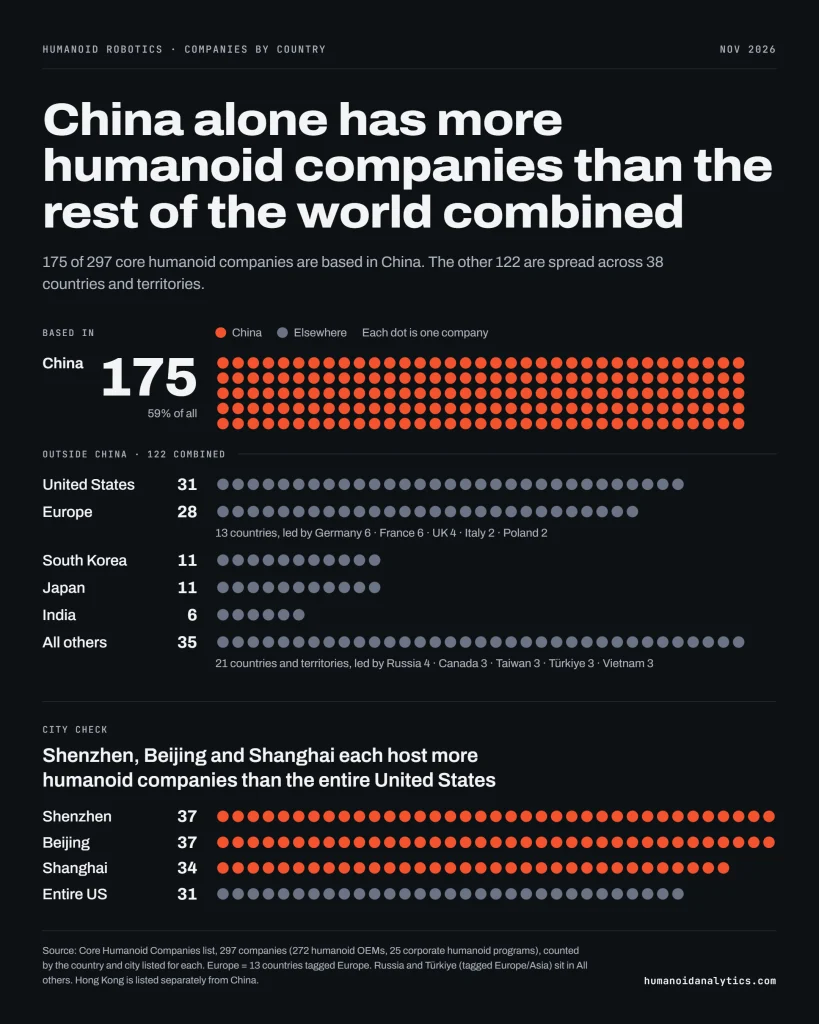
China accounts for 59% of the core companies in our tracker. For every humanoid company outside China, there are roughly 1.4 inside it.
The US is the largest single country after China, and it has less than a fifth of China’s total. Below the US the field thins out fast. No European country has more than six entries, and 13 of the 21 places in the long tail have exactly one.
Three cities, each bigger than the US
Shenzhen and Beijing host 37 core humanoid companies each, and Shanghai hosts 34. Any one of them has more than the whole United States. Together they account for 108 of China’s 175 companies.
Most of the rest sit nearby. The Yangtze River Delta, which takes in Shanghai, Hangzhou, Suzhou, Wuxi and Hefei, holds 73 companies. The Pearl River Delta around Shenzhen holds 44, and the Beijing and Tianjin area holds 38.
Those three coastal regions contain 155 companies, or 89% of China’s total. Hangzhou, where Unitree is based, ranks fourth with 14. Wuhan, with 7, is the biggest cluster away from the coast.
The American field is concentrated too, around one region. Fourteen of the 31 US companies are in the San Francisco Bay Area, including Figure AI and 1X Technologies. Texas has five, among them Tesla and Apptronik in Austin.
Density has two sides. Suppliers and engineers are within reach, but so are dozens of rivals pitching similar robots to the same buyers.
Why China’s count runs so high
Policy set the direction. In November 2023 the Ministry of Industry and Information Technology issued its Guiding Opinions on the Innovation and Development of Humanoid Robots. Its 2025 targets included mass production at an “international advanced level.” The plan also called for two or three companies with global influence, supported by specialized smaller firms.
What followed looks less like a few champions than a crowd. In November 2025 the National Development and Reform Commission (NDRC) said more than 150 Chinese companies were building humanoids. Over half were new startups or firms that had moved in from other industries.
Our data shows those moves directly. Eleven of China’s 175 entries are humanoid programs inside established companies. Carmakers XPENG and Seres are on the list, as are appliance makers Midea and Haier and phone makers Xiaomi and HONOR. So are ByteDance, Ant Group and the automation firms JAKA, Siasun and TOPSTAR.
Supply chains lower the cost of entry. When Morgan Stanley identified 100 listed companies involved in developing humanoids, 56 were based in China. The bank’s analysts credited Chinese startups’ access to established domestic supply chains.
Capital markets keep the door open. Unitree began trading on Shanghai’s STAR Market on August 19, 2026, priced at about 61 billion yuan ($9 billion). Its shares closed the first day up 460%. A debut like that tells founders and investors across China that the listing route works.
All four forces reward entry. The filter comes later, from customers who need robots that work through a full shift.
Outside China, two different models
Outside China the field splits in two. The US runs on startups. Japan, South Korea and Taiwan lean on incumbents.
| Market | Core companies | Corporate programs | Share of entries |
| China | 175 | 11 | 6% |
| United States | 31 | 1 | 3% |
| Europe | 28 | 2 | 7% |
| South Korea | 11 | 3 | 27% |
| Japan | 11 | 4 | 36% |
| Taiwan | 3 | 3 | 100% |
Thirty of the 31 US entries are dedicated humanoid companies, and Tesla is the only corporate program. We count headquarters, not owners. Boston Dynamics therefore counts as American although Hyundai Motor Group controls it, and so does 1X, which began in Norway as Halodi Robotics.
In South Korea, Hyundai Motor Group, LG Electronics and Samsung Electronics make up three of the 11 entries. In Japan, Toyota, Honda, Kawasaki Heavy Industries and SwitchBot make up four. All three Taiwanese entries, Foxconn, HIWIN and Techman Robot, are programs at established firms.
Seoul is coordinating its effort from the top. The trade ministry’s K-Humanoid Alliance, launched in April 2025, gathered more than 40 companies, universities and institutes, including LG Electronics, Doosan Robotics and Rainbow Robotics. Its goal is to make Korea a top player in humanoids by the end of 2030.
The two models trade breadth for backing. Startups produce more attempts. Incumbents bring money and their own factories, where a robot can be tested before it is sold to anyone else.
Europe is startup-led like the US, but more scattered. Its 28 companies are spread across 13 countries, and none has more than six. Germany’s six include NEURA Robotics and Agile Robots, France’s six include Wandercraft and Pollen Robotics, and the UK’s four include Engineered Arts and Humanoid.
Counting Russia and Türkiye, which our tracker tags as Europe/Asia, would lift Europe to 35 and put it ahead of the US. We keep them in the long tail.
India has six companies, all dedicated humanoid makers, including Addverb and Perceptyne. The remaining 35 sit in 21 countries and territories. Russia has four, among them Sber’s Green humanoid program, and Canada has three, including Sanctuary AI.
Thirteen places have a single entry. They include Israel (Mentee Robotics), Australia (Andromeda Robotics), Nigeria (Omeife Technologies) and Uganda (Zeus Technologies Africa).
A count is not a market
China’s lead in units is even larger than its lead in companies. Morgan Stanley estimated that about 90% of the 13,000 to 16,000 humanoids shipped in 2025 came from Chinese firms. Figure, Tesla and Agility each managed only a few hundred, The Next Web reported.
Those units came from very few companies. Omdia put 2025 shipments at about 13,000, with AgiBot at 5,168, Unitree at 4,200 and UBTECH at 1,000. By our arithmetic, those three account for about 80% of Omdia’s total, which leaves roughly 2,600 units for every other vendor in the world.
The estimates disagree, too. Counterpoint counted 16,000 installations for 2025. Unitree itself reported more than 5,500 shipments, well above Omdia’s 4,200.
Shipments are not deployments either. As of its July 2026 update, our Humanoid Deployment Tracker shows operating proof backed by metrics for only two companies, Agility Robotics and Figure AI, both American. The next tier, named customer deployments or pilots, holds UBTECH and AgiBot from China, Apptronik from the US, Humanoid from the UK and Sanctuary AI from Canada.
Our October comparison of Optimus, Figure and Digit found the same gap. Digit had repeat customer demand and Figure had measured factory output, while Tesla still lacked comparable customer proof.
So there are three leaderboards, and they disagree. China leads on companies by a wide margin and on units by a wider one, but its unit lead rests on three companies. On measured customer work, the clearest evidence we track comes from two US firms.
Beijing has noticed the crowd. On November 27, 2025, NDRC spokesperson Li Chao warned of bubble risk in humanoid robotics. China must stop a wave of similar products from “overwhelming the market and squeezing out real research and development initiatives,” she said, according to Bloomberg.
Regulators also said they would improve the rules for entering and leaving the market. Our tracker, built a different way, counts 175 Chinese core companies a year later. The crowd Beijing worried about is still there.
Our assessment
The count measures attempts, and China has made more of them than everyone else together. That breadth is an advantage, but it does not pick winners. Measured work for paying customers will, and that evidence is still thin everywhere.
We expect the count to fall while shipments rise. Three Chinese companies already ship most of the world’s units, and Beijing has promised tighter rules on entry and exit. Many of the 175 will merge or fold.
For any single vendor, its place in our Deployment Tracker says more than the size of its home country’s count.
Three things would change our view.
- Chinese vendors publishing customer-verified operating metrics at scale. That would give China the evidence lead as well as the volume lead.
- The Chinese core count still rising through 2027, after new entry and exit rules. That would mean the crowd is sustainable, or that the filter is not working.
- US vendors moving from hundreds of units a year to thousands.
Sources
- Global Humanoid Company Tracker, Humanoid Analytics. Core scope, accessed November 3, 2026. Source type: first-party data.
- Humanoid Deployment Tracker, Humanoid Analytics. Last updated July 2, 2026. Source type: first-party data.
- Tesla Optimus vs Figure vs Digit: Who Is Actually Getting Work Done?, Humanoid Analytics, October 29, 2026. Source type: first-party analysis.
- Humanoid robots + China’s charm offensive towards foreign firms + 5G, MERICS, December 6, 2023. Covers MIIT’s Guiding Opinions of November 2, 2023. Source type: research institute.
- China Warns of Bubble Risks in Booming Humanoid Robots Arena, Bloomberg, November 27, 2025. Source type: news report of a government statement.
- Report on the NDRC’s humanoid bubble warning, Interesting Engineering, November 27, 2025. Source type: news report of a government statement.
- China holds dominant position in humanoid robot ecosystem: analysts, South China Morning Post, February 2025. Covers Morgan Stanley’s humanoid value-chain screen. Source type: news report of analyst research.
- China’s Unitree soars in market debut as investors bet on humanoid robots, Al Jazeera, August 19, 2026. Source type: news report.
- China’s AgiBot leads global humanoid robot shipments in 2025, Omdia says, TechNode, January 9, 2026. Source type: news report of an analyst estimate.
- Global Humanoid Robot Installations Reach 16,000 Units in 2025 as Mass Production Picks Up Pace, Counterpoint Research, January 14, 2026. Source type: analyst firm.
- China now builds almost every humanoid robot shipped worldwide, The Next Web, August 10, 2026. Cites Morgan Stanley’s 2025 shipment estimate. Source type: news report of analyst research.
- Korea launches alliance to become top player in humanoid robotics by 2030, Korea JoongAng Daily, April 10, 2025. Source type: news report.