
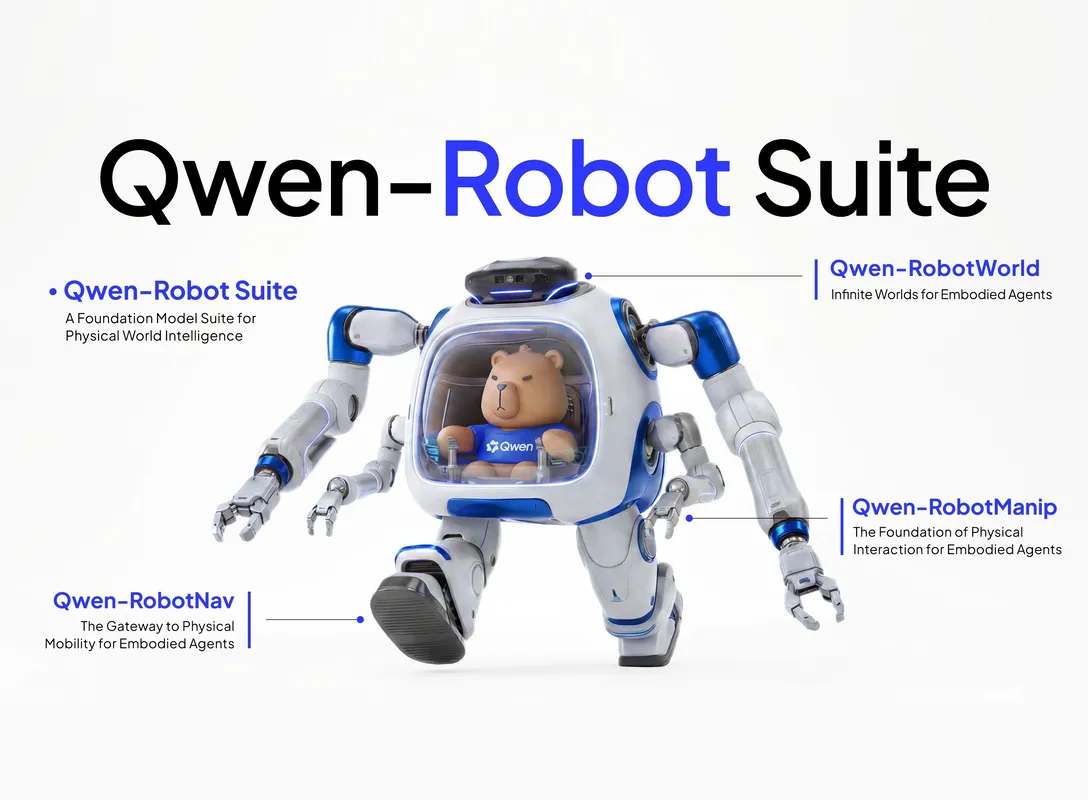
Alibaba’s Qwen team has introduced Qwen-Robot Suite, a set of three robotics foundation models aimed at navigation, manipulation, and physical world prediction. The launch matters because it shows a major AI platform supplier moving from language and multimodal models into systems that could eventually support robots operating in physical environments. What it does not yet show is customer-verified deployment, paid usage, humanoid robot readiness, or reliable task performance in production settings.
The linked X post focuses on Qwen-RobotWorld, which Alibaba describes as a world model for physical agents using a single model across more than 20 embodiments, a natural-language action interface, and prediction of future physical trajectories. That is a meaningful technical claim, but it remains largely company-controlled evidence.
The broader Qwen-Robot Suite includes Qwen-RobotNav for vision-language navigation, Qwen-RobotManip for vision-language-action manipulation, and Qwen-RobotWorld for video-based world modeling. TechNode reported that the Qwen team released the suite on June 17, 2026, and described the three models as aligning language with different types of physical action.
The strongest evidence is technical rather than commercial. Alibaba’s Qwen-RobotManip paper says the model was trained using about 38,100 hours of open-source datasets and human videos, with validation across platforms including AgileX ALOHA, Franka, UR, and ARX. The paper also claims strong benchmark performance and cross-embodiment transfer.
Qwen-RobotNav is similarly framed as a scalable navigation model trained on 15.6 million samples, with task modes for navigation behavior and configurable observation parameters. The paper claims state-of-the-art results across navigation benchmarks and zero-shot generalization to real-world robots, but those claims still come from the authors’ technical report rather than independent customer evidence.
Qwen-RobotWorld is potentially the most commercially interesting component because robot training and evaluation remain bottlenecks for physical AI. Its paper describes a language-conditioned video world model trained on 8.6 million video-text pairs, more than 200 million frames, more than 20 embodiment types, and over 500 action categories. The stated use cases include synthetic data generation, virtual evaluation environments, and planning signals for downstream robot control.
That could matter for humanoid robotics if the model helps reduce data scarcity, improve simulation quality, or make policies transfer more reliably between robots and tasks. However, the current evidence does not establish that Qwen-Robot Suite can operate a humanoid robot safely, autonomously, or economically in a real workplace. It also does not show uptime, failure handling, maintenance burden, safety approval, or total cost of ownership.
Alibaba-sourced press material says the suite has entered pilot testing with selected Alibaba Cloud enterprise customers in the robotics sector, but the customers are unnamed, the tasks are unspecified, and payment or commercial terms are not confirmed. That makes this a technology signal and possibly an ecosystem signal for Alibaba Cloud, not yet a deployment signal.
The commercial question is whether Qwen can become infrastructure for robotics companies rather than only another benchmark-performing model family. Stronger evidence would include named robot manufacturers, customer-confirmed pilots, public task metrics from real facilities, repeat use across sites, and evidence that the models reduce integration cost or improve reliability compared with existing robot software stacks.
For now, Alibaba has shown a serious technical push into embodied AI. The market should treat it as progress in enabling technology, not proof that general-purpose robots, humanoid or otherwise, are closer to commercial scale.
Sources:
Qwen, “Qwen-RobotWorld Infinite Worlds for Physical Agents”: https://x.com/Alibaba_Qwen/status/2066870197122899980
Qwen, “A Foundation Model Suite for Physical World Intelligence”: https://qwen.ai/blog?id=qwen-robotsuite
TechNode, “Alibaba unveils Qwen-Robot series with three foundation models for embodied AI”: https://technode.com/2026/06/17/alibaba-unveils-qwen-robot-series-with-three-foundation-models-for-embodied-ai/
arXiv, “Qwen-RobotManip Technical Report: Alignment Unlocks Scale for Robotic Manipulation Foundation Models”: https://arxiv.org/abs/2606.17846
arXiv, “Qwen-RobotNav Technical Report: A Scalable Navigation Model Designed for an Agentic Navigation System”: https://arxiv.org/abs/2606.18112
arXiv, “Qwen-RobotWorld Technical Report: Unifying Embodied World Modeling through Language-Conditioned Video Generation”: https://arxiv.org/abs/2606.17030
ZAWYA, “Entering the physical AI era: Introducing the Qwen-Robot Suite”: https://www.zawya.com/en/press-release/companies-news/entering-the-physical-ai-era-introducing-the-qwen-robot-suite-knymzo89