
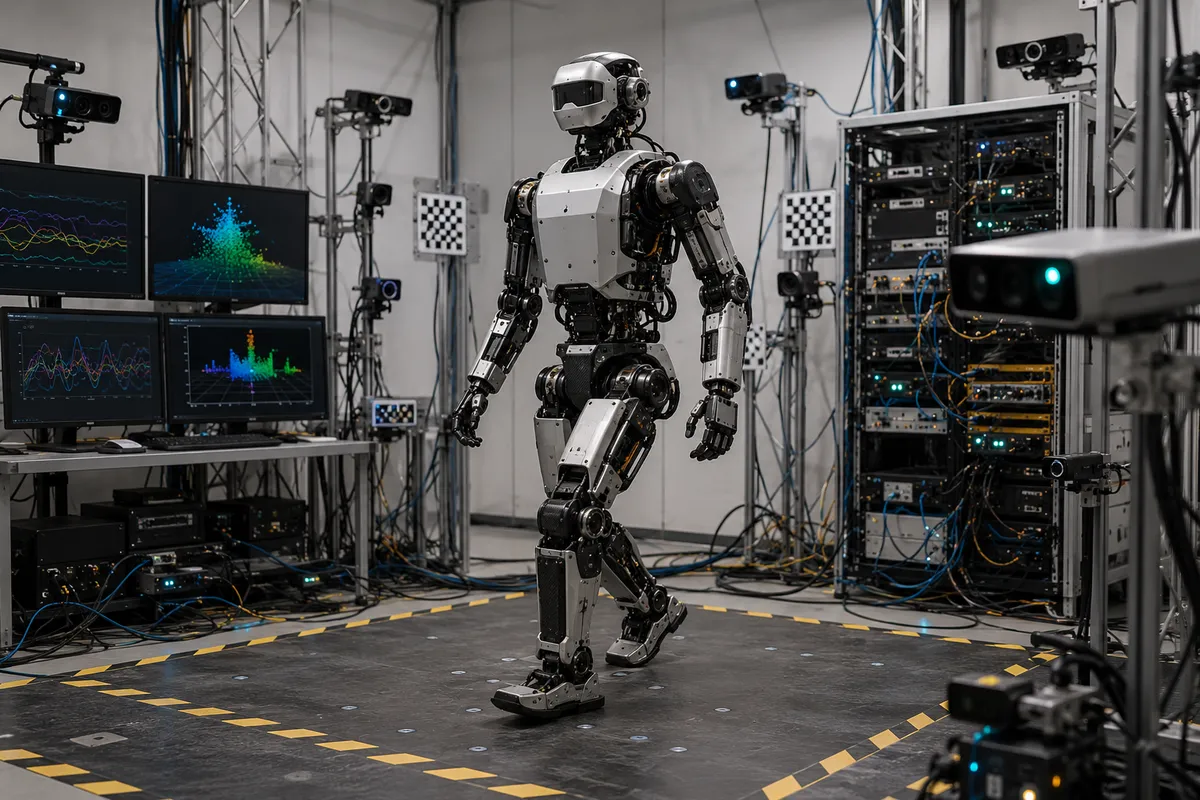
Humanoid robotics is difficult for a reason that is easy to underestimate from demonstration videos: the robot has to solve many problems at the same time.
It must perceive its surroundings, understand a task, decide what to do, move through physical space, maintain balance, manipulate objects, respond to unexpected conditions and monitor its own hardware. Those functions must work together quickly enough for the machine to remain useful and safe.
That makes a humanoid fundamentally different from an AI system that only produces information on a screen. A humanoid converts intelligence into physical action, and every action creates new information about what worked, what failed and what happened to the machine.
This is where telemetry becomes important.
The long-term competitive question may not simply be which company has the most impressive robot today. It may be which companies can build the strongest loop between physical operation, data collection, analysis, model improvement and redeployment.
A Humanoid Is a Moving Data System
Modern robotics systems can record large numbers of time-synchronized data streams. ROS 2, a widely used robotics software framework, supports sensor message types including images, inertial measurements, joint states, battery states, laser scans and point clouds. Its rosbag tooling can record data moving through a robot’s software system for later inspection and analysis.
For a humanoid, that data can be grouped into several commercially useful categories.
Movement data includes walking behavior, balance, posture, speed, joint positions and movement trajectories. Engineers can examine where motion becomes unstable, whether the robot repeatedly loses accuracy in a particular pose, or how its behavior changes when carrying an object.
Sensor data provides the robot’s view of the world. Depending on the platform, this can include cameras, LiDAR or other range sensing, inertial sensors, microphones, tactile or force information and internal position measurements. The important point is not simply the number of sensors. It is whether their data can be synchronized with the robot’s actions and operating context.
Task-performance data answers a different question: did the robot actually complete useful work? Relevant fields can include successful tasks, failed attempts, retries, completion time, cycle time, human interventions and the point in a task where failure occurred.
Human-interaction data can record instructions, handoffs, operator overrides and other interactions that reveal where autonomy works and where people still need to intervene.
System-health data covers the machine itself: battery condition, motors, temperatures, actuator behavior, faults and other diagnostics. ROS diagnostic tooling, for example, is designed to collect status information from sensors and actuators and can report abnormal conditions.
Over time, trends in such information can support maintenance planning and failure detection. But telemetry does not automatically predict a failure. The value comes from having enough consistent historical data to identify patterns before a fault becomes operationally significant.
Physical AI Turns Observation Into Action
The term Physical AI is often used broadly, but the important technical shift is straightforward: AI models are increasingly being developed to interpret information about the physical world and produce actions for robots.
NVIDIA’s current Isaac GR00T development workflow explicitly connects data creation, policy training, simulation-based evaluation and deployment onto real robots. NVIDIA describes demonstration data from simulated and real environments as an input to robot-policy development. Its GR00T architecture processes image, language and robot-state inputs to produce robot actions.
The underlying GR00T N1 research similarly describes a vision-language-action model trained on a mixture of real robot trajectories, human video and synthetic data. Its architecture combines interpretation of visual and language inputs with a system that generates motor actions.
Google DeepMind is pursuing a related direction. Its current Gemini Robotics 2 work describes a vision-language-action model that converts vision and language into motor control, including whole-body humanoid movement. A separate embodied-reasoning model handles higher-level planning, progress tracking and coordination with the action model. DeepMind also reports that its system can identify failed steps and attempt corrective behavior. These are company research claims rather than independent evidence of commercial deployment, but they illustrate the emerging architecture of Physical AI systems.
The basic learning loop can therefore be understood as:
Robot observes the environment.
Robot takes an action.
Telemetry records what happened.
The result is evaluated.
Useful experience becomes training or evaluation data.
The model or control policy is improved.
A new version is tested and deployed.
The process repeats.
This sounds simple. Implementing it reliably is not.
More Data Does Not Automatically Mean Better Robots
One reason telemetry could become strategically important is that robot learning appears to benefit from diverse real-world experience.
The Open X-Embodiment research collaboration assembled more than one million real robot trajectories across 22 robot embodiments. The project reported that models trained across the combined data could benefit from experience generated by other robot platforms.
That supports a broader point: physical experience can be valuable training material.
But it does not follow that the company collecting the most terabytes has the strongest technology.
Useful robot data needs context. Engineers need to know what task was attempted, what the robot perceived, what action it selected, whether a human intervened, whether the task succeeded and what happened immediately before a failure.
A thousand successful repetitions of one tightly controlled movement may be less informative than a smaller set containing unusual objects, changing lighting, different floor conditions, unexpected human behavior or edge-case failures.
Data also needs to be cleaned, synchronized, stored and connected to the correct software and hardware versions. Otherwise a company risks creating a large archive of sensor information that is difficult to convert into model improvement.
The defensible asset, therefore, is not telemetry alone. It is the complete learning system around it.
Telemetry Could Become Commercial Evidence
There is another reason this matters for humanoid robotics investors: telemetry can help close the gap between a demonstration and operating proof.
A video may show that a robot successfully completed a task once. Telemetry can potentially answer much harder questions.
How many times was the task attempted?
How often did it succeed?
How many human interventions were required?
How long did the task take?
What caused failures?
How many hours did the robot operate?
How quickly did the battery decline?
How frequently did hardware faults occur?
Did performance improve after a software update?
Did the customer continue using the robot?
Under the Humanoid Analytics Evidence Standards, operating metrics such as hours worked, tasks completed, throughput, uptime, error rate, productivity and intervention rate can materially strengthen evidence of real-world commercial activity when they have sufficient context. Technical sophistication by itself does not increase the Evidence Score.
This distinction is important. A sophisticated Physical AI stack may be technologically valuable while remaining commercially unproven. The commercial evidence appears when that technology enables useful, repeated and measurable work in customer environments.
What Investors Should Look for Next
For investors evaluating humanoid robotics companies, the quality of the telemetry loop may eventually become as important as visible hardware capability.
The strongest evidence would not be a company saying that it collects large amounts of robot data. It would be evidence showing what that data changes.
A stronger disclosure might show that a fleet accumulated a defined number of operating hours, that a particular task-success rate improved between software versions, that intervention requirements fell, or that maintenance data reduced unplanned downtime.
Customer confirmation would make those metrics considerably more useful for commercial assessment.
Companies could also disclose the boundaries of autonomy. A system that produces good task statistics while relying heavily on teleoperators tells a different commercial story from one producing similar results with limited intervention. Humanoid Analytics therefore treats autonomy and human assistance as separate operating questions rather than assuming that observed robot motion is autonomous.
The same applies to system health. Better telemetry may help engineers identify degrading actuators or battery problems earlier, but the commercially relevant proof would be measurable improvements in reliability, maintenance burden or uptime.
That is the evidence still largely needed across the sector.
The Robot Is Only Half the System
Humanoid robotics is often presented as a competition between machines: whose robot walks faster, lifts more, manipulates more precisely or looks most human.
That view misses part of the architecture.
The physical robot generates experience. Telemetry captures that experience. Data infrastructure organizes it. Physical AI learns from selected parts of it. Evaluation determines whether a new policy is actually better. The updated system returns to the physical world and creates another round of evidence.
For companies that can make this cycle work at scale, every useful operating hour could potentially contribute to future improvement.
For investors and customers, however, the standard should remain higher than the existence of a data pipeline. The question is whether the loop produces observable progress: more successful tasks, fewer interventions, higher uptime, better reliability, safer behavior and ultimately stronger operating economics.
That is where telemetry stops being a technical detail and starts becoming part of the commercial evidence.
Sources:
- NVIDIA Technical Blog, “Develop Humanoid Robot Policies End-to-End with NVIDIA Isaac GR00T”
https://developer.nvidia.com/blog/develop-humanoid-robot-policies-end-to-end-with-nvidia-isaac-gr00t/ - NVIDIA et al., “GR00T N1: An Open Foundation Model for Generalist Humanoid Robots”
https://arxiv.org/abs/2503.14734 - Google DeepMind, “Gemini Robotics 2 brings whole body intelligence to robots”
https://deepmind.google/blog/gemini-robotics-2-brings-whole-body-intelligence-to-robots/ - Open X-Embodiment Collaboration, “Open X-Embodiment: Robotic Learning Datasets and RT-X Models”
https://robotics-transformer-x.github.io/ - ROS 2, sensor_msgs documentation
https://docs.ros.org/en/humble/p/sensor_msgs/ - ROS 2, “Recording and playing back data”
https://docs.ros.org/en/jazzy/Tutorials/Beginner-CLI-Tools/Recording-And-Playing-Back-Data/Recording-And-Playing-Back-Data.html - ROS 2, diagnostic_updater documentation
https://docs.ros.org/en/humble/p/diagnostic_updater/