
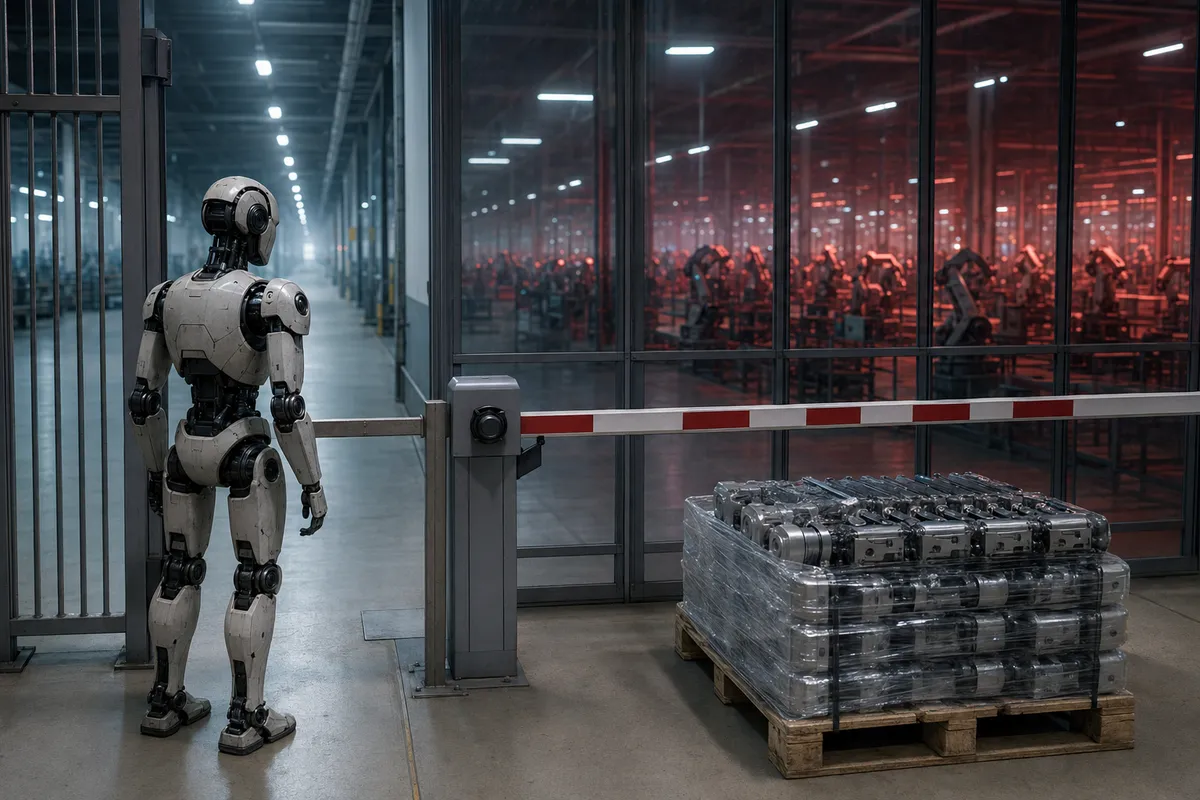
The Federal Communications Commission’s July 28 action is a material market-access shock for humanoid robotics, but it is not evidence that US manufacturers have won the commercial race.
The FCC added foreign-produced “advanced robotic devices,” including humanoid and quadruped robots, to its Covered List. New models generally cannot obtain the equipment authorization required for importation, marketing, or sale in the United States. Previously authorized models and previously purchased devices are not affected, and manufacturers can seek conditional approval from designated US security agencies.
CNN and the BBC described the development primarily as a ban on Chinese humanoid robots, reflecting China’s position in the existing supply base and the geopolitical context surrounding the decision. The official FCC language is broader. It covers qualifying foreign-produced devices regardless of the producer’s nationality.
For investors, three questions must remain separate. The first is whether a company can access the US market. The second is whether it can manufacture and deliver robots in meaningful volume. The third is whether those robots perform useful work reliably and economically for customers.
The FCC action changes the first question immediately. It does not answer the other two.
The Restriction Is Broader Than China, but Narrower Than a Blanket Ban
The official rationale is cybersecurity and supply-chain risk. The FCC said networked robots can collect sensitive data, create vectors for attacks, enable surveillance, and potentially allow outside actors to interfere with physical operation. Its fact sheet also identifies the risk that dependence on foreign-produced systems could disrupt US economic and national security.
Those concerns are commercially relevant. A connected humanoid operating inside a factory, laboratory, warehouse, data center, or critical-infrastructure site can potentially observe layouts, workflows, equipment, workers, production processes, and operational failures. Security therefore cannot be treated as a secondary software feature. It is becoming part of market access.
The immediate scope is nevertheless more limited than the word “ban” may suggest. The FCC said the action does not prohibit continued use of previously purchased robots, does not stop the sale or import of previously authorized models, and does not affect federal-government purchases or use. Conditional approval also provides an exception where security agencies determine that a device or class of devices does not present the specified risks.
This means the near-term impact will depend on company-specific details that remain largely undisclosed: which models already hold authorization, how much inventory is already in the country, which new models were planned for the US, and whether manufacturers can obtain conditional approval.
Reuters reported that the administration also intends the restrictions to encourage manufacturing in the United States. That creates an industrial-policy effect alongside the stated security objective.
Domestic production may therefore become more valuable. It should not, however, be confused with operating proof. A protected market can improve pricing power or reduce competition without proving that a supplier can produce reliable robots, support customers, or deliver acceptable economics.
China’s Manufacturing Lead Is Plausible, but the Current Totals Are Weak
CNN cited Interact Analysis as estimating that Chinese companies accounted for 90% of worldwide humanoid shipments in 2025 and that the United States was their largest overseas destination. The estimate supports the conclusion that the policy is aimed principally at Chinese supply, even though the FCC language is not country-specific.
That market-share figure should still be interpreted carefully. A shipment is not necessarily a customer delivery, an operating robot, a paid deployment, or evidence of useful work. It can include research systems, entertainment robots, demonstration units, training fleets, internal equipment, and machines awaiting integration.
Interact Analysis separately estimated that only about 10% of humanoid robots produced by 2025 were deployed in actual real-world applications. It described current demand as being driven largely by small deployments, subsidies, research, data collection, and strategic partnerships rather than workforce-scale economics.
The Humanoid Analytics 2026 year-to-date production and delivery review shows how difficult it remains to build a defensible current comparison.
The dataset covers 37 companies across 13 headquarters countries, including 16 Chinese companies and nine US companies. Only three records contained a countable 2026 production minimum. All three were Chinese, producing a combined evidence floor of 202 units. This is not an estimate of total Chinese output. It is only the minimum number that the available sources allowed the tracker to assign to the 2026 review period.
Two hundred of those units came from a reported batch of AgiBot-branded humanoids assembled by LY iTech. The source reported that the finished units were delivered at the opening of a manufacturing base, providing a specific quantity and date.
The remaining public figures often fail comparability tests. Unitree was reported to have produced approximately 11,000 units of one humanoid model cumulatively through May 2026, but the period began before 2026 and excluded other models. It cannot be converted into a 2026 production total.
US disclosures present similar problems. Figure said in April that its BotQ facility had delivered more than 350 Figure 03 robots and demonstrated a one-robot-per-hour cycle time. It also said those robots were allocated across internal research, data collection, home research, and commercial use-case development. The disclosure did not isolate units produced since January 1 or the number delivered to external customers.
Across the full tracker, only four companies had a countable 2026 delivery minimum, totaling four robots. That does not mean only four robots were delivered. It means that the remaining company-wide totals were unknown, mixed with other robot types, cumulative across prior periods, stated only as targets, or unsupported by a sufficiently specific recipient and date.
The evidence therefore supports two conclusions at once. Chinese manufacturers probably entered 2026 with a substantial volume advantage. Public disclosures are still too incomplete and inconsistent to calculate a defensible current country-level production or delivery share.
The Policy Creates Opportunity, Not Execution Proof
For Chinese manufacturers, the restriction removes or delays access to an important market for new models. Existing authorized products may continue to be sold, and conditional approval remains possible, but the value of future US sales pipelines has become less certain.
The size of that exposure is not yet established. Company-level disclosure is needed on US revenue, orders, distributors, authorized products, research customers, and planned product launches. Without it, the effect on individual manufacturers cannot be quantified reliably.
One alternative explanation is that leading Chinese companies had already reduced their expectations for the US market because of deteriorating technology relations. CNN cited an Omdia analyst who expected a limited overall effect as companies increasingly target Europe and other markets.
That could reduce the revenue impact, but it would not make the restriction immaterial. Losing access to US universities, developers, industrial customers, capital-market relationships, and technology partners can affect data collection, ecosystem development, brand credibility, and future strategic options even when current sales are modest.
US robot developers receive a clearer competitive benefit. New foreign models face a higher entry barrier, giving domestic producers additional time to improve manufacturing, lower costs, and secure customer relationships.
That benefit should not be capitalized as proven market share. The tracker does not establish complete 2026 production or external-delivery totals for major US developers. Production-line announcements, manufacturing cycle times, committed deployment schedules, and future capacity plans are useful execution signals, but they do not establish accepted customer deliveries or sustained operation.
The policy could also slow adoption. Chinese suppliers have competed partly through product availability and lower hardware prices. If restricted products are not replaced by comparable domestic alternatives, US researchers and industrial buyers may face higher costs, fewer platform choices, and longer procurement timelines. Protection can improve the position of domestic suppliers while making the overall market smaller in the near term.
What Evidence Should Appear Next
The next policy evidence should identify how the FCC will classify specific models, manufacturers, manufacturing arrangements, software configurations, and conditional-approval applications. The difference between a nominally foreign brand, a US-assembled product, and a system containing foreign connectivity or control components may become commercially important.
The next company evidence should include exact quarterly production by model, delivery quantities linked to identifiable recipients, the share of units assigned to internal rather than external use, and geographic revenue or order exposure.
Most importantly, the market still needs operating evidence. Units produced and delivered should eventually be connected to tasks, customers, operating hours, intervention rates, uptime, safety performance, renewals, and commercial terms.
The FCC has changed who can introduce new robot models into the United States. It has not changed what counts as commercial proof.
Chinese manufacturers retain stronger visible volume signals, but their exact 2026 lead cannot be calculated from current public records. US manufacturers have gained strategic protection, but not demonstrated replacement capacity. The companies that benefit durably will be those that combine authorized supply chains with repeatable manufacturing and customer-confirmed operating results.
Sources:
- Federal Communications Commission, “FACT SHEET: FCC Updates Covered List to Include Foreign-Produced Advanced Robotic Devices and Power Inverters”
Source type: Tier 1, direct or official evidence
https://docs.fcc.gov/public/attachments/DOC-423682A1.pdf - CNN, “China’s Humanoid Robots Have Been Taking Over the Global Market. Now the US Is Banning Them”
Source type: Tier 2, strong independent evidence
https://edition.cnn.com/2026/07/29/tech/us-china-robot-ban-intl-hnk - BBC, “Trump Administration Bans New Chinese Humanoid Robots”
Source type: Tier 2, strong independent evidence
https://www.bbc.com/news/articles/cp9e2ex3ekyo - Reuters, “Trump Administration Bans New Chinese Humanoid Robots, to Protect US AI Buildout”
Source type: Tier 2, strong independent evidence
https://www.reuters.com/world/trump-administration-ban-new-chinese-robots-inverters-protecting-us-ai-buildout-2026-07-28/ - Interact Analysis, “Humanoid Robot Revenue to Reach $15bn by 2035”
Source type: Tier 2, detailed independent research
https://interactanalysis.com/humanoid-robot-revenue/ - Gasgoo, “Partnering With AgiBot, LY iTech Rolls Off 200 General-Purpose Humanoid Robots for Delivery”
Source type: Tier 2, independent reporting of a supplier disclosure
https://autonews.gasgoo.com/articles/news/partnering-with-agibot-ly-itech-rolls-off-200-general-purpose-humanoid-robots-for-delivery-2058923574767915009 - Figure AI, “Ramping Figure 03 Production”
Source type: Tier 3, detailed company-controlled disclosure
https://www.figure.ai/news/ramping-figure-03-production