
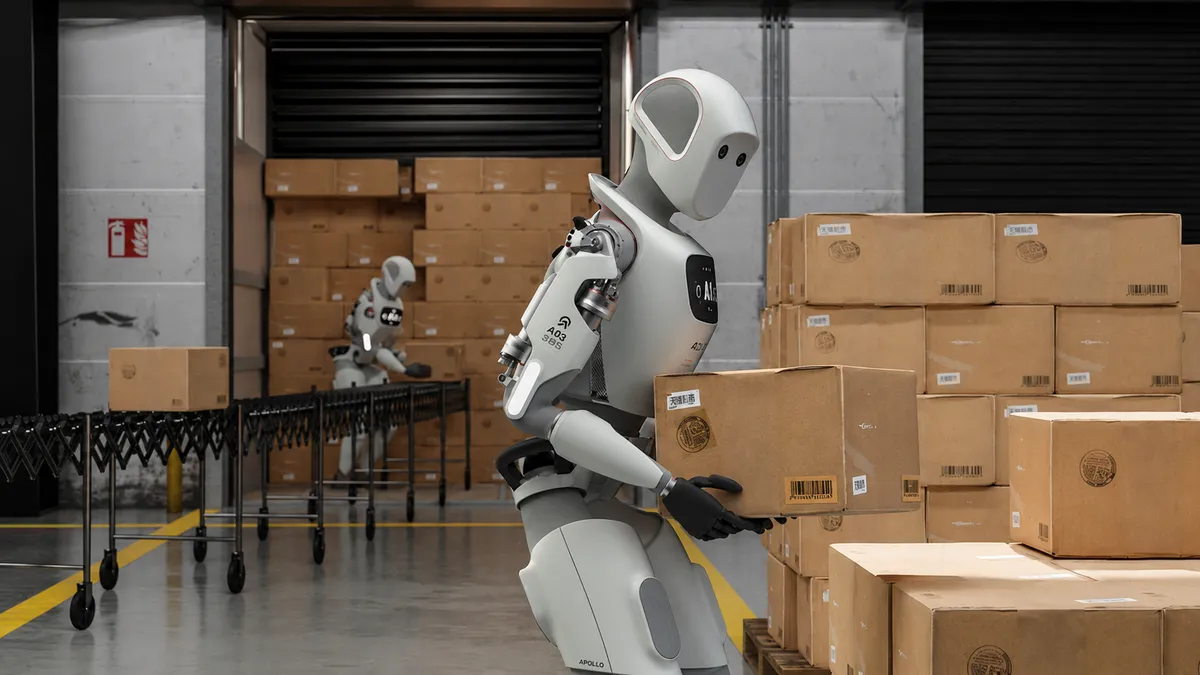
Apptronik has raised more than $935 million across an unusually large Series A, giving the Austin-based robotics company substantial resources to manufacture, train, and deploy its Apollo humanoid robot. The financing, supported by Google, Mercedes-Benz and several industrial investors, strengthens Apptronik’s competitive position, but it also raises the standard of evidence the company must now meet.
The funding is confirmed. Apollo’s broader commercial readiness is not.
Apptronik has named enterprise relationships with Mercedes-Benz, GXO Logistics and Jabil, and Mercedes-Benz has publicly confirmed that it is testing a small number of Apollo robots in production environments. However, there is still no public evidence of repeat fleet orders, multi-site commercial expansion or Apollo operating at meaningful scale without extensive human support.
The central question is therefore no longer whether Apptronik can attract capital or prominent partners. It is whether nearly $1 billion of Series A funding can move Apollo from high-profile customer trials into reliable, repeatable deployments.
A Series A Built In Several Stages
Apptronik announced an initial $350 million Series A in February 2025, led by B Capital and Capital Factory with participation from Google. The company later expanded the round to $403 million, adding investors that included Mercedes-Benz, Japan Post Capital and other financial backers.
In February 2026, Apptronik added a $520 million Series A extension, bringing the full round to more than $935 million. Existing investors including B Capital, Google, Mercedes-Benz and PEAK6 participated, alongside new investors including AT&T Ventures, John Deere and the Qatar Investment Authority. Reuters reported that the extension valued Apptronik at approximately $5 billion.
The size of the round is significant even within a humanoid robotics market that has become accustomed to large capital raises. It gives Apptronik room to expand production capacity, recruit engineering and deployment staff, collect robot training data, and absorb the long development cycles associated with complex electromechanical systems.
It also increases execution pressure. Investors are no longer financing only a research program or an early prototype. Apptronik says the new capital will support Apollo production, commercial deployments, pilots, robot training facilities and a new robot expected to be introduced in 2026.
Those are measurable commitments. The next phase should produce evidence in factories and warehouses, not just additional demonstrations.
| Area | Confirmed Signal | Evidence Still Needed |
|---|---|---|
| Funding | More than $935 million raised across the Series A | Capital efficiency and future financing requirements |
| Mercedes-Benz | Apollo robots tested at production sites in Germany and Hungary | Repeat orders, fleet expansion and productivity results |
| Jabil | Manufacturing partnership and pilot announced | Production volume, deployment results and sustained factory use |
| GXO Logistics | Commercial relationship reported by Apptronik and Reuters | Customer-confirmed operating sites, fleet size and performance |
| Google DeepMind | Strategic AI partnership and investor participation | Measurable autonomy gains in customer operations |
| Apollo production | Funding allocated to scale manufacturing | Delivered unit volumes, quality, reliability and service capacity |
Mercedes-Benz Offers The Strongest Customer Evidence
Mercedes-Benz provides Apptronik’s clearest independently confirmed customer signal.
The automaker said in March 2025 that it was testing Apollo at its Digital Factory Campus in Berlin. Reuters reported that a handful of Apollo robots were being trained for tasks including moving components to production lines and performing quality checks, with testing also taking place in Kecskemét, Hungary.
The robots were being trained through teleoperation, where humans remotely guide the system through tasks so that it can collect data and eventually repeat those tasks more autonomously. This is credible customer-pilot evidence, but it is not the same as autonomous operational deployment.
Mercedes-Benz also invested a low double-digit million-euro amount in Apptronik, according to Reuters. That strengthens the strategic relationship, but it does not prove that Apollo has met the economic or reliability requirements for a factory-wide rollout.
The automaker’s production chief identified cost as a decisive factor and discussed humanoid robots becoming more attractive when pricing reaches the tens-of-thousands-of-dollars range. No public timetable was given for reaching that cost, and Apptronik has not disclosed Apollo’s current production price or commercial service terms.
For Apptronik, Mercedes-Benz is therefore both an asset and a test. The relationship provides access to a demanding manufacturing environment, but it will become commercially meaningful only if a handful of trial robots lead to additional units, more workflows or deployment at further plants.
Jabil Addresses The Manufacturing Problem
Apptronik’s partnership with Jabil targets a different obstacle: building humanoid robots consistently and at scale.
In February 2025, the companies announced that Jabil would become a worldwide manufacturing partner for Apollo. They also outlined a pilot in which Apollo robots would be evaluated for work in Jabil manufacturing operations, including lines involved in building the robots themselves.
The partnership is strategically credible. Jabil brings global manufacturing, procurement and supply chain capabilities that a robotics startup would struggle to reproduce quickly. Apptronik says its actuator design and simplified bill of materials are intended to reduce component count, production time and cost.
But the public announcement remains forward-looking. Neither company has disclosed how many Apollo units Jabil has built, what yields have been achieved, which tasks the robots are performing, or whether the pilot has moved into sustained operational use.
The phrase “robots building robots” is commercially attractive, but it should not be mistaken for evidence of production scale. The relevant measures are units delivered, manufacturing cycle time, defect rates, component availability and field reliability.
Google’s Backing Strengthens The AI Case
Google’s participation matters for more than financing. Apptronik also has a strategic partnership with Google DeepMind to develop humanoid systems using Gemini Robotics models. Apptronik presents the relationship as a way to combine Apollo’s hardware with more capable embodied AI.
The potential advantage is clear. A commercially useful humanoid needs to adapt to variation in objects, layouts and workflows rather than relying entirely on fixed programming.
The evidence threshold should nevertheless remain practical. Progress in AI models matters only if it reduces teleoperation, engineering time, task-specific retraining and human intervention in real customer environments. Apptronik and Google have not yet published enough operational data to evaluate those outcomes.
Capital Has Reduced One Risk And Increased Another
The $935 million Series A reduces Apptronik’s immediate financing risk. It gives the company a larger margin for hardware development, manufacturing preparation and customer testing than most humanoid startups possess.
At the same time, the round increases commercialization risk because expectations now extend beyond technical progress. A company valued at approximately $5 billion and backed by major industrial names will be judged on deployment conversion, not partnership count.
Apptronik’s public record supports a Customer Pilot evidence level. Mercedes-Benz has confirmed testing at identifiable manufacturing locations, while Jabil has confirmed a pilot and manufacturing relationship. Claims of a broader commercial pipeline are plausible, but customer-level evidence remains incomplete.
The strongest next signal would be a repeat order from Mercedes-Benz, followed by Apollo deployments at additional factories or workflows. Customer-confirmed results from Jabil or GXO would also strengthen the case, particularly if they include fleet size, autonomous operating time, intervention rates, throughput and economic outcomes.
Apptronik has assembled capital, industrial partners and an experienced development program around Apollo. Those advantages make it a serious competitor. They do not remove the hardest part of humanoid robotics commercialization: proving that customers will deploy more robots after the initial trial.
The $935 million round has bought Apptronik the resources to attempt that transition. It has also made the absence of repeat deployment evidence more consequential.