
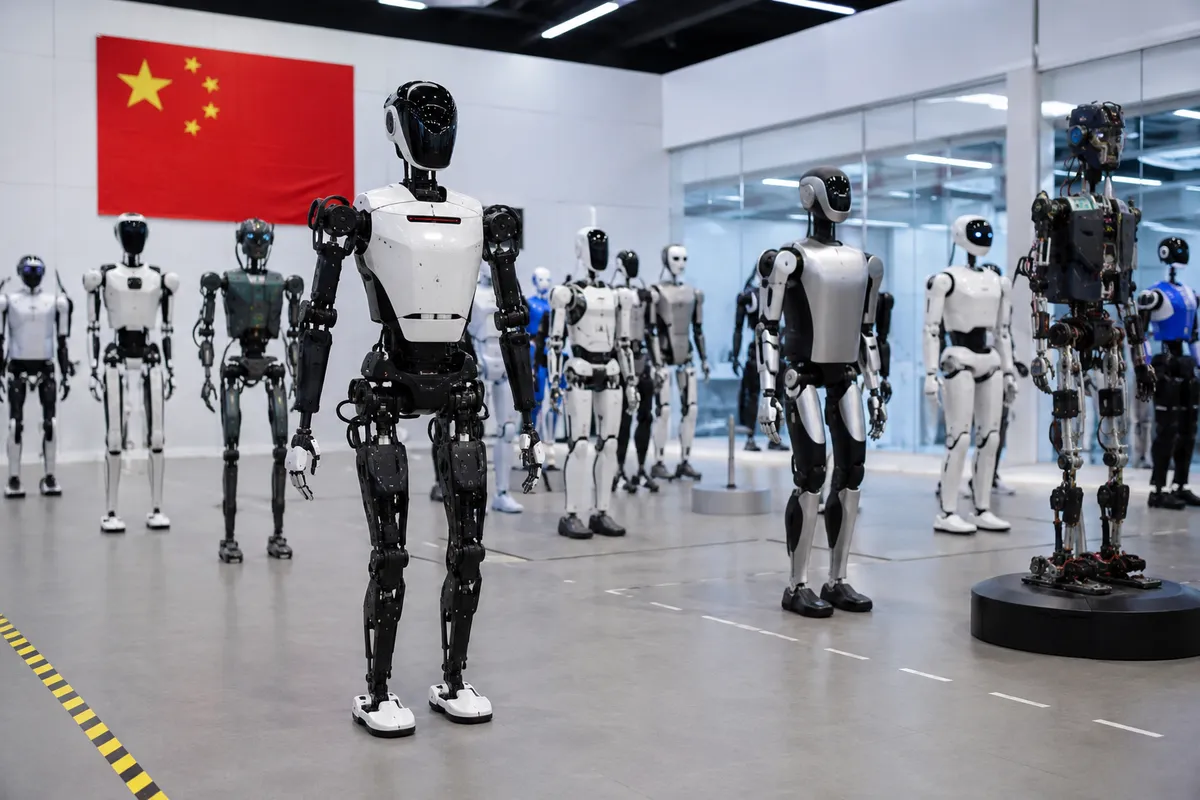
China’s humanoid robot sector is moving from spectacle to shipment claims, and that shift deserves serious attention. AgiBot has reported more than 5,100 humanoid robot shipments, Unitree is being discussed as another high-volume seller, UBTECH is publicizing large Walker S2 orders, Galbot is raising substantial capital for embodied AI, and XPENG is preparing a dedicated production base for its IRON humanoid. The market signal is clear: China is trying to industrialize humanoid robots faster than most other regions, but the evidence still needs segmentation before shipment totals can be treated as deployment proof.
What is confirmed is a rapid increase in Chinese humanoid activity, supported by manufacturing capacity, state interest, lower-cost hardware platforms and a growing supplier base. What remains less clear is how many shipped robots are doing economically useful work, how many are research or education units, how many are demonstration machines, and how many are operating repeatedly in customer environments.
That distinction matters because humanoid robotics is still a market where demos, preorders, government-backed purchases and early production runs can be mistaken for adoption. A shipment count is more concrete than a video. It is still not the same as a paid operational deployment.
Shipment Numbers Are Becoming The New Marketing Battleground
AgiBot, also known as Zhiyuan Robotics, has put one of the strongest shipment claims into the market. The company said, citing Omdia, that it shipped 5,168 humanoid robots in 2025 and accounted for 39 percent of global humanoid robot market share. The same announcement said global humanoid robot shipments reached roughly 13,000 units in 2025.
That is a meaningful number if accurately segmented. It suggests Chinese firms are no longer only building prototypes for trade shows, but are producing and delivering physical units at volumes that exceed most Western humanoid programs.
The problem is that “shipped” is an incomplete commercial metric. It does not explain whether robots were delivered to factories, universities, government-backed demonstration centers, robotics labs, entertainment venues, retail pilots or internal data collection sites. It also does not show utilization, autonomy, maintenance cost, safety performance, human intervention, or customer satisfaction.
There is also some inconsistency in public reporting. AP reported that more than 13,000 humanoid robots shipped globally in 2025 and that AgiBot and Unitree each shipped more than 5,000 units, while Reuters Breakingviews reported that Unitree sold 5,500 units last year and described the company as the world’s top humanoid robot seller in 2025.
That conflict does not invalidate the broader signal. It does show why shipment claims should be treated carefully. The market needs common definitions before rankings can be taken at face value.
| Company | Strong Public Signal | Evidence Caution |
|---|---|---|
| AgiBot | Company says it shipped 5,168 humanoid robots in 2025, citing Omdia | Shipments need breakdown by model, customer, use case and operating status |
| Unitree | Reuters Breakingviews reported 5,500 units sold in 2025 and IPO preparation | Reporting also notes limited real-world applications beyond research and education |
| UBTECH | Walker S2 orders reportedly exceeded 800 million yuan, according to company-linked release | Orders and delivery claims need customer confirmation, fleet data and operational metrics |
| Galbot | Raised RMB 1.1 billion, about $153 million, with CATL and others backing the round | Funding and retail pilots do not yet prove broad deployment economics |
| XPENG | Plans a humanoid robot production base and targets large-scale IRON production by end-2026 | Production ambition remains forward-looking until unit output and customer use are shown |
UBTECH Shows The Promise And Risk Of Order Claims
UBTECH is another important case because its Walker S2 messaging has shifted toward mass production, delivery and order value. A PR Newswire release said UBTECH’s Walker series had accumulated orders exceeding 800 million yuan, about $112 million, since early 2025. It also cited a 159 million yuan contract for Walker S2 robots at a data collection center in Zigong, following a larger 250 million yuan order in September.
Those figures are commercially relevant because they point to purchase commitments rather than only demonstrations. They also suggest that China’s market may be forming around industrial, logistics and data collection use cases, not just consumer robotics.
But order value is still not deployment evidence. Public materials do not fully clarify how many robots have been delivered, which customers are operating them, what tasks they perform, how much autonomy they use, or whether customers have expanded orders after initial trials. The Walker S2 story is therefore a partially confirmed commercialization signal, not proof of repeat deployment or commercial scale deployment.
This is the recurring pattern in China’s humanoid market. The signals are stronger than they were several years ago, but they often stop short of the operational data that would prove durable customer demand.
Unitree Is Productizing Platforms, But Use Cases Remain Narrow
Unitree has become one of China’s most visible robotics companies partly because its humanoid platforms are accessible compared with many Western systems. Its official site lists humanoid robots including H1, H2, G1 and R1, alongside quadrupeds, robotic arms and related components.
That matters because lower-cost platforms can expand the developer and research ecosystem. If more universities, labs, integrators and early customers can buy humanoid robots, China may accumulate practical data faster than competitors that rely on small, expensive, closed pilot programs.
The limitation is that platform availability does not equal commercial readiness. Reuters Breakingviews reported that Unitree’s real-world applications remain limited beyond research and education, even as the company prepares for a Shanghai STAR Market IPO and faces pressure to expand manufacturing.
That is not a minor caveat. A robot sold to a lab or university can be valuable for ecosystem development, but it should not be counted the same way as a robot performing paid work in a factory, warehouse or logistics operation.
Galbot And XPENG Add Capital And Industrial Ambition
Galbot shows the financing side of China’s humanoid push. Yicai Global reported that Galbot raised RMB 1.1 billion, approximately $153 million, in a round led by CATL and Puquan Capital, with additional backing from the China Development Bank’s venture arm, the Beijing Robotics Industry Fund and Jiyuan Capital. Yicai also reported that Galbot planned a joint venture with Bosch’s investment arm Boyuan Capital and a cooperation agreement with Bosch China focused on industrial manufacturing applications and global commercialization.
That combination of battery, industrial and state-linked capital is strategically important. It suggests Chinese humanoid developers are not only chasing consumer attention, but also trying to connect embodied AI with manufacturing supply chains and industrial customers.
XPENG brings a different signal: automaker-led production ambition. XPENG said in November 2025 that it aimed to achieve large-scale mass production of high-level humanoid robots by the end of 2026. CnEVPost reported in February 2026 that XPENG’s humanoid robot production base would span about 110,000 square meters and cover processes from research and development to large-scale manufacturing. Reuters reported in June 2026 that CEO He Xiaopeng would personally lead the robotics division as the company pushes toward mass production of IRON by the end of 2026.
The automaker angle matters because car companies know high-volume manufacturing, supplier management and quality control. But XPENG’s robot program is still forward-looking. A production base and a target date do not yet show customer adoption, fleet reliability or deployment economics.
China’s Advantage Is Real, But Commercial Demand Is Still Being Tested
The strongest macro signal is that China appears to be building the hardware side of humanoid robotics faster than most markets. AP reported in June 2026 that Chinese firms accounted for around 85 percent of global humanoid robot production in 2025, citing Barclays, and that China had more than 140 humanoid robot manufacturers and more than 330 models in 2025, according to the Ministry of Industry and Information Technology.
China’s advantages are structural. It has dense electronics and robotics supply chains, strong manufacturing capacity, state support, price competition and a large domestic market for industrial experimentation. Those conditions can accelerate iteration and reduce hardware cost.
The weakness is demand quality. AP also reported expert concerns that demand for humanoids may lag production capacity, and that many robots remain expensive, fragile, limited in function and dependent on structured environments. Much current demand appears to come from government, research, demonstration or early industrial settings rather than broad private-sector pull.
That is why shipment claims need segmentation. The key questions are not only how many humanoids left factories, but where they went, what they do, whether they are paid for, whether they operate without constant human help, and whether customers buy more.
China’s humanoid sector is moving faster than many observers expected. AgiBot, Unitree, UBTECH, Galbot and XPENG show a market trying to turn prototypes into production systems. But the next stage of evidence must be more disciplined. Shipment volume is a useful signal. Repeat operational deployment is a stronger one.
Until Chinese companies disclose model mix, customer mix, use cases, uptime, intervention rates and follow-on orders, the sector should be described as moving from demos to shipment claims, not yet from shipment claims to proven commercial scale.
Sources:
AgiBot, “Zhiyuan Robotics Ranks First in Global Humanoid Robot Shipments in 2025”:
https://www.agibot.com/article/231/detail/33.html
Associated Press, “China Rushes to Build Humanoid Robots, But Who Will Buy Them?”:
https://apnews.com/article/china-humanoid-robots-ai-demand-7d542b5ee92caa9d79efa28de89afbbe
Reuters Breakingviews, “Unitree Previews China’s Bleak Robot Reality”:
https://www.reuters.com/commentary/breakingviews/unitree-previews-chinas-bleak-robot-reality-2026-06-11/
PR Newswire, “UBTECH Humanoid Robot Walker S2 Begins Mass Production and Delivery With Orders Exceeding 800 Million Yuan”:
https://www.prnewswire.com/news-releases/ubtech-humanoid-robot-walker-s2-begins-mass-production-and-delivery-with-orders-exceeding-800-million-yuan-302616924.html
Yicai Global, “Chinese Robotics Startup Galbot Bags USD153 Million in Latest Fundraiser”:
https://www.yicaiglobal.com/news/chinese-robotics-startup-galbot-bags-usd153-million-in-latest-fundraiser
XPENG, “XPENG Unveils Next-Generation Humanoid Robot IRON”:
https://www.xpeng.com/news/019a56f54fe99a2a0a8d8a0282e402b7
CnEVPost, “XPeng to Break Ground on Humanoid Robot Factory in Q1”:
https://cnevpost.com/2026/02/25/xpeng-to-break-ground-on-humanoid-robot-factory-q1/
Reuters, “XPeng Boss to Head Robot Unit With Humanoid Mass Production Imminent”:
https://www.reuters.com/world/china/xpeng-boss-head-robot-unit-with-humanoid-mass-production-imminent-2026-06-10/
Humanoid Analytics, “Humanoid Company Tracker”:
https://humanoidanalytics.com/humanoid-company-tracker/