
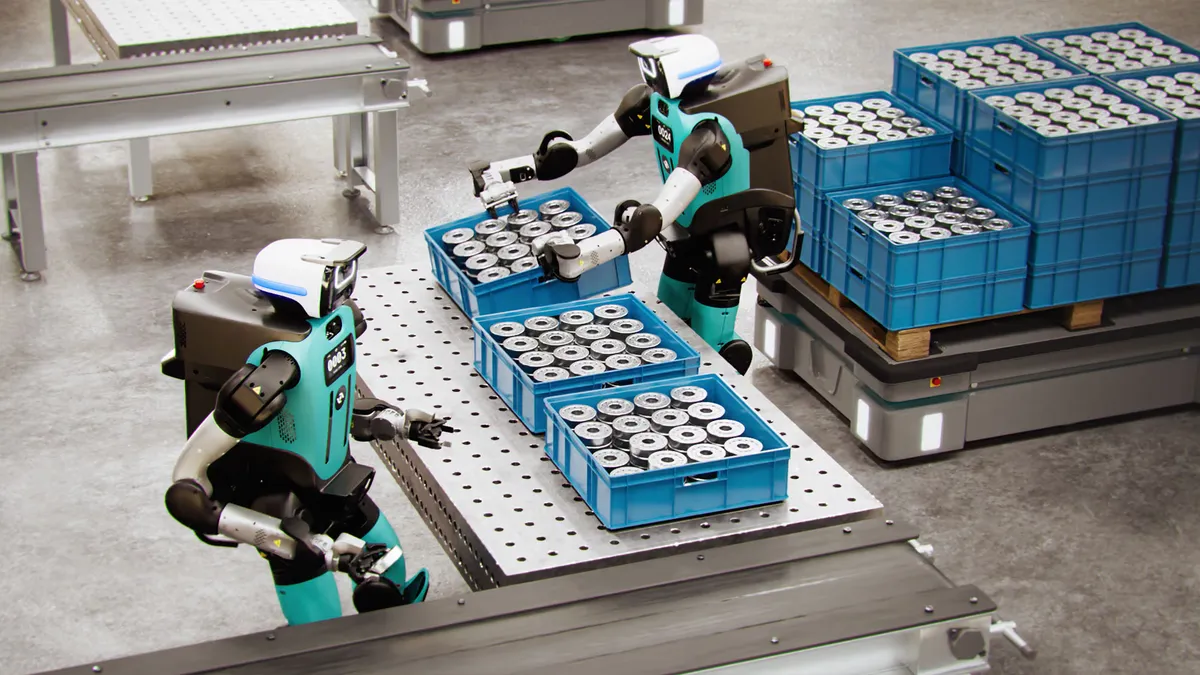
Agility Robotics is bringing one of humanoid robotics’ strongest documented deployment stories to public markets. Nasdaq confirms that its merger with Churchill Capital Corp XI closed on November 4, with the switch to ticker AGLT effective November 5. For investors, the next question is whether useful robot work can become a sustainable business.
The transaction assigned $2.5 billion of equity value to Agility’s existing holders, rather than establishing a live stock-market valuation. A November 2 filing estimated approximately $465.1 million in gross capital from the transaction and related financings, including $100 million already received. That figure is before transaction expenses.
The distinction matters: capital can finance the next stage of development. It cannot establish profitable deployment economics.
Humanoid Analytics’ July 3 analysis, updated July 27, identified Agility and Figure as the only two companies among 164 tracked to reach its highest deployment-evidence tier. Agility’s position reflected documented customer activity. That was a historical assessment, not a fresh November ranking.
The same analysis explicitly warned that strong deployment evidence did not establish positive unit economics, low intervention rates or scalable manufacturing. Agility’s public disclosures now make that distinction especially concrete.
The prospectus reports 2025 net sales of $1.782 million, a $138.1 million net loss and $99.8 million used in operating activities. Related parties accounted for $1.132 million of sales.
The newer figures deserve attention too. In the unaudited first half of 2026, net sales were $174,000, compared with $625,000 a year earlier. Operating cash use rose to $86.2 million from $46.2 million. The filing attributes the sales decline mainly to one-time robot sales in the earlier period.
Those numbers do not establish that humanoids cannot become economical. They show a business whose disclosed revenue remains small relative to the resources committed to development, manufacturing and deployments. Accounting losses also include substantial non-cash compensation charges, so cash spending needs separate scrutiny.
Agility’s future revenue case depends heavily on Digit 5. Its investor presentation describes more than $300 million in potential multi-year order value tied to 1,000 robots under a three-year robots-as-a-service contract. The prospectus identifies a single customer behind the $300 million commitment.
The conditions are material. Revenue depends on contractual milestones and promised product capabilities. The purchaser also receives warrants that vest as robots are deployed. This is conditional future business, not money already earned.
For investors, concentration makes execution particularly consequential: a delay affecting that customer could move a large part of the expected revenue opportunity. Under a service model, the cost of building and supporting robots also arrives before the full stream of subscription payments.
There is a concrete timetable to watch. Agility targets an initial Digit 5 rollout to existing partners in the first half of 2027 and general availability by year-end. Its November 4 announcement also says deployments at two additional GXO facilities are expected to begin in early 2027. These remain future milestones.
Humanoid Analytics’ assessment is that the listing makes Agility a useful public case study in the distance between deployment evidence and commercial maturity. Its operating history provides a foundation to examine. The financial record shows how much remains to be built on it.
The next meaningful proof will be accepted deliveries, customer-confirmed operating hours, repeat revenue and improving margins after maintenance and human support. Agility has earned attention for putting humanoids to work. Sustained, economical work is the next test.
Sources:
- Nasdaq Trader, “Equity Corporate Actions Alert #2026 – 791 (UPDATED: Closed) Information Regarding the Business Combination of Churchill Capital Corp XI (CCXI/W/U) and Agility Robotics, Inc.” Source type: Tier 1, direct or official evidence. https://www.nasdaqtrader.com/TraderNews.aspx?id=ECA2026-791
- Churchill Capital Corp XI and Agility Robotics, “PROSPECTUS” (October 13, 2026; Form 424B3). Source type: Tier 1, direct or official evidence. Issuer-filed regulatory disclosure. https://www.sec.gov/Archives/edgar/data/1727116/000121390026109058/ea0297114-07.htm
- Churchill Capital Corp XI, “FORM 8-K” (November 2, 2026). Source type: Tier 1, direct or official evidence. Issuer-filed regulatory disclosure. https://www.sec.gov/Archives/edgar/data/2074973/000121390026115038/ea0310517-8k425_church11.htm
- Humanoid Analytics, “Only Two Humanoid Companies Reach Top Deployment Evidence Score.” Source type: Tier 2, strong independent evidence. Historical HA analysis, published July 3 and updated July 27, 2026. https://humanoidanalytics.com/2026/07/03/only-two-humanoid-companies-reach-top-deployment-evidence-score/
- Agility Robotics, “Analyst & Investor Day” (October 6, 2026). Source type: Tier 3, detailed first-party disclosure. Company-controlled investor presentation filed with the SEC; forecasts remain company claims. https://www.sec.gov/Archives/edgar/data/2074973/000121390026107259/ea030784201ex99-1.htm
- Agility Robotics, “Agility Robotics and Churchill Capital Corp XI Complete Business Combination.” Source type: Tier 3, detailed first-party disclosure. Company-controlled announcement, November 4, 2026. https://www.agilityrobotics.com/content/agility-robotics-and-churchill-capital-corp-xi-complete-business-combination