
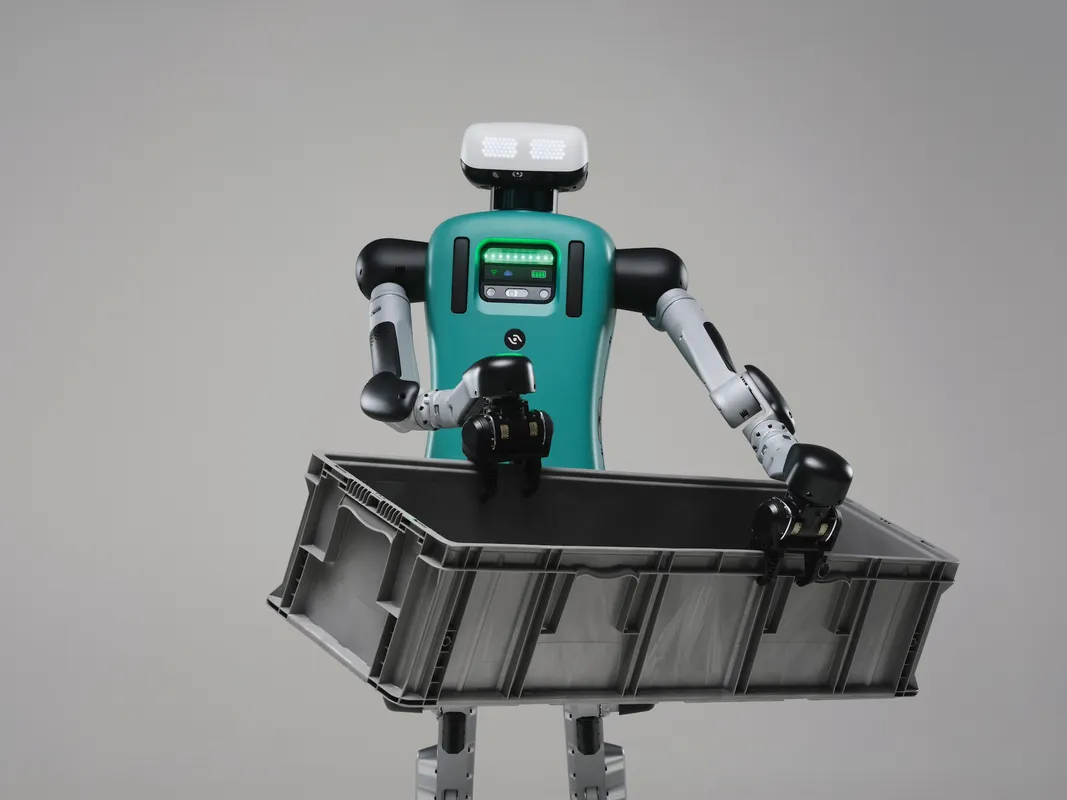
Agility Robotics unveiled Digit 5 on September 15, 2026, positioning its fifth-generation humanoid as a significant redesign for industrial scale. The company says the robot can handle payloads of up to 50 lb, reach 2.2 meters, work more than 20 hours in a 24-hour period through a 10:1 run-to-charge ratio, and use a new safety architecture intended to let it operate in closer proximity to people without the physical barriers used by earlier Digit deployments.
For investors, the important point is not that Agility has announced another humanoid. It is that Digit 5 appears designed around constraints Agility encountered while putting earlier Digit robots into customer environments. That makes the launch more commercially relevant than a prototype demonstration. It does not, however, make the new generation operationally proven.
Agility’s own product page states that Digit 5 remains in development, that certain safety features are still being developed, and that the published specifications are preliminary estimates based on internal testing and benchmarking of pre-production hardware and software. Early access is expected in the first half of 2027, with general availability targeted by the end of 2027. Independent reporting has likewise described Digit 5 as the next-generation system intended to overcome limitations of earlier deployments rather than a robot already operating at customer scale.
Digit 5 Is Designed Around Real Deployment Bottlenecks
Two changes stand out commercially.
The first is cooperative safety. Agility currently describes deployed Digit systems as operating inside restricted-access workcells that use physical perimeter barriers and safety interlocks. Digit 5 instead uses human detection, visual and audible warnings, and an independent safety controller intended to slow, stop or otherwise respond when people enter unsafe proximity. Agility says the design is intended to make external barriers unnecessary in live deployments.
That distinction matters. A humanoid that needs a fenced workcell can still create value, but the infrastructure limits where it can move and weakens part of the humanoid proposition: using automation flexibly in environments originally designed for people. Removing that constraint could make it easier to connect workflows across conveyors, autonomous mobile robots, machines and human work areas.
The second change is duty cycle. Agility says Digit 5 can operate for roughly 90 minutes before recharging in about nine minutes, compared with a 2:1 run-to-charge ratio for Digit 4. The company says that translates into more than 20 hours of productive availability per 24 hours. It has also redesigned the robot for repeated 50 lb lifts and added swappable end effectors for workflows ranging from tote movement to machine tending.
These are commercially meaningful specifications if they survive deployment. For now, they remain pre-production claims. Public evidence does not yet show the charging performance under continuous customer workloads, the effect of heavier loads on reliability, or whether barrier-free operation can be maintained with acceptable intervention and incident rates.
Earlier Digit Deployments Give Agility a Stronger Starting Point
Digit 5 should not be analyzed as if Agility were entering customer environments for the first time.
GXO directly confirmed in June 2024 that it moved from a pilot to a multi-year Robots-as-a-Service agreement with Agility and deployed fully operational Digit humanoids in a live warehouse environment. That is customer-side confirmation of real commercial use, not simply a developer announcement.
Agility now reports that Digit 4 has accumulated more than 65,000 hours of operation across customer sites including GXO, Schaeffler, Amazon and Toyota Motor Manufacturing Canada. The company also says Digit 4 passed 100,000 totes moved at GXO’s Flowery Branch facility with approximately 98% accuracy while on task. Those aggregate metrics are company-reported, although GXO independently confirms that Digit progressed into live warehouse operation under a multi-year commercial agreement.
This history matters because it gives Agility field experience from which to design a successor. It does not establish that the successor has inherited the same reliability. New legs, batteries, actuators, safety systems, end effectors and workflows introduce new validation requirements.
The correct distinction is therefore that Agility has meaningful historical operating evidence for the Digit platform, while Digit 5 itself still lacks customer operating evidence.
The $300 Million Order Is Significant, but More Concentrated Than the Headline Suggests
Digit 5 already has a material commercial commitment.
Agility says it had more than $300 million of multi-year Digit 5 orders as of May 2026. An SEC-filed investor presentation provides important additional detail: the disclosed amount relates to 1,000 Digit 5 robots under a three-year RaaS contract, is subject to the achievement of contractual milestones, includes warrants issued to the purchaser that vest in proportion to robots deployed, and is explicitly not a measure of current-period revenue.
That changes how the number should be interpreted.
The contract is stronger evidence than a non-binding expression of interest or generic partnership. It represents a substantial commercial commitment tied to a physical deployment program. At the same time, the disclosed order value should not be read as evidence that hundreds of millions of dollars of Digit 5 revenue have already been generated, nor as proof of broad multi-customer adoption.
The concentration also matters analytically. A 1,000-robot commitment from one purchaser can validate customer interest while leaving Agility exposed to product qualification, deployment schedules, contractual milestones and customer-specific execution. The next evidence step is therefore conversion: robots produced, accepted, deployed and retained in operation.
The Evidence Supports a 6, Not Yet Digit 5 Deployment Proof
Under the Humanoid Analytics Evidence Standards, the current Digit 5 commercial event produces a draft raw score of 7: 3 points for source quality because material order details are contained in an official SEC record, 1 for real-world operation because this remains a purchase or planned-deployment signal without Digit 5 operating proof, 2 for commercial commitment, 0 for measurable Digit 5 operating evidence, and 1 for current verification.
The applicable ceiling is 6 because a purchase or planned deployment without operating proof cannot score above that level. Earlier Digit 4 hours, tote counts and customer operations are not carried across as Digit 5 operating metrics.
Manufacturing evidence should be treated with the same separation. Agility says its 70,000-square-foot RoboFab facility is designed for up to 10,000 Digit robots annually at full capacity. That is evidence of a capacity target, not evidence that Digit 5 is already being produced at that rate. The company currently targets early-access availability in the first half of 2027.
What Would Change the Assessment
The next meaningful evidence will not be another specification or order announcement. It will be customer-side operating data.
A stronger Digit 5 assessment would require identifiable customers confirming delivered robots performing useful work, followed by metrics such as operating hours, throughput, uptime, intervention frequency and deployment duration. The cooperative-safety thesis will need evidence that robots can operate near people without external barriers under real production conditions. The battery claim needs validation under repeated industrial workloads, not only internal benchmarking.
Manufacturing progress should likewise be measured through actual Digit 5 production, deliveries and acceptance rather than RoboFab’s theoretical annual capacity.
The most important commercial test will be whether the disclosed 1,000-robot contract progresses from order value to deployed units and whether additional customers make comparable commitments.
Digit 5 therefore strengthens Agility’s product and commercialization story without yet strengthening its operating evidence to the same degree. Agility enters this next phase with something many humanoid developers still lack: customer-confirmed experience from previous-generation robots. The question for 2027 is whether that experience converts into a new generation that can work longer, lift more, move beyond fenced workcells and do so reliably enough for customers to expand.
That is the evidence threshold that would turn Digit 5 from a credible commercial signal into operating proof.
Sources:
- Agility Robotics, “Digit 5”
Source type: Tier 3, detailed first-party disclosure
https://www.agilityrobotics.com/solutions/digit-5 - Agility Robotics, “Agility Unveils Digit 5 Humanoid Robot Built for Cooperatively Safe Work at Scale”
Source type: Tier 3, detailed first-party disclosure
https://www.agilityrobotics.com/content/agility-unveils-digit-5-humanoid-robot-built-for-cooperatively-safe-work-at-scale - Business Insider, “Agility’s new humanoid is supposed to stop before it gets too close to humans”
Source type: Tier 2, strong independent reporting
https://www.businessinsider.com/agility-robotics-reveals-early-look-at-digit-5-humanoid-robot-2026-9 - GXO, “GXO Signs Industry-First Multi-Year Agreement with Agility Robotics”
Source type: Tier 1, direct customer confirmation
https://gxo.com/news_article/gxo-signs-industry-first-multi-year-agreement-with-agility-robotics/ - U.S. Securities and Exchange Commission, “Agility Robotics Investor Presentation”
Source type: Tier 1, official SEC record of company disclosure
https://www.sec.gov/Archives/edgar/data/2074973/000121390026071287/ea029548401ex99-2.htm - Agility Robotics, “FAQs”
Source type: Tier 3, detailed first-party disclosure
https://www.agilityrobotics.com/faq